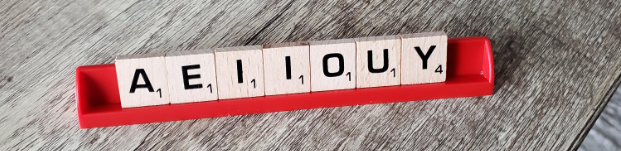
1. Executive Summary — The Drought of Consonants
A vowel flood is not a flexible rack.
It is a consonant drought.
Pretty letters still produce paralysis.
Small pairwise dumps prolong the crisis.
Elite players flush vowels in bulk.
Hold a rack like A E E I O O U and the board stops cooperating. Every stem wants a consonant hinge. Every bingo shape collapses. Every “safe” two-letter vowel play returns you to the same swamp with slightly different tiles.
This is the structural crisis of vowel overload: too many scoring connectors, too few structural anchors. You are not short of options in theory. You are short of playable geometry.
Rack Drainage Rate (RDR)
Define the rate at which a play removes excess vowels from an overwhelmed rack:
RDR = Vowels Removed ÷ Turns SpentCompare two salvage strategies from a 6–7 vowel rack:
| Strategy | Vowels removed | Turns spent | RDR | Practical result |
|---|---|---|---|---|
Pairwise dumps (AI, OE, OU) | 2 per turn | 3 turns | 0.67 | Still flooded; tempo lost |
| One 4-letter triple-vowel dump | 3 in 1 turn | 1 turn | 3.00 | Rack resets immediately |
| One 4-letter near-all-vowel dump | 3–4 in 1 turn | 1 turn | 3.00–4.00 | Maximum stabilization |
Proof of superiority:
Assume each wasted midgame turn costs ~25–30 points of turn equity (score + leave + access). Three agonizing pairwise turns cost:
3 × (−25 to −30) ≈ −75 to −90 expectancyeven if each tiny play scores 4–6 points. A single 4-letter dump scoring 12–18 while removing 3 vowels collapses the crisis in one cycle and restores Consonant Draw Probability for the next bag pull.
Decision rule: If you hold 5+ vowels, prioritize RDR ≥ 3 over raw face-value maximization.
Four-letter vowel exits are the precision tools of that rule. They are not filler words. They are mathematical rack stabilization devices.
2. The Mathematical Underpinnings of Vowel Dumping
Consonant Draw Probability
A standard Scrabble set contains 100 tiles: 42 vowels (A/E/I/O/U), 56 consonants, 2 blanks. Wordfeud and Words With Friends use different distributions, but the principle holds: when your rack is vowel-flooded, the bag is relatively consonant-richer than your tray.
After you play, you draw as many tiles as you just spent. Dumping vowels therefore does two jobs at once:
- Removes the imbalance from the leave.
- Increases the chance the refill restores a playable 3V–4C or 4V–3C ratio.
Approximate midgame intuition (unseen pool still mixed):
| Play type | Tiles drawn | Typical leave after dump | Next-turn balance outlook |
|---|---|---|---|
| 2-letter vowel pair | 2 | Still 4–5 vowels | Weak |
| 4-letter triple-vowel dump | 4 | 1 consonant + 2–3 leftovers | Strong |
| 4-letter near-all-vowel dump | 4 | Mostly consonants kept/drawn | Strongest reset |
Consonant Draw Probability rises with tiles drawn while vowel count falls. That is why a 14-point ALAE can be worth more than a 22-point play that removes only one vowel.
Vowel Concatenation Metrics
Use this matrix to compare the elite 4-letter exits profiled below.
| 4-Letter play | Vowel-to-consonant ratio | Board vulnerability factor | Next-turn bingo probability boost |
|---|---|---|---|
| ALAE | 3V–1C | Medium (open A/E terminals) | High — classic triple dump |
| UNAI | 3V–1C | Medium | High |
| OLIO | 3V–1C | Medium-high (double O hooks) | High |
| EIDE | 3V–1C | Medium (E terminals) | High |
| TOEA | 3V–1C | Medium | High |
| EUOI | 4V–0C | High if lane stays open | Maximum — full vowel flush |
| AQUA | 3V–1C (Q) | Low-medium (Q terminal awkward) | High + Q relief |
| OGEE | 3V–1C | Medium (EE hook surface) | High |
| ILIA | 3V–1C | Medium | High |
Reading the table:
Higher RDR words with manageable Board Vulnerability Factors are your default resets. Maximum dumps like EUOI are elite when legal and lane-safe. AQUA uniquely solves vowel flood and Q overhead in one stroke.
3. The Master Directory: High-Density Vowel Exits
All profiles below are written for competitive adjudication. Confirm the exact edition of CSW, TWL/NWL, or WWF used at your table.
Triple-Vowel Dumps (3 Vowels, 1 Consonant)
ALAE
Definition: Plural of ala — a winglike anatomical structure or side process.
Legality: CSW: yes. TWL: yes. WWF: yes (standard enablement lists).
Hook Liabilities:
- Already plural of ALA; further casual backhooks are limited — still scan for rare extensions in your lexicon.
- Front hooks: possible in some lists; verify before assuming the lane is sealed.
- Open A and E terminals invite parallel vowel overlaps from the opponent.
Spatial Footprint: Deploy off a board L, or place L yourself if it is your sole keeper consonant. Ideal parallel overlay beside words ending or containing letters that form legal two-letter crosses with A/L/A/E.
UNAI
Definition: A two-toed sloth of Central and South America.
Legality: CSW: yes. TWL: yes. Also compare cousin UNAU (same animal family spelling) — both are study-list dumps.
Hook Liabilities:
- Backhook: S → UNAIS where listed.
- Front hooks: uncommon; check anyway.
- U-N-A-I sequence leaves soft vowel ends — do not aim them at Triple Word corridors.
Spatial Footprint: Use an open board N, or spend your only N while burning U/A/I. Excellent when the rack is U-heavy and A/I duplicated.
OLIO
Definition: A miscellaneous mixture, medley, or highly seasoned stew.
Legality: CSW: yes. TWL: yes. WWF: yes on standard lists.
Hook Liabilities:
- Backhook: S → OLIOS.
- Double-O structure increases parallel vulnerability; opponents love O-contact for short plays.
- Front hooks: limited but not zero — audit the front cell.
Spatial Footprint: Hinge on a board L, or keep L and dump O/I/O. Outstanding Parallel Overlay Shield candidate because O/L/I/O often forms dense legal crosses beside common letters.
EIDE
Definition: Plural of eidos — a form, essence, or species in philosophical usage.
Legality: CSW: yes. TWL: yes. WWF: commonly enabled.
Hook Liabilities:
- E-terminals are high-traffic hook surfaces.
- Back/front extensions can reopen lanes quickly if an S, R, or D is available to the opponent.
- Prefer Dead Zone placement when the score lead matters more than max points.
Spatial Footprint: Hinge on board D, or spend a spare D while flushing E/I/E. Best on E-flooded racks with a single usable consonant.
TOEA
Definition: A monetary subunit of the Papua New Guinean kina (100 toea = 1 kina).
Legality: CSW: yes. TWL: yes.
Hook Liabilities:
- Backhook: S → TOEAS.
- Front hooks: possible with common letters in some lists — verify.
- Terminal A facing open premiums is the main structural risk.
Spatial Footprint: Hinge on board T, or preserve a strong T elsewhere and use a different dump if T is your bingo keystone. Strong when rack is O/E/A heavy and a T is already visible.
All-Vowel / Near-All-Vowel Outlets
EUOI
Definition: An exclamation of Bacchic revelry from ancient Greek cultic cry tradition.
Legality: CSW: yes. TWL: no. WWF: no. International/Collins players get a pure four-vowel flush. North American and standard WWF players must skip this exit and use AQUA / OGEE / ILIA instead.
Hook Liabilities:
- All-vowel body creates soft edges; hook surface depends on lexicon.
- Never open EUOI into a 7-cell bingo approach.
- Treat as a CSW specialist tool, not a universal default.
Spatial Footprint: No consonant hinge required from the rack — you need legal attachment to an existing board letter or bridge. Maximum RDR (4.00). Use only when lane safety is already high.
AQUA
Definition: Water; also used in pharmaceutical and color contexts (aqua vitae, aqua shades).
Legality: CSW: yes. TWL: yes. WWF: yes.
Hook Liabilities:
- Backhooks: E → AQUAE; S → AQUAS where listed.
- Front hooks: limited.
- Q terminal is awkward for many extensions — natural defensive advantage versus softer vowel endings.
Spatial Footprint: Hinge on board Q (rare gift) or spend Q while dumping A/U/A. Dual-purpose: vowel salvage and Q-without-U relief. One of the highest utility 4-letter resets in the entire language.
OGEE
Definition: An S-shaped curve or molding used in architecture and design.
Legality: CSW: yes. TWL: yes. WWF: yes.
Hook Liabilities:
- Backhook: S → OGEES.
- EE ending is hook-friendly and parallel-friendly — elevated Board Vulnerability Factor.
- Front hooks: check O-front contacts carefully.
Spatial Footprint: Hinge on board G, or burn a spare G. Ideal for O/E floods. Prefer tight corners (Defensive Grid Crushing) because EE endings otherwise invite opponent overlays.
ILIA
Definition: Plural of ilium — the broad upper bone of the pelvis.
Legality: CSW: yes. TWL: yes. WWF: yes.
Hook Liabilities:
- Already plural; further extensions are less common but not impossible — verify.
- Dual I + terminal A still create parallel vowel targets.
- Safer than OGEE on hook density, still not inert.
Spatial Footprint: Hinge on board L, or keep L as your conserved consonant while dumping I/I/A. Excellent when the rack is I-heavy and A is duplicated.
Directory snapshot
| Word | Pattern | Core legality | Primary mission |
|---|---|---|---|
| ALAE | 3V–1C | CSW / TWL / WWF | Classic L-hinge triple dump |
| UNAI | 3V–1C | CSW / TWL | U-heavy short reset |
| OLIO | 3V–1C | CSW / TWL / WWF | Parallel overlay favorite |
| EIDE | 3V–1C | CSW / TWL / WWF | E-flood D-hinge clear |
| TOEA | 3V–1C | CSW / TWL | T-hinge O/E/A dump |
| EUOI | 4V–0C | CSW only | Maximum vowel flush |
| AQUA | 3V–1C | CSW / TWL / WWF | Vowel dump + Q relief |
| OGEE | 3V–1C | CSW / TWL / WWF | O/E flood G-hinge clear |
| ILIA | 3V–1C | CSW / TWL / WWF | I-heavy L-hinge clear |
4. Spatial Placement: Parallel Wall Building
Vowel dumps fail when they spray open vowels into bingo corridors. They succeed when they form walls.
1. The Parallel Overlay Shield
Mission: Play a triple-vowel four-letter word fully parallel to an existing word. Harvest stacked crossword points. Trap vowels inside a dense legal block.
Best tools: ALAE, OLIO, ILIA, OGEE.
Step-by-step:
- Find an existing four-letter (or longer) word on a safe interior row/column.
- Test ALAE/OLIO/etc. beside it so every adjacency is a legal two-letter word.
- Prefer placements that do not extend a file toward TWS/DWS.
- Accept moderate main-word scores; the crosswords plus RDR are the real payout.
Schematic (OLIO overlay):
Existing:  H A L O
Parallel:  O L I O
Crosses:   HO, AL, LI, OO  → keep only lexicon-legal pairs
If all crosses validate, you score one main word + multiple crosswords while converting floating vowels into a sealed strip. That is NTV-positive salvage: points now, balance next, limited lane gift.
Shield rule: Parallel density beats lonely edge dumps.
2. Defensive Grid Crushing
Mission: Park high-vowel words in tight corners / Dead Zones so opponent cannot use your open vowels as bingo fuel.
Step-by-step:
- Identify corners or sealed pockets with Reach Length to premiums already broken.
- Place the vowel dump so A/E/I/O/U terminals face clogged edges, not open 7-cell lanes.
- Avoid creating a fresh parallel track beside the dump.
- If an S-hook cell would open a corridor, choose a different dump or orientation.
Schematic:
Corner crush:
Row 14/15 area already semi-sealed
Play:  A L A E
Result: vowels sit in a crushed pocket; no 7-letter runway
Why this matters:
Your dump letters become opponent resources next turn. Grid crushing minimizes Board Vulnerability Factor while keeping RDR high.
3. Consonant Preservation
On a flooded rack, your single strong consonant is often more valuable than two weak vowels.
Keep-bias consonants: R, S, T (also N/L depending on leave).
Burn-first vowels: duplicates (second E, second O, extra A/I/U).
Math of the keep:
Suppose rack = A E E I O R S (5V–2C, still unstable).
| Play | Vowels burned | Consonants kept | Leave quality |
|---|---|---|---|
Weak AE | 2 | Keep clutter | Still flooded |
ALAE needing board L | 3 | Keep R S | Bingo-ready leave |
| Greedy dump spending S | 3 | Lose S | Lower next-turn ceiling |
Preserving R/S/T while burning three vowels maximizes:
Next-Turn Bingo Probability Boost
≈ f(restored V:C ratio, retained high-equity consonants)
That is Consonant Preservation: the consonant is the hinge of future equities; the extra vowels are ballast.
5. Case Studies: The Vowel Stagnation vs. The Clean Reset
Case Study A — The Stagnation
Opening rack crisis: six vowels, minimal consonant help.
Panic line: Play AI for 4 points.
What happens next:
- Draw two tiles — both vowels (common when the tray was already vowel-weighted and the bag still mixed).
- Rack remains vowel-paralyzed.
- Next turn: another weak pair.
- Third turn: still no bingo shape, still low scores.
Net accounting:
Scores across three turns: ~4 + 6 + 8 ≈ 18
Forfeited equity vs healthy turns: ≈ −40 or worse
Opponent tempo advantage: compounding
Net point loss: ≈ −40
Failure modes:
- Optimized for “something legal,” not RDR.
- Removed only 2 vowels per crisis turn.
- Never restored Consonant Draw Probability at scale.
- Allowed Board Vulnerability to persist through indecision rather than a planned wall.
Case Study B — The Clean Reset
Crisis rack: heavily vowel-flooded; needs bulk drainage.
Board: a standalone L available on a safe stretch.
Master line: Play ALAE through the board L.
Board hinge:     L
Completed play:  A L A E
Score:           ~14 (more with overlaps/premiums)
Vowels removed:  3
RDR:             3.00
Draw after the clear: balanced consonants — conceptually an R-S-T-rich refill.
Next turn: an 80-point bingo becomes available because the leave + draw restored real stem geometry.
Comparative result:
| Line | Immediate score | Vowels removed | Two-turn outlook |
|---|---|---|---|
| Stagnation (`AI`) | 4 | 2 | Paralysis continues; ≈ −40 net |
| Clean Reset (`ALAE`) | 14 | 3 | Bingo setup; +80 follow-up possible |
Why the master line wins:
- Chose RDR 3 over face-value pride.
- Used a single board consonant hook efficiently.
- Preserved stronger leave consonants for the refill cycle.
- Converted salvage into offense within one turn.
Reset doctrine: The 14-point dump is often the real setup play for the 80-point turn.
6. The Vowel-Salvage Cheat Sheet
Use this as an instant midgame recall board.
A-heavy floods
- ALAE — L hinge; classic triple dump.
- AQUA — A/U dump + Q relief.
- TOEA — T hinge when O/E accompany A.
- ILIA — if I duplicates around an L/A shape.
E-heavy floods
- EIDE — D hinge; burns two Es.
- OGEE — G hinge; burns O + two Es (watch EE hooks).
- TOEA — still available when T/O/A fit.
- ALAE — if A/L remain in the pile.
I/O-heavy floods
- OLIO — L hinge; parallel overlay star.
- ILIA — I-heavy L hinge.
- UNAI — U/A/I with N hinge.
- EUOI — CSW-only pure four-vowel flush; skip in TWL/WWF.
Pre-play vowel-flood scan
- Count vowels. If 5+, enter salvage mode.
- Compute candidate RDR for each play (target ≥ 3).
- Identify board consonant hinges: L, N, D, T, G, Q.
- Match hinge to directory word (ALAE / UNAI / OLIO / EIDE / TOEA / AQUA / OGEE / ILIA).
- If CSW and lane-safe, consider EUOI for RDR 4.
- Prefer Parallel Overlay Shields over lonely edge dumps.
- Crush into Dead Zones when opponent bingo threat is live.
- Preserve key consonants (R/S/T) unless the dump absolutely requires them.
- Audit front/back hooks — especially S and soft vowel terminals.
- Only then accept a 2-letter vowel pair — and treat it as a last resort, not a plan.
One-line operating system
Flush vowels in bulk. Keep the consonant that builds tomorrow.
Master these 4-letter exits and a flooded tray stops being a multi-turn prison. It becomes a one-turn stabilization problem with a solved word list.
Leave a Reply