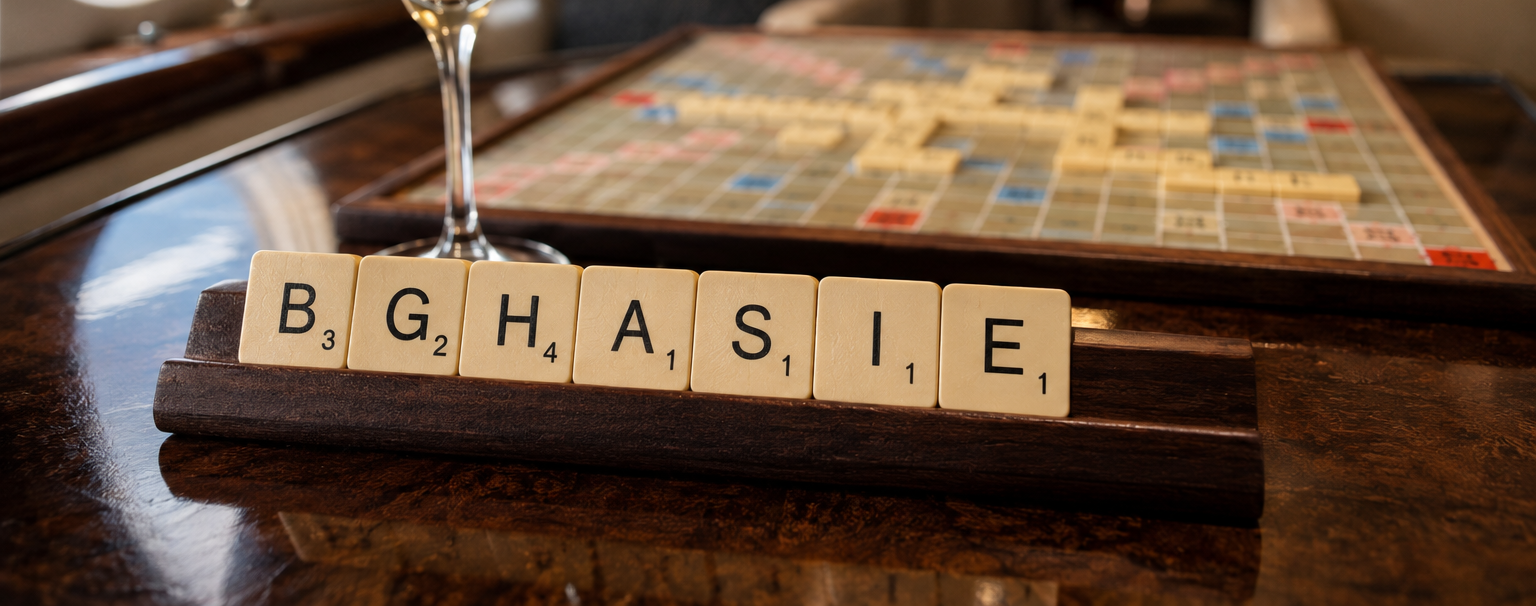
1. Executive Summary — One Point, Outsized Power
S is only one point.
It is not a cheap tile.
It is the hook king.
It pluralizes. It bingo-fuels. It parallel-plays.
Spend it for six extra points and you have been robbed.
Keep two of them and the king becomes clutter.
Wordmaster.pro examines when the S tile is worth holding for hooks and bingos, when a modest plural is a waste, and how duplicate S tiles quietly wreck an otherwise healthy rack. The goal is practical: help players treat S as high-equity currency — second only to the blank — instead of a free ending they attach to every word.
Standard Scrabble includes four S tiles in a 100-tile bag. Each is worth 1 point. That low face value is the trap. The real value of S is future access: back hooks, front hooks, seven-letter stems, and tight parallel plays that other consonants cannot make.
This article is about S decision-making. Not every word that happens to end in S.
2. Why S Is Different From Other One-Point Tiles
E, A, I, O, N, R, T, L, and S all score one point. They are not equal.
S has three jobs no other one-point tile does as well:
1. The back hook
Most nouns and many verbs take a final S. Adding S to a word already on the board scores the old word again plus the new word. That is why S is called the hook king.
2. The front hook
S also starts words. AT becomes SAT. IN becomes SIN. OW becomes SOW. Front-S hooks are easier to miss than plurals — and often cleaner, because they do not freeze the end of a word.
3. The bingo engine
S appears in the most productive stems in the language. SATIN, SATIRE, TISANE, and the AEINRST family all want an S. A rack with S bingoes more often than the same rack without it.
What S is not
- It is not an automatic plural on whatever you were going to play anyway.
- It is not worth spending for a 4–6 point bump.
- It is not better in pairs. Two S tiles overlap. They do not stack.
Think of S the way you think of a blank: cheaper, narrower, still too valuable to burn.
3. The Practical S-Equity Rule
Tournament players treat a held S as roughly 8–10 points of future value. You do not need a spreadsheet at the table. You need a hurdle.
Spend S only when the play scores about 8 or more points better than the best play that keeps S — unless the S enables a bingo, dumps a duplicate, or wins an endgame.
Worked comparison
| Play | Score | Keep S? | Verdict |
|---|---|---|---|
| CAT | 12 | Yes | Often better |
| CATS | 16 | No | S earned only 4 extra — usually keep it |
| CATS on a Double Word | 30 | No | S earned 18 extra — spend it |
| Seven-letter word using S | 50+ bingo | No | Always cash |
That is the paradox in one table. The same letter is either a gift or a waste, depending on the delta, not the word.
4. The Eight NWL Two-Letter S Words
If you cannot parallel with S, you will dump it in the wrong places. These eight two-letter words are the S parallel toolkit under NWL2023:
AS ES IS OS US SH SI SO
Five of them end in S. Three of them start with S. Together they let S sit beside vowels and a few consonants on a packed board.
CSW note: International play adds ST. That one extra pair makes S even more parallel-friendly. Do not play ST in an NWL event.
5. When to Keep the Hook King
Keep S when:
- The board still has hookable words that will score later.
- Your leave without S is already bingo-prone (AEINRT, SATIN, RETINA).
- Adding S this turn only adds a handful of points.
- You have one S, not two.
- The bag still holds enough tiles for a future bingo to matter.
Keep it for a named target
Bad reason: “S is good, so I never play it.”
Good reason: “If I hook QI to make QIS, or draw E into this SATIN leave, the S earns its keep next turn.”
A held S with no lane and no stem is just a one-point tile you refused to score.
6. When S Becomes a Liability
S turns from king to clutter in five situations.
1. Duplicate S
Two S tiles do not double your hook power. They compete for the same job. Default play: spend one, keep one.
Useful duplicate dumps (all NWL-valid):
| Word | Why it helps |
|---|---|
| ASS | Short double-S dump |
| ESS | Letter-name dump |
| SIS | Easy I pairing |
| SOS | Easy O pairing |
If the board will not take a double-S word, spend one S on any decent hook and keep the other.
2. The cheap plural
CAT → CATS for four extra points is the classic amateur leak. You used a tile worth ~8–10 equity to buy 4.
3. The S-dependent board you created for them
Hooking your own word with S can leave an S-shaped bingo lane for the opponent. If the only good S play also opens OUTS-style endings on a hot row, calculate their reply before you celebrate the plural.
4. Late bag, no hooks left
When the board is sealed and the bag is thin, S-as-future-hook dies. Then S is just another one-point tile. Score it. Do not worship it.
5. S blocking a better leave
Keeping S by playing off your only E, R, and T can destroy bingo shape. The king is not worth a wrecked rack.
7. High-Utility S Dumps and Hooks (NWL-Verified)
Power-tile S hooks — spend without guilt
These back-hooks turn S into real points because they ride Q, Z, X, or J:
| Hook | Result | Why it is worth it |
|---|---|---|
| QI + S | QIS | Clears Q and scores |
| ZA + S | ZAS | Z dump plus S that actually earns |
| XI + S | XIS | X parallel/hook value |
| KA + S | KAS | Short K relief |
| GI + S | GIS | Easy G/I clearance |
If S is the only way to unload Q or Z this turn, spend it. Trapped power tiles cost more than S equity.
Front-S hooks worth seeing
Front hooks are the missed half of S play. Common NWL examples:
| Board word | Front S | New word |
|---|---|---|
| AT | S | SAT |
| ET | S | SET |
| IT | S | SIT |
| IN | S | SIN |
| ON | S | SON |
| OW | S | SOW |
| OX | S | SOX |
| OY | S | SOY |
| PA | S | SPA |
| OH | S | SHO |
Front-S often scores the hook and leaves the original word extendable. Back-S often finishes the word and kills the end.
Short S words that clear extras without wasting the king
When you must play S but want a healthy leave: SAT, SET, SIT, SIN, SON, SUN, SEA, SEE, SIR, SOW.
Play these when they dump a clunker (U, extra I, W) and the score delta justifies the S — or when you are spending the second S.
8. S and Bingo Stems
S is a passenger on the best stems. That changes hold/spend math.
| If you hold | S role | Bias |
|---|---|---|
| SATIN + one extra | Already inside the stem | Keep S unless the extra tiles score hugely |
| RETINA + S | Completes AEINRST | Search the bingo first: NASTIER, RETAINS, RETINAS, STAINER, STEARIN |
| ERS leave | Elite three-tile keep | Do not spend S to gain 6 points |
| Ugly rack + S | May be your only hook | A scoring S-hook can be correct if it restores balance |
Always anagram the full rack before “saving S for later.” RETINA + S is often a bingo now.
9. Case Studies
Case Study A — The Four-Point Theft
Rack: A C T S E R N
Play chosen: CATS for 16
Alternative: CANE / CART / CARE keeping S, similar score, better leave
Result: S gone; next rack cannot hook; opponent takes the open plural lane instead
Diagnosis: S earned too little. The king was spent like a spare vowel.
Case Study B — The Duplicate Clearance
Rack: S S A E I N T
Play: ASS or SIS for a modest score, keep AENT or AENT-shape
Result: One S remains; SATIN-family chances stay alive
Diagnosis: Two S tiles are a problem set. Spend one immediately.
Case Study C — The Power-Tile Hook
Board: QI open
Rack: includes S and no pretty bingo
Play: QIS
Result: Q leaves; S paid for a trapped 10-point tile
Diagnosis: Correct spend. Q equity was the emergency, not S worship.
Case Study D — The Stem Blindness
Rack: A E I N R T S
Player decision: hooks a small plural “to keep options”
Missed: RETAINS / NASTIER / STAINER already on the rack
Result: 12 points instead of a 50-point bonus
Diagnosis: Search the bingo before you protect the S. The S is already doing its best job inside the seven-letter word.
10. Tracking S — Yours, Theirs, and the Bag
Four S tiles exist. Count them.
| Unseen S tiles | What it means |
|---|---|
| 3–4 | Opponent may also be holding one; do not gift S-lanes cheaply |
| 2 | Normal; your held S still has future hook value |
| 1 | S is scarce; holding yours is stronger |
| 0 | No more S hooks from the bag; remaining S is on a rack — play accordingly |
If you have just played the fourth S, stop planning future plurals that require a fifth.
11. CSW / Digital Notes
- CSW24 adds ST as a two-letter word. Parallel packing with S gets easier internationally.
- Wordfeud still has four S tiles in its 104-tile bag. The hold/spend paradox does not change. The board geometry might.
- On a digital rack, slide S to the far right (back-hook mindset) or far left (front-hook mindset) and re-scan. Do not leave it buried in the middle where the eye skips it.
12. The S-Tile Decision Checklist
- Do I already have a bingo using this S? Play it.
- Do I hold two S tiles? Spend one. Keep one.
- Does keeping S cost only a few points? Keep it.
- Does spending S gain ~8+ over the keep-S play? Spend it.
- Does S unload Q, Z, X, or J via QIS, ZAS, XIS, or similar? Spend it.
- Is this a cheap plural that also opens their bingo lane? Don’t.
- Is the board sealed and the bag thin? S is no longer a king. Score it.
- Can I front-hook (SAT, SIN, SOX, SPA) instead of freezing a word-ending?
- How many S tiles remain unseen?
- After the play, is the leave still a stem — or did I keep S and dump the letters that make S useful?
Final Takeaway
S is the best one-point tile in the set — and the easiest to waste.
Keep it when it still has a job: a hook, a stem, a future bingo.
Spend it when the score jump is real, when a duplicate must go, or when it frees a trapped power tile.
Never spend it as decoration on a word you could have played without it.
One point on the tile.
Eight points in the decision.
Treat the hook king like currency, not like a spare letter.
Leave a Reply