Executive Summary
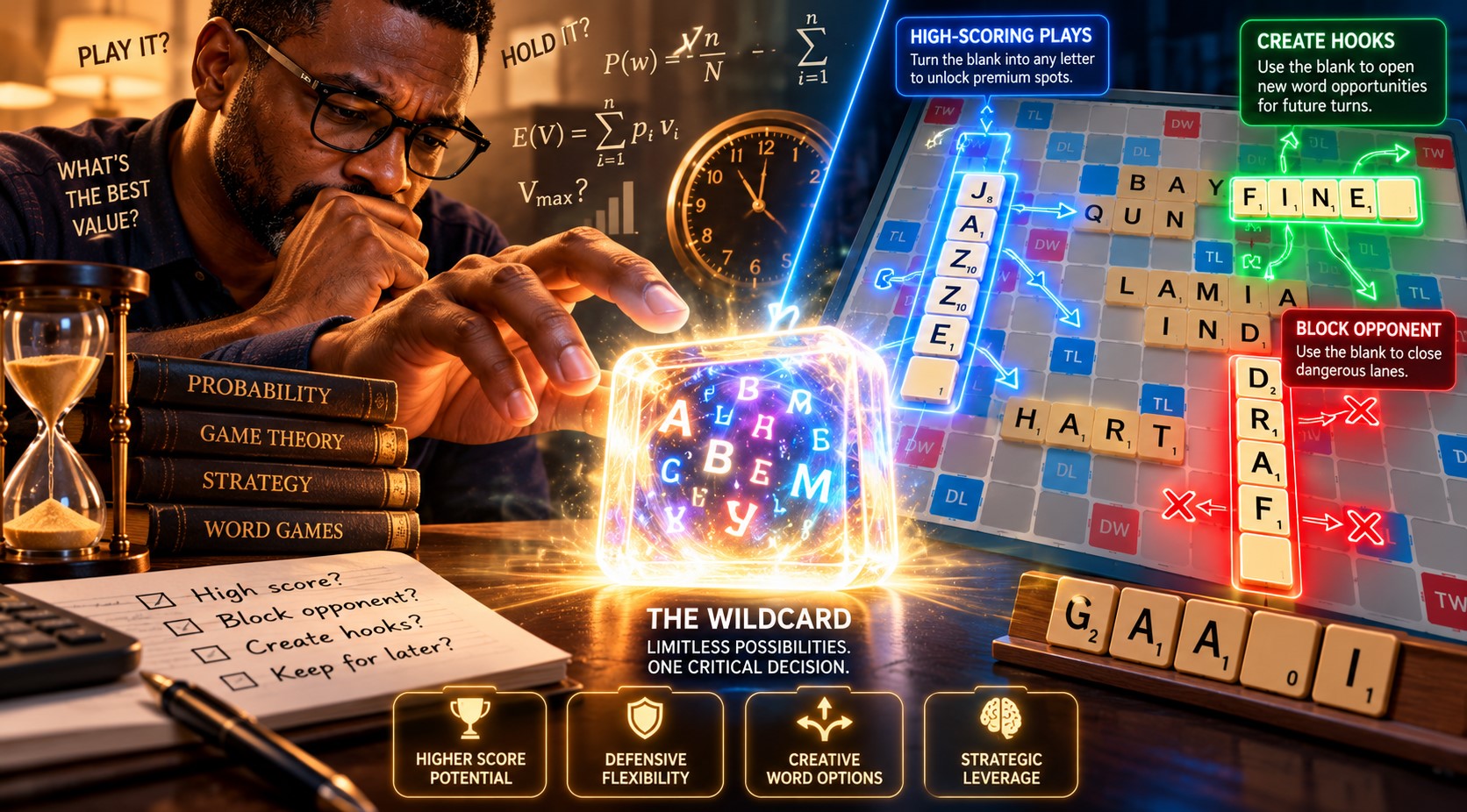
The blank tile is universally recognized as the most powerful piece in any word game, capable of transforming a dead-end rack into a high-scoring masterpiece. Yet, despite its unmatched utility, it triggers a profound psychological paradox: players tend to hoard it far too long, dragging down their point-per-turn efficiency. In digital spaces where tools like wordmaster.pro instantly unlock a player’s vocabulary options, the blank tile is frequently mismanaged due to the fear of wasting its potential. This article analyzes the cognitive biases behind blank-tile hoarding, evaluates the exact mathematical moment to deploy it, and explores how this flexible mechanic serves as a foundational blueprint for next-generation, equalized game design.
1. The Paradox of Infinite Potential
When a blank tile drops into a player’s hand, it introduces an immediate cognitive burden. Because the tile can represent any letter in the alphabet, its potential value feels infinite. This infinite potential creates a psychological phenomenon known as “loss aversion.” Players become so terrified of wasting the blank on a mediocre 20-point word that they choose to hold onto it for turn after turn, waiting for a perfect, mythical 80-point play that may never actually materialize.
2. The Hidden Financial Drag of Asset Hoarding
In economics, an asset that sits idle without generating value is a drag on your portfolio. In word games, keeping a blank tile on your rack for three consecutive turns means you are effectively playing with a 6-tile hand. While you wait for a miracle layout, your point-per-turn momentum grinds to a halt. If hoarding the blank causes you to score only 15 points per turn for three rounds, you have lost a massive chunk of momentum that a single flashy play later cannot easily recover.
3. Symmetrical Discovery and the Efficiency Pivot
In traditional physical matches, finding a 7-letter “bingo” with a blank tile required immense mental gymnastics. In the modern digital era, platforms like wordmaster.pro eliminate that friction entirely. By inputting your rack with a wildcard character, the unscrambler instantly displays every mathematical configuration available. Because discovery is now symmetrical and instantaneous, the strategic question changes from “Can I find a word with this blank?” to “Is the current board layout optimal for spending this asset right now?”
4. Setting the Exact Mathematical Threshold for Deployment
Elite players do not rely on intuition to play their blank tiles; they rely on concrete scoring thresholds. As a general rule of thumb, a blank tile should be deployed the moment it unlocks a play that satisfies one of three conditions: it yields a premium “bingo” bonus, it scores at least 25 points above your rack’s average output, or it permanently blocks an opponent’s lethal high-scoring lane. If a play meets any of these criteria, holding onto the tile is mathematically inefficient.
5. Managing the Post-Blank Rack Transition
The second most common mistake players make with the blank tile is using it to spell a word while completely ignoring their remaining rack leave. If using the blank allows you to score 45 points but leaves you holding awkward, duplicate consonants like V-V-W, you have traded a premium asset for a broken engine. A master tactician ensures that the blank tile serves a dual purpose: maximizing the current turn’s score while cleanly purging problematic letters from the hand.
6. The Psychological Weapon of the Unplayed Wildcard
While holding the blank tile too long is generally a mistake, displaying strategic patience can act as a powerful psychological weapon against an observant opponent. In high-level digital matches, players track the tile bag closely. If an opponent deduces that both blanks are still missing or sitting on your rack, their play style will often become overly defensive and constrained. They will squeeze the board geometry shut out of fear, allowing you to dictate the tempo of the match without even placing the tile.
7. Strategic Flexibility vs. Raw Tile Values
The blank tile carries a face value of zero points, meaning its entire worth is derived from the spatial flexibility it provides. This makes it the direct opposite of high-value power tiles like the ‘Q’ or ‘Z’. Understanding the interplay between flexibility and raw power is a key indicator of player mastery. The ultimate sequence involves using the flexibility of the blank tile to navigate onto a premium board square, pairing it directly with a high-value consonant to maximize the grid’s scoring multipliers.
8. The Blueprint for Next-Generation Dynamic Mechanics
This fascinating tension between flexibility and hoarding provides a direct blueprint for where modern puzzle mechanics are heading. Emerging concepts in digital game design are moving away from restrictive tile draws and toward systems that integrate wildcards and adaptive interfaces natively. By shifting the focus away from the luck of pulling a blank and giving both players predictable access to flexible pieces, the genre transforms into a pure test of resource management, timing, and positioning.
Take Home Conclusion
The blank tile is an engine of momentum, not a trophy to be hoarded. Relying on an unscrambler like wordmaster.pro will quickly reveal the massive array of options a wildcard provides, but you must supply the decisiveness to pull the trigger. Stop waiting for the perfect, textbook setup while your turn-by-turn scores suffer. When you learn to view the blank tile as a fluid resource meant to maximize your net point differential and stabilize your rack balance, you elevate your strategy from a hesitant guessing game to a calculated, winning formula.
Leave a Reply