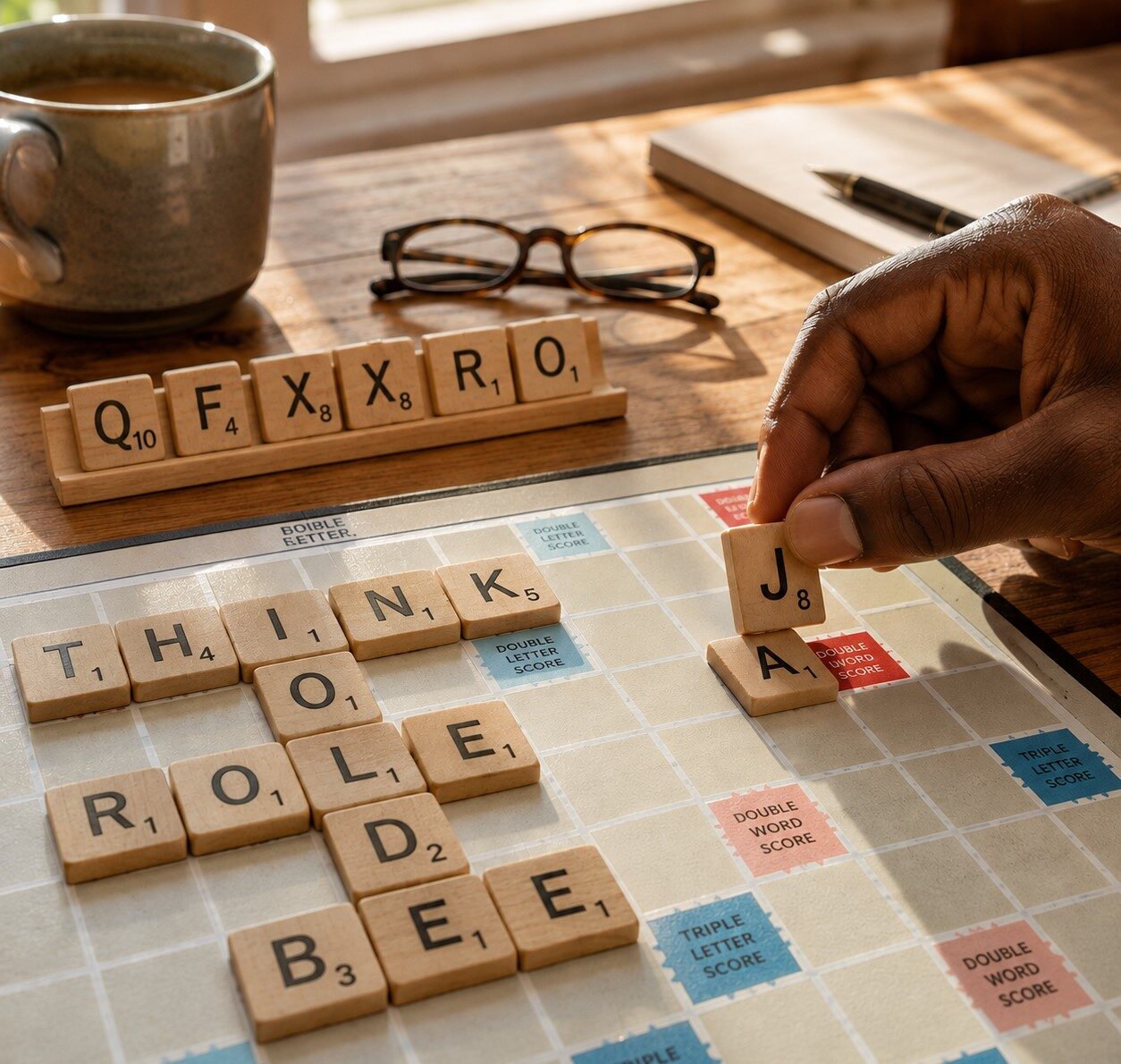
1. Executive Summary — The High-Value Turbo
The J is not a letter. It is an event.
Eight points of trapped mass.
One tile that can win a turn — or lose three.
Amateurs hoard it for a “big word.”
Masters deploy it as a localized scoring weapon.
Short. Parallel. Multiplied. Gone.
Wordmaster.pro analyzes the absolute mathematical localized multiplier velocity of short ‘J’ structural blocks in order to provide competitive players with an unshakeable offensive toolkit that spikes turn metrics without exposing dangerous open pathways to the opponent.
Drawing the J is a tempo gift. Keeping it is a tax. Every turn you retain an unplayed J, your power tile management debt compounds. Bingo shape narrows. Vowel pairing options shrink. The rack becomes a seven-tile cage with an eight-point anchor bolted inside.
Why a trapped J degrades point velocity
Model competitive j words scrabble strategy on turn equity, not face value.
| State | Typical outcome |
|---|---|
| J played turn 1–2 on a premium | 22–45+ scored; rack reopens |
| J held turns 3–5 | 0 scored; leave quality −15 to −25 |
| J forced into open long word | J cleared; board corridor donated |
| J juggernaut parallel | J cleared; board tight; LMV maximized |
A stranded J does not merely cost eight face points. It costs localized multiplier velocity. You miss Double Letter Score (DLS) and Triple Letter Score (TLS) windows. You pass premium real estate to the opponent. You accept lower rack drainage rate on the other six tiles because the J refuses to pair.
That is the structural crisis. Not bad luck. Bad deployment timing.
The juggernaut thesis
High scoring j words are rarely long. They are short hooks parked on multipliers with parallel placement geometry. A legal JA or JO through a lone board vowel can outscore a five-letter main word played flat. That is not intuition. It is arithmetic.
This guide is the operational manual for 3 letter j words, 4 letter j words scrabble, words with friends j plays, and wordfeud j strategy under clock. Same physics. Different UI. Identical multiplier law.
2. The Mathematics of the J-Tile: Localized Multiplier Velocity
Localized Multiplier Velocity (LMV)
Localized Multiplier Velocity (LMV) measures how fast an eight-point tile converts into scored points when it touches a premium square and participates in more than one scored axis in the same turn.
LMV = (Σ Letter Values per Axis, including multiplier re-application) ÷ Tiles You PlacedThe J is unique because its face value is so large that premium placement creates step-change yield. On a DLS, one J contributes 16 before any word multiplier. On a TLS, 24.
LMV spikes when the same physical J cell is counted in two legal words in one play. That is the double-count cross.
Proof: short parallel J vs. long flat word
Scenario A — flat five-letter word
Play JACKS with no letter premium and no word premium:
J(8) + A(1) + C(3) + K(5) + S(1) = 18Tiles spent: 5. LMV = 18 ÷ 5 = 3.6 points per tile placed.
Scenario B — single-tile J parallel on DLS
Board holds A and O in a junction configuration. You place one J forming JA horizontally and JO vertically. J sits on DLS.
JA axis: J(8×2) + A(1) = 17
JO axis: J(8×2) + O(1) = 17
Total   = 34
Tiles spent: 1. LMV = 34 ÷ 1 = 34.
The short parallel JA/JO junction scores 34 with one tile. The five-letter flat word scores 18 with five. Length lied. LMV told the truth.
Even a modest 3 letter j words route — JET on a DLS with a legal two-letter cross — routinely beats unmultiplied fours and fives.
Power tile management corollary
Power tile management for the J follows one rule:
Extract on the highest LMV square available this turn — not on the longest word available next turn.
Waiting for JACKET is how strong players lose to players who know JA.
J-Tile Extraction Matrix
Face values use standard Scrabble scoring. “Net yield” includes typical cross bonuses; exact totals depend on board premiums.
| Playable J-Word | Letters Used | Multiplier Target | Net Point Yield (typical) | Next-Turn Rack Health |
|---|---|---|---|---|
| JA | 1 (J) | DLS + vowel hijack | 14–34 | Excellent |
| JO | 1 (J) | DLS + vowel hijack | 14–34 | Excellent |
| JAW | 2–3 | DLS on J | 18–28 | Strong |
| JAY | 2–3 | DLS on J | 18–28 | Strong |
| JET | 2–3 | TLS preferred on J | 22–38 | Strong |
| JIB | 2–3 | DLS on J | 17–26 | Good |
| JIG | 2–3 | DLS on J | 17–26 | Good |
| JIN | 2–3 | DLS + S-hook caution | 17–28 | Good |
| JOB | 2–3 | DLS on J | 17–26 | Good |
| JOT | 2–3 | DLS on J | 17–26 | Good |
| HAJ | 3 | DLS on J | 20–30 | Good |
| TAJ | 3 | DLS on J | 20–30 | Good |
| RAJ | 3 | DLS on J | 20–30 | Good |
| JAVA | 4 | DLS on J | 22–32 | Moderate |
| JEAN | 4 | DLS on J | 22–32 | Moderate |
| JINX | 4 | TLS on J | 28–42 | Moderate |
| JIVE | 4 | DLS on J | 22–32 | Moderate |
| JOEY | 4 | DLS on J | 22–32 | Moderate |
| JOLT | 4 | DLS on J | 22–32 | Moderate |
| JUDO | 4 | DLS on J | 22–32 | Moderate |
Prioritize top rows under a 15-second mobile clock. They maximize LMV per tile.
3. The Juggernaut Directory: Short Power Hooks
These are tournament-legal anchors for j words scrabble strategy. Grouped by length. Each group covers lexicon variance, terminal hook letter risk, and structural footprint for vowel hijacks.
Lexicon key: NWL = North American tournament · CSW = international Collins · WWF = Words With Friends ENABLE-family (broad; most NWL words accepted).
3A. The 2-Letter Foundation — JA · JO
The entire J economy begins here. Two tiles. Maximum LMV potential.
JA
Definition: An affirmative (German import in international play).
Lexicon legality
| Lexicon | Status |
|---|---|
| NWL / TWL | Valid (modern NWL editions) |
| CSW | Valid |
| WWF | Valid |
Terminal hook liabilities
| Direction | Extensions | Risk |
|---|---|---|
| Back | JAG, JAM, JAR, JAW, JAY | Moderate — opens J-stem lane |
| Front | Rare at competitive level | Low |
Structural footprint
The premier vowel hijack play. Scan for a lone A on or beside a DLS. Place J to complete JA. Hunt a vertical O, I, or U through the J for a double-count cross.
| Col 1 | Col 2 | |
| Board | A | · |
| Below J | O | · |
| Your play | J | · |
| Axes scored | JA + JO (J on DLS → 34 baseline) | |
NWL-legal 2-letter words: JO confirmed; JA in current NWL.
JO
Definition: A sweetheart; darling (archaic).
Lexicon legality
| Lexicon | Status |
|---|---|
| NWL / TWL | Valid |
| CSW | Valid |
| WWF | Valid |
Terminal hook liabilities
| Direction | Extensions | Risk |
|---|---|---|
| Back | JOB, JOG, JOT, JOE, JOEY | Moderate |
| Front | Minimal | Low |
Structural footprint
Mirror geometry of JA on exposed O. Highest-frequency words with friends j plays when a vowel sits on a premium. Pair with vertical JA, JE, or JI crosses only when the 2-letter cross is verified in your event lexicon.
2-letter foundation rule: If you know only two J words, know JA and JO. Everything else is extension.
3B. The 3-Letter Sharp Shooters
Operational 3 letter j words for rack relief, premium contact, and controlled dumps.
| Word | Definition (short) | NWL | CSW | WWF | Primary hook risk |
|---|---|---|---|---|---|
| JAW | Mouth bone; idle talk | ✓ | ✓ | ✓ | JAWS back hook |
| JAY | Bird; talkative person | ✓ | ✓ | ✓ | JAYS plural |
| JEE | Gee (horse command) | ✓ | ✓ | ✓ | Front vowel hooks |
| JET | Fast aircraft; black lignite | ✓ | ✓ | ✓ | JETS; TLS target |
| JEU | French game | ✓ | ✓ | ✓ | JEUX not JEUS |
| JEW | To bargain (verb) | ✓ | ✓ | ✓ | Sensitive; legal in lexicon |
| JIB | Sail; refuse to proceed | ✓ | ✓ | ✓ | JIBS |
| JIG | Lively dance; tool | ✓ | ✓ | ✓ | JIGS |
| JIN | Spirit (Arabic) | ✓ | ✓ | ✓ | JINS; stem family |
| JOB | Task; employment | ✓ | ✓ | ✓ | JOBS |
| JOG | Run slowly | ✓ | ✓ | ✓ | JOGS |
| JOT | Write briefly | ✓ | ✓ | ✓ | JOTS |
| JOW | Ring a bell | ✓ | ✓ | ✓ | JOWS |
| JUN | North Korean coin | ✓ | ✓ | ✓ | No JUNS plural |
| JUS | Legal right; gravy | ✓ | ✓ | ✓ | JUST front hook |
| JUT | Protrude | ✓ | ✓ | ✓ | JUTS |
| HAJ | Pilgrimage to Mecca | ✓ | ✓ | ✓ | HAJI, HAJJ family |
| TAJ | Conical cap | ✓ | ✓ | ✓ | Low volatility |
| RAJ | Rule; British India era | ✓ | ✓ | ✓ | RAJA extension |
Group-wide terminal hook liabilities
Terminal hook letter risk clusters on S and vowel-front extensions:
- S-back hooks (JAWS, JAYS, JETS, JOBS) — never park terminal S on a TWS ray unless the lane is dead.
- J-front hooks — opponent extends your play into a four-letter stem (JETS, JIBE family). Prefer closed sides.
- Vowel-leak hooks — a J left beside open A/E/I/O invites opponent JA/JO steals. Cover or block.
Group-wide structural footprint
Vowel hijack protocol for 3-letter J words:
- Locate standalone board vowel (A, O, E, I).
- Place J on premium if possible.
- Add second rack letter only if it raises LMV or fixes leave.
- Validate every 2-letter cross before committing.
High-priority sharp shooters under clock: JET (TLS hunter), JIN (stem hub), HAJ/TAJ/RAJ (through-tile J on existing vowel), JIB/JIG (consonant pairing).
3C. The 4-Letter Strategic Dumps
4 letter j words scrabble tier: extract the J, stabilize leave, accept moderate LMV when premiums are dry.
| Word | Definition (short) | NWL | CSW | WWF | Primary hook risk |
|---|---|---|---|---|---|
| JATO | Jet-assisted takeoff | ✓ | ✓ | ✓ | JATOS |
| JAVA | Coffee; programming language | ✓ | ✓ | ✓ | Low |
| JEAN | Denim fabric | ✓ | ✓ | ✓ | JEANS |
| JEEZ | Exclamation | ✓ | ✓ | ✓ | Low |
| JIBE | Agree; sail maneuver | ✓ | ✓ | ✓ | JIBES |
| JILL | Female ferret | ✓ | ✓ | ✓ | Low |
| JINK | Sudden turn | ✓ | ✓ | ✓ | JINKS |
| JINX | Curse; bad luck | ✓ | ✓ | ✓ | JINXES |
| JIVE | Jazz slang; deceive | ✓ | ✓ | ✓ | JIVES |
| JOEY | Young kangaroo | ✓ | ✓ | ✓ | JOEYS |
| JOLT | Sudden bump | ✓ | ✓ | ✓ | JOLTS |
| JUBA | African dance | ✓ | ✓ | ✓ | Low |
| JUCO | Junior college | ✓ | ✓ | ✓ | Low |
| JUDO | Martial art | ✓ | ✓ | ✓ | JUDOS |
| JUGA | Anatomical connector (zoology) | ✓ | ✓ | ✓ | Low |
| JUTE | Fiber plant | ✓ | ✓ | ✓ | Low |
Group-wide terminal hook liabilities
Four-letter dumps trade length for clarity. Main risks:
| Pattern | Example | Mitigation |
|---|---|---|
| S plural back hook | JOLTS, JIVES | Block TWS approach vectors |
| Stem extension | JINX → JINXES | Do not leave floating X beside open vowel |
| JOEY/JUDO open vowel | Opponent bingo lane | Parallel overlay into closed column |
Group-wide structural footprint
Use 4-letter dumps when:
- No 2-letter or 3-letter LMV junction exists.
- The J must exit this turn to preserve bingo shape.
- You can land the J on DLS/TLS even without a double-count cross.
Wordfeud j strategy note: premium coordinates differ on random boards. The deployment rule is unchanged — J seeks letter premium first, word premium second.
4. Spatial Positioning: The Parallel Overlay Engine
Firewall defense protects vowel-less racks. The J overlay engine attacks with parallel placement discipline.
4.1 The Double-Count Cross
Objective: Score the same J in two legal words in one turn.
Protocol
- Scan for two board vowels that can partner with J on orthogonal axes.
- Place J on the intersection cell — ideally DLS or TLS.
- Confirm both resulting words are legal in your lexicon.
- Score both axes; the J value applies to each word separately.
Baseline math (J on DLS, no word premium)
Axis 1 (JA): 16 + 1 = 17
Axis 2 (JO): 16 + 1 = 17
LMV         = 34 ÷ 1 tile = 34
That is the double-count cross. Eight face becomes 32 from the J alone before word multipliers.
| Vowel col | J col | |
| Row A (board) | A | J |
| Row O (board) | O | · |
| Scored words | JA horizontal · JO vertical | |
| Premium | J on DLS — counted twice | |
4.2 Multiplier Shielding
Objective: Occupy premium squares with short J blocks without gifting the opponent a TWS extension path.
Protocol
- Identify DLS/TLS cells adjacent to a board vowel.
- Play JA, JO, or a 3-letter sharp shooter with J on the premium.
- Audit terminal hook letter exposure on both ends of the new word.
- Reject any play that leaves a single-letter hook into an open Triple Word Score corridor.
Shield ranking
| Play type | Shield quality | Why |
|---|---|---|
| Single-tile JA/JO double-count | Excellent | One new cell; J consumed |
| 3-letter JET/JIB on TLS | Strong | High LMV; watch S hooks |
| 4-letter open dump | Weak | Clears J; may open lane |
| 6-letter JACKET into open quadrant | Poor | Length ≠ safety |
Multiplier shielding is defensive offense. You score now. You deny premium equity later.
4.3 The Vowel Hijack
Objective: Instantly convert lone board vowels into high scoring j words with minimal rack spend.
Target vowels (priority order)
| Vowel | Best 2-letter | Best 3-letter extensions |
|---|---|---|
| A | JA | JAW, JAY, JAB |
| O | JO | JOB, JOG, JOT |
| E | — | JET, JEE, JEU |
| I | — | JIB, JIG, JIN |
| U | — | JUS, JUT, JUN |
Hijack scan (15-second clock)
- Sweep board for isolated A and O.
- Check DLS/TLS under the J intersection.
- Hunt orthogonal second vowel for double-count.
- If none, play best 3-letter sharp shooter.
- If still stuck, 4-letter dump — never pass with J unplayed.
The vowel hijack is the fastest LMV engine in wordfeud j strategy and tournament Scrabble alike.
5. Case Studies: The Raw Length Miscalculation vs. The Juggernaut Strike
Case Study A — The Raw Length Miscalculation
Rack: J A C K E T plus filler consonants.
Board: open quadrant leading toward a live Triple Word Score.
Player decision: Force JACKET into the open lane for 32 points.
Sequence
- Player clears the J and four other tiles. Solid face value.
- The play opens a wide corridor toward the TWS.
- Opponent slots a seven-letter through the gap with TWS coverage.
- Opponent scores 65. Net exchange: −33 minimum.
Autopsy
| Metric | Result |
|---|---|
| Player score | 32 |
| Opponent score | 65 |
| J extracted | Yes |
| LMV | Moderate (5 tiles spent) |
| Board state | Corridors opened |
| Premium equity donated | TWS lane |
Diagnosis: Raw length miscalculation. The J left, but localized multiplier velocity was mediocre and parallel placement discipline failed. This is weak power tile management dressed as aggression.
Case Study B — The Juggernaut Strike
Rack: J plus balanced leave.
Board: lone A on a DLS; O directly below the A column.
Master decision: Place one J forming JA and JO with J on the DLS.
| 1 | 2 | |
| Before | A | · |
| Vowel stack | O | · |
| After | J | · |
| Score | JA 17 + JO 17 = 34 | |
Results
| Metric | Result |
|---|---|
| Tiles placed | 1 |
| Score | 34 |
| LMV | 34.0 |
| J extracted | Yes |
| Board state | Tight; no corridor |
| Opponent TWS access | Denied |
| Leave | Six balanced tiles |
Diagnosis: Juggernaut strike. One tile. Double-count cross. Premium captured. Board locked. This is elite j words scrabble strategy — not because it is clever, but because the math is dominant.
Extraction principle: A 34-point single-tile JA/JO junction beats a 32-point five-tile open JACKET when the opponent’s TWS reply is live.
6. The Instant Recall “J” Engine Cheat Sheet
Twenty highest-yield J plays for 15-second mobile clocks. Grouped by length.
2-Letter — deploy first
- JA — supreme vowel hijack on A; double-count king
- JO — supreme vowel hijack on O; double-count king
3-Letter — sharp shooters (12)
- JET — TLS hunter; aviation dump
- JAW — through-vowel or standalone
- JAY — bird hook; JAYS risk
- JIN — spirit stem; bingo-adjacent
- JIB — sail dump; clean consonant pairing
- JIG — dance/tool; rack relief
- JOB — practical dump
- JOT — low-volatility exit
- HAJ — pilgrimage; strong face on J
- TAJ — cap; through-tile tool
- RAJ — rule; through-tile tool
- JEU — French game; JEUX extension
4-Letter — strategic dumps (6)
- JINX — TLS ceiling play; X terminal discipline
- JAVA — stable extract
- JOLT — sudden-move dump
- JIVE — mid-scoring exit
- JOEY — kangaroo dump
- JUDO — martial-art extract
10-second deployment checklist
- J in rack? Enter juggernaut mode immediately.
- Scan for lone A / O on DLS or TLS.
- Attempt JA / JO double-count cross.
- If blocked, deploy best 3-letter sharp shooter on premium.
- Reject open long words that donate TWS lanes.
- Audit terminal hook letter before submit.
- Maximize LMV, not length.
Final operating rule
The J is an eight-point accelerator. Not a seven-letter hostage.
Localized multiplier velocity wins turns. Length merely spends tiles.
Parallel placement scores twice. Open boards score your opponent.
Power tile management means extraction on premium — this turn.
When the J appears, do not wait for grandeur.
Drop the juggernaut.
Count it twice.
Move on.
Leave a Reply