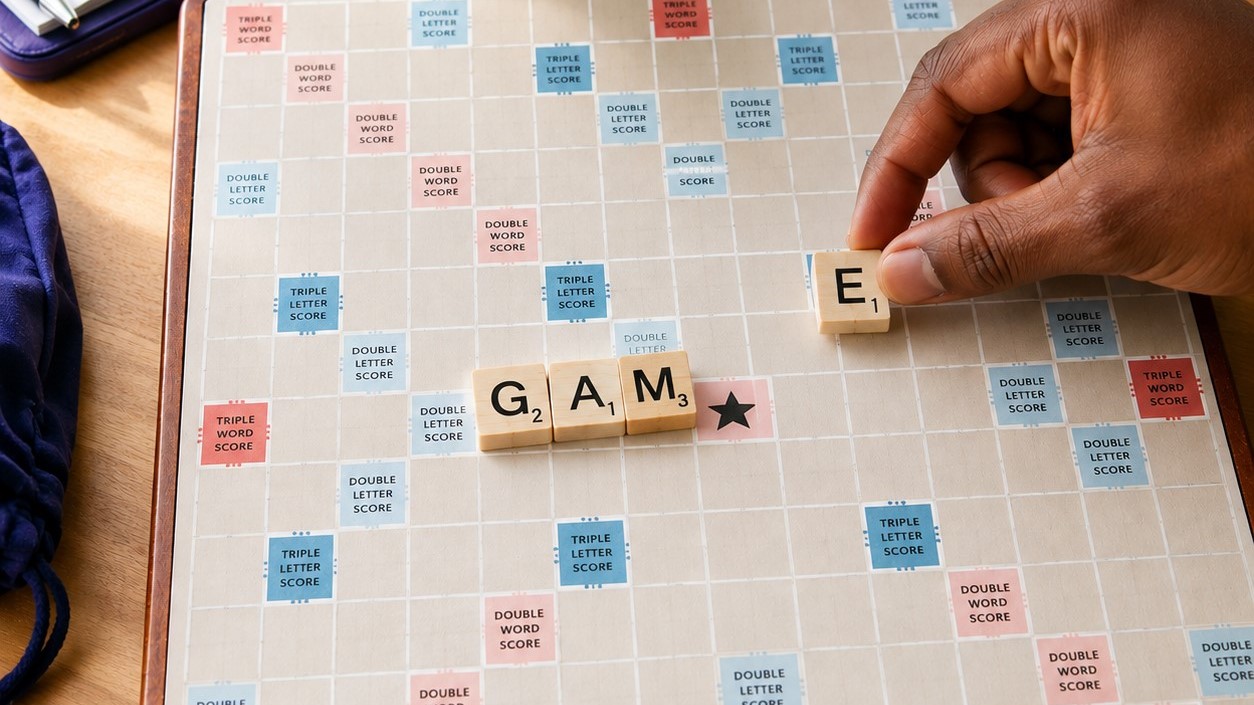
1. Executive Summary — The Architectural Genesis
Turn 1 is not a warm-up.
It is architectural genesis.
The center star is absolute territory.
One word. One orientation. One board destiny.
Amateurs maximize raw points.
Masters maximize grid trajectory.
Short enough to choke. Long enough to drain. Gone.
Wordmaster.pro analyzes the absolute mathematical initial spatial volatility of center star structural blocks in order to provide competitive players with an unshakeable offensive toolkit that spikes turn metrics without exposing dangerous open pathways to the opponent.
The first play is unique in every competitive word game. No opponent structure exists. No defensive geometry is inherited. You alone decide the board expansion vector. That is why elite scrabble opening moves are positional decisions first and scoring decisions second.
Why Turn 1 dictates match trajectory
| Factor | Turn 1 reality |
|---|---|
| Premium access | Free Double Word Score on the center star |
| Opponent structure | Zero — you invent the board |
| Hook density | Entirely created by your terminals |
| Leave quality | Sets bingo probability for Turns 2–4 |
| Spatial risk | Permanent — lanes you open stay open |
A greedy opener can print twenty-eight points and still lose the next exchange by forty. A positional opener can print eighteen and seize momentum for the next three turns. That is scrabble first turn strategy in its pure form.
The central star thesis
The best first word is not the highest face total. It is the word that balances:
- Center-star Double Word Score capture
- Opening rack management
- Controlled initial spatial volatility
- Minimal opponent counter-bingo probability
This guide is the operating system for best opening words scrabble, words with friends opening play, wordfeud first move guides, and center star tile placement under clock.
2. The Mathematics of Turn 1: Initial Spatial Volatility
Initial Spatial Volatility (ISV)
Initial Spatial Volatility (ISV) measures how vulnerable an opening play leaves the board to high-scoring parallel plays or fast bingo tracks, based on word length and letter density.
ISV = (Exposed Terminal Risk + Premium Proximity Risk + Hook Density)
      ÷ Leave Quality Weight
A simplified tournament form:
ISV ≈ (Word Length Extension Factor) + (Soft Terminal Count × 8)
      − (Consonant Seal Bonus)
High ISV means the opponent inherits easy parallel overlays, soft vowel hooks, or short paths into Double Word Score lanes. Low ISV means the center is choked and replies are forced into awkward racks.
Proof: 4–5 letter openers beat greedy 6-letter extensions
Scenario A — greedy 6-letter stretch
You open with a 6-letter word for 28 after center Double Word Score. One terminal vowel hangs two empty squares from a live Double Word Score approach.
Immediate score              = 28
Opponent parallel/hook reply = 48
Net exchange                 = −20
ISV                          = High
Length looked strong. Geometry was soft.
Scenario B — compact 4–5 letter equilibrium
You open with a dense 4-letter or balanced 5-letter word for 18–24. Terminals are hard. Premium approach paths remain blocked or awkward.
Immediate score              = 18–24
Opponent forced reply        = 10–16
Net exchange                 = +2 to +14
ISV                          = Low–moderate
You score less now. You win the architecture.
Why length past five raises volatility faster than score
On a standard 15×15 Scrabble grid, every extra letter past the center increases:
- Parallel track surface area
- Hook-accessible terminal count
- Distance toward side Double Word Score diagonals
- Bingo runway potential along the opened axis
A six-letter opener often reaches into strike distance of early premium conversion. A four-letter closed-grid anchor rarely does. That is the core of grid trajectory optimization.
Opening Move Blueprint Matrix
Tactical Safety Grade: A = closed / low ISV · B = balanced · C = volatile.
| Opening Word Length | Board Style Generated | Average Point Yield | Opponent Counter-Bingo Probability | Tactical Safety Grade |
|---|---|---|---|---|
| 2–3 letters | Underpowered center | 8–16 | Low | C (wastes DWS) |
| 4 letters | Closed-grid choke | 16–24 | Low–moderate | A |
| 5 letters | Equilibrium standard | 20–32 | Moderate | A–B |
| 6 letters | Extended axis | 24–36 | Elevated | C |
| 7 letters (bingo) | Launchpad board | 60–110+ | High if soft hooks | B (conditional) |
Use length as a volatility dial. Not as a vanity metric.
3. The Grandmaster First-Turn Directory: Balancing Raw Points and Risk
These frameworks define elite center star tile placement. They are length architectures, not trivia lists.
3A. The 4-Letter Closed-Grid Anchor
Role: Choke the center early. Drain weak tiles. Minimize opponent parallel surface.
Play short, dense words when the rack is awkward, duplicate-heavy, or loaded with dangerous soft terminals. Prefer strong terminal consonants — V, C, J, K, X, Z — that resist easy hooks.
Structural placement rules
- Cover the center star. Capture the free Double Word Score.
- Prefer centering the block so both flanks stay short of premium approach lanes.
- Offset a high-value tile only if it improves leave and does not create a soft parallel hinge.
- Reject any 4-letter open that ends in an exposed A/E/I/O/U beside empty parallel rows.
Front and back hook liabilities
| Terminal type | Typical risk | Opening verdict |
|---|---|---|
| Soft vowel (A/E/I/O/U) | High parallel/hook risk | Avoid on either end |
| S | Plural and bingo-feed risk | Use only if leave demands |
| Hard consonant (C/V/J/K/X) | Low–moderate | Preferred seals |
| Y | Medium | Acceptable if buried or sealed |
Spatial footprint
On Scrabble’s 15×15 grid with center at H8:
- A centered 4-letter horizontal open occupies roughly columns F–I or G–J depending on offset.
- Distance from each terminal to the nearest side Double Word Score diagonal remains comparatively large.
- Parallel rows above/below offer only four hinge cells — easier to starve than longer opens.
When to choose it: Bad leave candidates. Duplicate vowels. Power tiles you refuse to gift as parallel hinges. This is the safest scrabble first turn strategy under rack stress.
3B. The 5-Letter Equilibrium Standard
Role: The sweet spot for balanced rack drainage with controlled premium contact.
Five letters is the equilibrium standard for most tournament opens. You refresh five tiles. You capture meaningful Double Word Score value. You can often place a strong letter on a nearby Double Letter Score without fully opening the board.
Structural placement rules
- Aim for five tiles through the center star.
- If a Double Letter Score is reachable on the opened axis, park a mid/high consonant there — not a soft vowel.
- Keep both terminals consonant-heavy whenever possible.
- Do not chase one extra point if it rotates a vowel onto an exposed end.
Front and back hook liabilities
| Pattern | Risk | Mitigation |
|---|---|---|
| Trailing S | Opponent plural/bingo hinge | Prefer internal S or no S |
| Leading vowel | Front-hook highway | Bury vowels mid-word |
| Soft pair ends (AE, EA feel) | Parallel overlay bait | Reject for denser anagram |
| Floating R/D | Medium extension risk | Acceptable if leave is elite |
Spatial footprint
A well-built 5-letter open:
- Reaches useful letter-premium geometry without overextending into early Double Word Score strike zones
- Creates five parallel hinge cells above and below — manageable if terminals are hard
- Leaves two tiles on rack for intentional opening rack management
When to choose it: Default. If your rack supports a clean five with hard ends and a strong leave, take it. This is the practical center of best opening words scrabble.
3C. The 7-Letter Bingo Launchpad
Role: Cash a natural bingo when the rack is already solved — then map the safest axis.
A 7-letter opening through the center star is doubled, then receives the bingo bonus. The score spike is real. The board shock is also real. You create the longest possible early axis and the densest hook surface of any opener.
Structural placement rules
- Take the bingo if leave after bingo is empty by definition and the word is legal.
- Choose orientation by defensive safety, not habit.
- Prefer the direction that keeps soft letters farther from early premium conversion lanes.
- If two bingo anagrams exist, choose the one with harder terminals.
Front and back hook liabilities
Bingo opens are hook magnets.
| Risk | Why it matters | Control method |
|---|---|---|
| Dual open ends | Opponent can extend either side | Prefer consonant terminals |
| Long parallel surface | Seven hinge cells per flank | Accept only if score compensates |
| Soft internal vowels | Multi-cross overlays | Unavoidable; plan reply defense |
| S-heavy bingo | Instant plural highways | Prefer non-S forms when available |
Spatial footprint and direction choice
Map both orientations before submitting:
| Orientation | Typical safety profile | Prefer when |
|---|---|---|
| Horizontal | Slightly easier visual tracking; common tournament default | Soft letters sit better horizontally away from hot diagonals |
| Vertical | Equal math, different reply heuristics | Soft letters are safer on the vertical axis for this rack |
Defensive safety rule: After placing the bingo, count empty cells from each terminal to the nearest Double Word Score approach. Choose the orientation that maximizes that minimum distance for your softest letter.
When to choose it: Natural 7. Do not break a bingo to play a “safer” four unless the bingo creates an immediate catastrophic Triple Word Score gift on the reply. Most natural opening bingos should be taken.
Directory synthesis — scrabble opening moves
| Framework | Primary goal | ISV profile | Default use |
|---|---|---|---|
| 4-letter closed-grid | Choke + drain | Lowest | Stressed racks |
| 5-letter equilibrium | Score + leave | Balanced | Standard racks |
| 7-letter launchpad | Max spike | High but justified | Natural bingos |
| 6-letter greedy stretch | Raw points | Often too high | Usually avoid |
This is the architecture of grid trajectory optimization.
4. Spatial Positioning: Orientation and Tile Placement
Turn 1 geometry is orientation plus tile ethics. Points follow.
4.1 The Horizontal Bias
Objective: Prefer horizontal opens in most tournament settings.
Horizontal placement is marginally superior for practical reasons:
- Players track left-to-right word forms faster under clock.
- Parallel defense above/below is easier to visualize quickly.
- Hook audits on open ends map cleanly in reading order.
- Most study materials and replay notation reinforce horizontal pattern recognition.
The math of premiums is rotationally symmetric. The cognition is not. Under a 15-second decision window, cognitive ease is a real equity factor.
Protocol
- Default to horizontal.
- Switch to vertical only when it clearly improves terminal safety or high-tile offsetting.
- Never choose vertical for style.
| F | G | H★ | I | J | |
| Row 8 open | C | R | A | V | E |
| Note | 5-letter equilibrium · center star captured · audit the soft E end before accepting | ||||
Teaching sketch: prefer a harder right-end consonant when an anagram allows it.
4.2 High-Value Tile Offsetting
Objective: Prevent Turn 1 high-point consonants from becoming free parallel amplifiers.
Strict rules:
- If you play H, Y, W, F, V, or stronger, do not gift an easy double-count parallel on the reply.
- Prefer placing those tiles on interior non-premium cells when the alternative creates an open hinge beside empty premium approach squares.
- If a Double Letter Score is available on the opening axis, use it for a strong consonant only when both flanks remain defensible.
- Never place a lonely high tile on an exposed end “for style.”
Offset ranking
| Placement | Safety | Verdict |
|---|---|---|
| High tile buried mid-word, hard ends | Excellent | Preferred |
| High tile on reachable DLS, sealed ends | Strong | Conditional take |
| High tile on open terminal | Weak | Reject |
| High tile creating soft parallel pocket | Poor | Reject |
This is center star tile placement ethics: score the free Double Word Score without manufacturing the opponent’s next overlay.
4.3 Vowel Isolation
Objective: Bury vowels inside the opening block. Keep terminals hard.
Exposed vowels are the primary fuel of early parallel overlays and hook extensions. Interior vowels are structural necessities. Terminal vowels are gifts.
Protocol
- Generate candidate opens.
- Discard any candidate with two soft vowel ends.
- Prefer one hard consonant end at minimum; two is elite.
- If the only high-scoring open ends in a vowel, compare it against a slightly lower 4-letter closed-grid anchor.
- Keep one flexible vowel on the leave when possible for Turn 2 connectivity.
Vowel isolation map
| Pattern | Example shape | ISV effect |
|---|---|---|
| C V C C | Hard sandwich | Low |
| C C V C C | Ideal 5-letter core | Low–moderate |
| V C C C | Soft front | Elevated |
| C C C V | Soft back | Elevated |
| V C C V | Dual soft ends | High — reject |
Words with friends opening play and wordfeud first move guides follow the same isolation law even when premium maps differ: hide vowels, show consonants.
5. Case Studies: The Greedy 6-Letter Blunder vs. The Positional Open
Case Study A — The Greedy 6-Letter Blunder
Rack: mixed scoring support.
Decision: Stretch a 6-letter opener for 28 after center Double Word Score.
Geometry: trailing vowel hangs two spaces from a Double Word Score approach lane.
Sequence
- First player prints a flashy 28.
- Board axis is long and soft.
- Opponent lands a parallel hook conversion for 48.
- Momentum flips instantly.
Autopsy
| Metric | Result |
|---|---|
| Opening score | 28 |
| Opponent reply | 48 |
| Net margin | −20 |
| ISV | High |
| Board state | Premium path donated |
Diagnosis: Greedy length. The opener maximized Turn 1 optics and ignored initial spatial volatility. This is failed scrabble first turn strategy.
Case Study B — The Positional Open
Rack: imperfect; needs drainage and leave repair.
Decision: Compact 4-letter closed-grid anchor for 18.
Geometry: hard terminals, no clean premium approach, minimal parallel bait.
| G | H★ | I | J | |
| Open | J | O | C | K |
| Effect | Center captured · hard ends · low parallel gift · leave repaired | |||
Results
| Metric | Result |
|---|---|
| Opening score | 18 |
| Opponent reply | Forced awkward 12 |
| Net margin | +6 immediate, larger in trajectory |
| ISV | Low |
| Momentum | Retained by first player |
Diagnosis: Positional open. Fewer points. Better board. Superior opening rack management. Momentum stays with the architect of the center.
Extraction principle: An 18-point closed-grid open that forces a 12-point reply beats a 28-point stretch that concedes a 48-point counter.
6. The First-Move Protocol Checklist
Execute this diagnostic sequence in the opening 15 seconds.
Second 0–3 — Inventory
- Confirm you are first.
- Count vowels and consonants.
- Flag power tiles and duplicates.
- Ask: bingo now, or architecture now?
Second 3–7 — Generate candidates
- Search natural 7-letter bingo.
- Search clean 5-letter equilibrium plays.
- Search dense 4-letter closed-grid anchors.
- Discard 2–3 letter opens that waste the center Double Word Score.
- Treat most 6-letter stretches as guilty until proven safe.
Second 7–11 — Score the geometry, not just the points
- Cover the center star.
- Prefer horizontal unless vertical is clearly safer.
- Bury vowels; harden terminals.
- Offset high-value consonants away from easy parallel amplification.
- Measure distance from soft letters to premium approach lanes.
- Estimate opponent’s best parallel/hook reply.
Second 11–14 — Leave and trajectory
- Evaluate leave for Turn 2 bingo shape.
- Keep one flexible vowel when possible.
- Preserve a bridge consonant when the open already drains enough.
- Choose the candidate with best combined score of: points + leave + low ISV.
Second 14–15 — Commit
- Submit the positional best, not the cosmetic best.
- Do not renegotiate after seeing a shinier anagram that opens the board.
Ultra-scannable decision tree
- Natural 7? Take safest orientation.
- Clean 5 with hard ends? Default take.
- Stressed rack? 4-letter closed-grid choke.
- Greedy 6 with soft terminal near premium path? Reject.
- Vowel on both ends? Reject.
- High tile on open hinge? Reject.
- Best ISV + leave wins even if second in raw points.
Final operating rule
Turn 1 is architectural genesis.
The center star is a Double Word Score and a territorial claim.
Initial spatial volatility decides whether you own the board or rent it.
Grid trajectory optimization beats greedy length.
Opening rack management builds Turns 2–4 before they start.
When the star is yours, do not decorate it.
Pivot the center.
Seal the ends.
Dictate momentum.
Leave a Reply