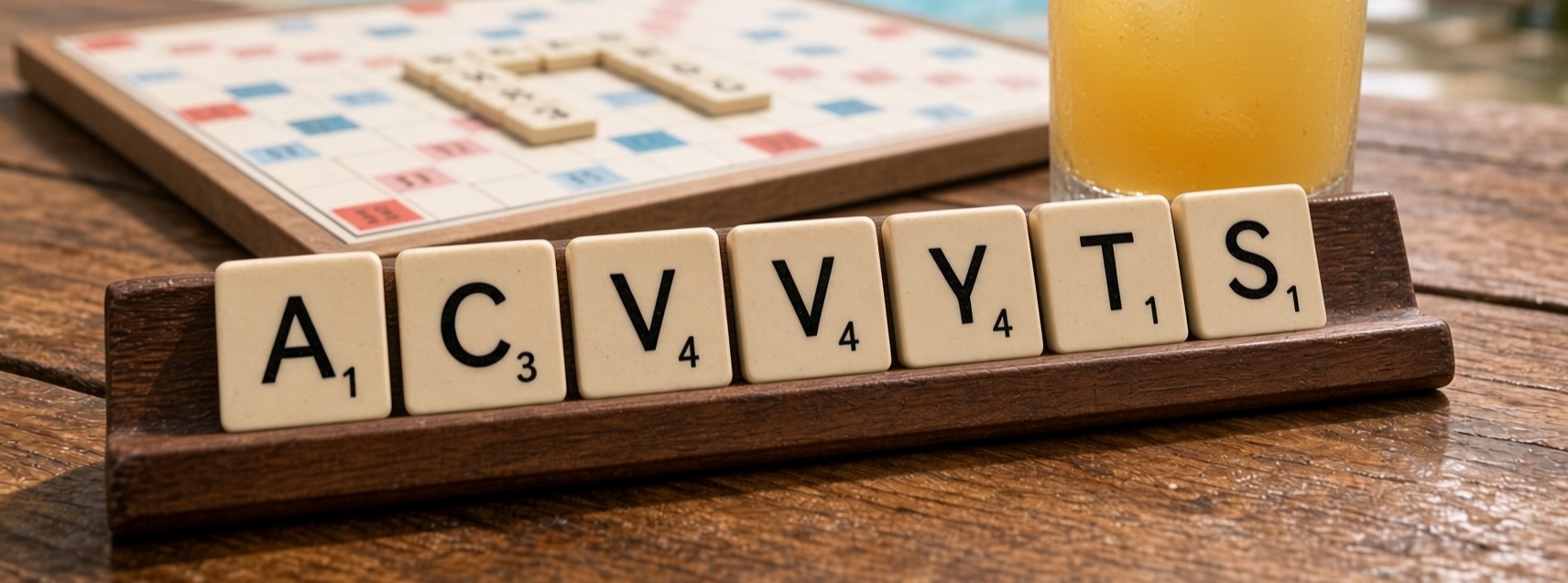
1. Executive Summary — Clear Them Before They Lock the Rack
Some tiles bend.
Some tiles break the rack.
C and V cannot parallel-play at all under NWL.
Y can, but only through a short list of exits.
Hold them too long and the board closes around you.
Dump early. Dump clean. Restore rack freedom.
Wordmaster.pro examines why C, V and Y create rack lockdowns, how their parallel-play limits differ, and which short, high-utility words clear them before the board tightens. The goal is practical: help players spot the choke point early, spend the tile efficiently, and protect bingo shape instead of carrying a rigid consonant into a dead endgame.
This is not about memorizing every word that contains C, V or Y. It is about recognizing three different kinds of danger and answering each with the right dumps.
2. Why These Three Letters Cause Choke Points
Parallel plays are the oxygen of midgame and endgame Scrabble. When you place a word beside another word, every overlapping pair must form a legal word — usually a two-letter word.
That is where the choke begins.
The C problem — zero two-letter exits in NWL
In NWL2023, there are no valid two-letter words containing C.
Not CA.
Not CE.
Not CO.
Not CU.
Not CI.
C shares this problem with V. Every C play needs at least a three-letter word except CH (CSW) unless you are hooking onto an existing board letter in a longer construction.
That makes C one of the most underrated rack killers in North American play. Its face value is only three points, so players underestimate it. But a held C quietly destroys parallel options and compresses your leave.
The V problem — zero two-letter exits in both lexicons
In both NWL2023 and CSW24, there are no valid two-letter words containing V.
Not VA.
Not VE.
Not VI.
Not VO.
Not VU.
V is the classic rack lockdown tile. Its face value is four points, but its leave penalty is severe because it cannot form any two-letter cross on a crowded board.
The Y problem — limited two-letter exits
Y is more flexible than C or V, but still rigid.
In NWL2023, Y participates in only seven two-letter words:
| Word | Role |
|---|---|
| AY | Affirmative vote |
| BY | Near / beside |
| MY | Possessive |
| OY | Exclamation of dismay |
| YA | You (informal) |
| YE | You (archaic) |
| YO | Call / greeting |
That is better than C or V — but still narrow. If the board edge next to your intended play does not support one of those seven crosses, Y becomes awkward fast.
Y also likes to sit at the end of words. That can create terminal blocks: the word looks finished, extension options shrink, and the tile keeps consuming rack space until you force it out.
Quick comparison
| Factor | C | V | Y |
|---|---|---|---|
| Face value | 3 | 4 | 4 |
| Tiles in bag | 2 | 2 | 2 |
| NWL 2-letter partners | None | None | AY, BY, MY, OY, YA, YE, YO |
| Minimum standalone play (NWL) | 3 letters | 3 letters | 2 letters |
| Parallel flexibility | Extremely low | Extremely low | Limited |
| Main failure mode | Cannot form 2-letter crosses | Cannot form 2-letter crosses | Needs specific partners; often ends words |
| Dump priority | High | Very high | High when leave is otherwise strong |
C and V are the zero-exit pair. Y is the narrow-exit letter.
3. The C Clearance Doctrine
Treat C like V: a temporary guest, not a long-term investment.
Rule 1: Spend C while three-letter lanes still exist
A modest COW, CAT, CAN, or COT that removes C and restores rack balance often beats a higher-scoring play that keeps C for “next turn.”
Rule 2: C pairs naturally with O and A
Many of the easiest C dumps use O or A as the anchor vowel. If your rack has C plus O, search COW, COT, COB, COD, COG, CON, COP, COR, COS, COX, COY immediately.
Rule 3: Do not underestimate C because it is only three points
Players hold C longer than V because it feels cheaper. That is a mistake. The rack penalty comes from geometry, not face value.
4. High-Utility C Dump Words (NWL-Verified)
These are the emergency valves. Learn them as clearance tools, not trivia.
Essential three-letter C dumps
| Word | Why it helps |
|---|---|
| COW | Classic C+O dump; extremely common letters. |
| CAT | Simple A/T pairing; easy placement. |
| CAN | Flexible; works on many boards. |
| CAR | Strong when R is spare. |
| COT | Reliable O/T clearance. |
| CUP | Uses U without needing a long word. |
| CUT | Common letters; strong midgame dump. |
| COB | Short O/B clearance. |
| COD | Clean O/D dump. |
| COG | Clears C and G together. |
| CON | Short O/N dump. |
| COP | Useful when P is spare. |
| COR | O/R pairing; common in midgame. |
| COS | Leaves S on board; can help future hooks. |
| COX | Strong scoring dump when X is available. |
| COY | Clears C and Y together. |
| ICE | Terminal-C dump when C sits at the end. |
| ARC | Another terminal-C shape. |
Useful four-letter C clearances
Start with these high-frequency shapes:
- CITY, CLAY, COLD, CONE, COVE, CRAB, CREW, CROP, CURE, CURL, CART, CARE, CASE, CAST, COST, COAT, COIN, CORE, CORN, CORD
CITY deserves special attention: it clears C and Y together.
5. The V Clearance Doctrine
Treat V as a temporary guest, not a long-term investment.
Rule 1: Prefer a clean three-letter dump over a pretty leave
A modest VIA, VIE, VET, or VOW that removes V and restores rack balance often beats a higher-scoring play that keeps V for “next turn.”
Next turn is where boards close.
Rule 2: Aim for premium squares when the dump is short
Because V needs three letters minimum, look for Double Letter or Triple Letter placements under the V itself. A short dump can still pay if the tile lands on a multiplier.
Rule 3: Do not fish forever for a perfect V bingo
Holding V while waiting for an elegant seven-letter word is a common trap. If the board is open now and clogged later, spend the V while you can still place a three- or four-letter word.
6. High-Utility V Dump Words (NWL-Verified)
Essential three-letter V dumps
| Word | Why it helps |
|---|---|
| VIA | Common vowels; easy placement; classic V escape. |
| VIE | Uses I and E; strong midgame dump. |
| VET | Simple, frequent letters; reliable clearance. |
| VEX | High face value; excellent if X is also present. |
| VOW | Clears V and another four-point tile together. |
| VOX | Strong scoring dump when X is available. |
| VAX | Short power dump; NWL-valid. |
| VAV | Hebrew letter; useful when both V tiles arrive. |
| VUG | Clears V with awkward U; rock-cavity word. |
| VOE | Small bay; clean O/E dump. |
| VEE | Letter-name dump for double-E racks. |
| VIM | Energy; easy I/M pairing. |
| VIS | Force / strength; S helps leave quality after play. |
| REV | V at the end; excellent when R and E are free. |
| DEV | Short terminal-V dump. |
Useful four-letter V clearances
- AVE, AVOW, LAVE, RAVE, SAVE, VASE, VEAL, VEER, VEIL, VEIN, VENT, VERB, VERT, VERY, VETO, VIAL, VIBE, VICE, VIDE, VILE, VINE, VISE, VOID, VOLE, VOTE
Double-V emergencies
If both V tiles appear, prioritize:
- VAV
- VIVID
- VALVE
7. The Y Clearance Doctrine
Y is not as toxic as C or V, but it becomes dangerous when it sits beside already awkward tiles.
Rule 1: Use the seven two-letter exits whenever they score or unblock
If the board offers AY, BY, MY, OY, YA, YE, or YO, take them when they remove Y cleanly and unlock a better leave.
Rule 2: Prefer short Y words over romantic long holds
Holding Y “because it might make a bingo later” is fine only when the rest of the rack is already excellent. If the rack is mixed or the board is closing, dump.
Rule 3: Watch terminal Y carefully
A word ending in Y often resists easy extension and creates fewer forward hooks. If you must end a word with Y, make sure the score justifies the geometry.
8. High-Utility Y Dump Words (NWL-Verified)
The seven two-letter Y words
AY, BY, MY, OY, YA, YE, YO
Strong three-letter Y dumps
| Word | Why it helps |
|---|---|
| AYE | Extends AY; easy affirmative dump |
| IVY | Clears I and Y together |
| SKY | Useful with K; consonant-heavy relief |
| WHY | Strong face value; clears W and Y |
| YAK | Simple A/K pairing |
| YAM | Soft vowel dump with M |
| YAW | Clears W and Y |
| YEA | Vowel-friendly |
| YEN | Common letters; easy fit |
| YEP | Casual dump with P |
| YES | Extremely flexible |
| YET | Extremely flexible |
| YOU | Clears awkward U with Y |
| YOW | Another W/Y relief valve |
Useful four-letter Y clearances
- ARMY, BUSY, CITY, DUTY, EASY, ENVY, GREY, HOLY, LAZY, MANY, ONLY, PLAY, PRAY, STAY, THEY, TRAY, VERY, YARD, YARN, YEAR, YOUR
9. When C, V and Y Appear Together
Multi-choke racks are common because C, V and Y are all relatively inflexible. When two or three appear together, search double- and triple-clearance words before anything fancy.
Priority escapes that spend multiple choke tiles
| Word | Letters cleared | Why it matters |
|---|---|---|
| CITY | C, I, T, Y | Best everyday C+Y clearance |
| COY | C, O, Y | Shortest C+Y dump |
| VERY | V, E, R, Y | Best everyday V+Y clearance |
| IVY | I, V, Y | Short triple using V and Y |
| VYING | V, Y, I, N, G | Strong mid-length V+Y clearance |
| ENVY | E, N, V, Y | Common natural V+Y dump |
| COVE | C, O, V, E | Useful when C and V both present |
| CAVY | C, A, V, Y | Clears three choke tiles in four letters |
Decision order when multiple choke tiles appear
- Can I play a word that clears two or three choke tiles at once?
- If not, dump V first — it has the highest leave penalty.
- Then dump C with a three-letter word.
- Then dump Y through a two-letter or three-letter exit.
- If the board is closing and nothing fits, exchange the worst choke tile before it becomes unplayable.
Never carry C, V and Y deep into a closed endgame unless the score gap forces desperation.
10. Parallel-Play Reality Check
Why C and V kill parallel packing
In parallel-column or parallel-row scoring, every adjacent pair must be legal. Because C and V form no two-letter words under NWL, any parallel involving either letter requires a longer overlapping construction. That is rare on dense boards.
So C and V are anti-parallel by nature.
Why Y only half-survives parallel packing
Y can participate in parallels, but only through:
AY, BY, MY, OY, YA, YE, YO
If your adjacent letters are C, D, F, G, H, J, K, L, N, P, R, S, T, U, V, W, X, or Z, Y cannot form a two-letter cross with them under NWL.
That is why Y often looks playable in isolation and still fails when you try to pack it tightly beside an existing word.
The zero-exit club
Under NWL, only C and V belong to the zero-exit club — no two-letter words at all. Learn to treat them as a pair. When you draw one, you already know the other’s geometry problem.
11. Case Studies
Case Study A — The C Hold That Looked Harmless
Rack: A E R S T C N
Board: open early midgame
Player decision: skips CAN / CAR / COT to protect a near-bingo leave including C
Next two turns: board lanes tighten; no three-letter C slot remains
Result: forced exchange or low-value dump under pressure
Diagnosis: C felt cheap at three points. The geometry cost was not cheap at all.
Case Study B — The V Hold That Died
Rack: A E R S T V N
Board: open early midgame
Player decision: skips VET / VAR options to protect a near-bingo leave including V
Next two turns: board lanes tighten; no three-letter V slot remains
Result: forced exchange or low-value dump under pressure
Diagnosis: Same mistake, higher face value. V needed out while three-letter lanes were still alive.
Case Study C — The Triple Clearance
Rack: E I T C V Y A
Play: CITY through an open lane
Leave: E V A
Result: C and Y gone; only V remains; rack dramatically healthier
Diagnosis: Spending four tiles to remove two choke letters can be correct even when a longer word scores slightly more but keeps both C and Y.
Case Study D — The Y Terminal Trap
Rack: B O Y L A T E
Player decision: plays a word ending in Y for modest points, leaving awkward consonants
Result: the new terminal Y blocks extension; opponent hooks elsewhere
Diagnosis: Clearing Y is good. Creating a dead terminal edge is not. Prefer Y dumps that leave future hooks when the score difference is small.
12. CSW / International Notes
Under CSW24, the picture shifts slightly:
| Letter | NWL | CSW change |
|---|---|---|
| C | No 2-letter words | CH becomes valid — C gains its first two-letter exit |
| V | No 2-letter words | Still no 2-letter words |
| Y | Seven 2-letter words | Adds KY, NY, YU |
For NWL players moving to CSW, CH is the single most important new parallel tool. It is also one of the words NWL-trained players miss most often over the board, because C has never had a two-letter partner in domestic play.
V remains the hardest tile in both lexicons. C becomes noticeably easier internationally. Y becomes slightly easier.
13. Training Routine
Drill 1 — C three-letter flash
COW CAT CAN CAR COT CUP CUT COB COD COG CON COP COR COS COX COY ICE ARC
Drill 2 — V three-letter flash
VIA VIE VET VEX VOW VOX VAX VAV VUG VOE VEE VIM VIS REV DEV
Drill 3 — Y two-letter flash
AY BY MY OY YA YE YO
Add CSW extras if you play internationally: KY NY YU
Drill 4 — Multi-choke clearance
Shuffle racks that include two or three of C, V and Y. Force yourself to find:
- a word that clears two or more choke tiles
- a word that clears only the worst one
- the healthiest leave after each option
Drill 5 — Board vision, not just anagrams
For every candidate dump, ask:
- Does this create a dead terminal?
- Does this open a Triple Word lane for the opponent?
- Am I clearing the choke tile or just rearranging the problem?
14. The C/V/Y Choke-Point Checklist
- Do I hold C or V? If yes, search three-letter dumps immediately — they share the zero-exit problem.
- Do I hold Y? If yes, check the seven NWL two-letter exits first.
- Do I hold two or more choke tiles? Search CITY, COY, VERY, IVY, ENVY, VYING, COVE, CAVY before anything fancy.
- Is the board still open enough for a short three-letter word? Spend C or V now.
- Am I keeping C only because it is “only three points”? Recalculate — geometry matters more than face value.
- Am I keeping V only to protect a “pretty” leave? Recalculate.
- Will a Y play end a word and kill extension? Prefer a better landing if score is close.
- Can C or V land on a letter premium during a short dump? Take the points.
- Are both C tiles or both V tiles on the rack? Prioritize double-letter escapes.
- Is the bag nearly empty and the board closed? Exchange before the tile becomes unplayable.
- After clearing C/V/Y, rebuild toward balanced stems — do not immediately re-hoard the next awkward consonant.
Final Takeaway
C, V and Y are not dramatic power tiles. They are quiet rack killers.
C and V share the worst problem: under NWL, neither can form a two-letter cross. Every play needs room, vowels, and a legal three-letter shape. Y is freer, but only through a short list of partners, and it loves ending words in ways that freeze the board.
The winning habit is simple:
See the choke early.
Clear the rigid tile while lanes still exist.
Protect the rest of the rack.
Return to flexible letters.
Do not admire a three- or four-point consonant while your bingo chances quietly disappear.
Leave a Reply