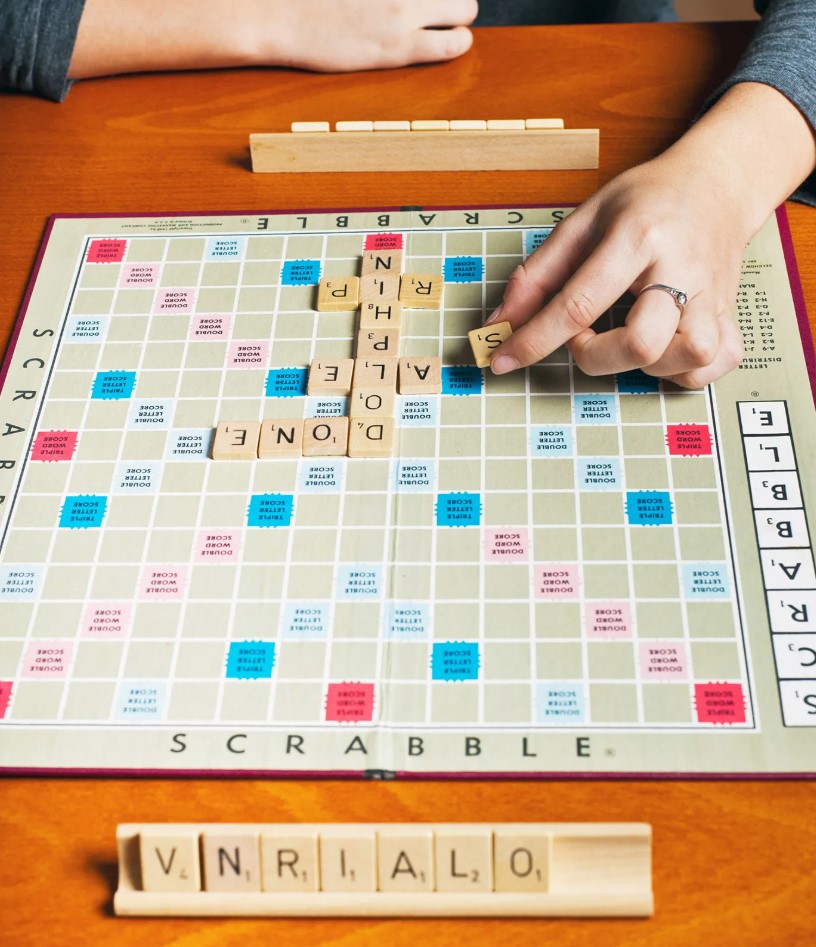
1. Executive Summary — The Spatial Choke
A Triple Word Score is not a prize.
It is a weapon.
Leave the wrong gap and you arm your opponent.
Leave a 3-tile gap behind a hard anchor and you choke the lane.
Amateurs open tracks for points.
Masters engineer deficits.
Count. Seal. Deny. Control.
Wordmaster.pro analyzes the absolute mathematical spatial extension deficit of defensive layout grids in order to provide competitive players with an unshakeable offensive toolkit that spikes turn metrics without exposing dangerous open pathways to the opponent.
Blocking triple word scores is the highest-leverage form of scrabble board positioning. One open track beside a Triple Word Score (TWS) can swing forty to eighty points in a single reply. That is not variance. That is geometry.
Why open tracks near TWS create point-swing disasters
| Gap left to TWS | Typical opponent path | Swing risk |
|---|---|---|
| 1 empty square | Easy 2-letter bridge | Extreme |
| 2 empty squares | Dense 3-letter bridges | Severe |
| 3 empty squares | Restricted 4-letter bridges | Controllable |
| 4+ empty squares | Flexible longer bridges / bingos | Situational |
A soft vowel two spaces from a corner TWS is an invitation. A rigid V three spaces from that same TWS is a trap. That is the spatial choke.
This guide is the operating system for words with friends multiplier defense, wordfeud lane blocking, how to stop triple words, and spatial layout traps under clock.
2. The Mathematics of Gap Engineering: The SED Index
Spatial Extension Deficit (SED)
Spatial Extension Deficit (SED) measures how severely a chosen gap reduces an opponent’s legal bridging options into a premium square.
SED = 1 − (Legal Bridge Plays at Gap G ÷ Legal Bridge Plays at Gap G*)Where G* is the most dangerous nearby alternative — usually a 2-tile gap.
In practical midgame terms:
- A 2-tile gap opens the huge 3-letter bridge set.
- A 3-tile gap forces a 4-letter bridge that must also match your terminal anchor.
- That dual constraint — length and terminal identity — collapses candidate plays.
Tournament-usable estimate:
3-tile gap success rate ≈ 20–35% of 2-tile gap success rate
SED ≈ 0.65–0.80
That is the “up to ~75% reduction” engine behind elite choke point spacing.
Why the 3-tile gap is the sticky zone
Define the lane:
[Your Anchor] · · · [TWS]
     ↑        1 2 3
Three empties stand between your letter and the Triple Word Score. To extend from your anchor onto the TWS in one play, the opponent must produce a 4-letter word whose first letter is your anchor (or a mirrored extension using your anchor as the terminal).
That is far harder than:
[Anchor] · · [TWS]   → 3-letter bridge set
[Anchor] · [TWS]     → 2-letter bridge set
Combinatorial squeeze
Let:
- T3 = playable 3-letter bridges from a soft vowel anchor
- T4(L) = playable 4-letter bridges starting with specific letter L
For soft anchors (A/E/I), T3 is enormous.
For rigid anchors (V/J/Q/C/W), T4(L) is tiny.
Opponent Hit Probability ∝ (Bridge Inventory) × (Rack Fit Chance)Force both inventory and fit downward and the lane dies.
Grid Gap Risk Architecture
Defensive Safety Grade: A = preferred trap · B = playable · C = dangerous · F = gift.
| Gap Distance to TWS | Permutations Allowed | Opponent Success Probability | Potential Point Yield | Defensive Safety Grade |
|---|---|---|---|---|
| 1 empty | 2-letter bridges | Very high | 30–70+ | F |
| 2 empties | Dense 3-letter bridges | High | 35–80+ | C |
| 3 empties | Restricted 4-letter bridges | Low–moderate | 20–50 if hit | A |
| 4 empties | Broader 5-letter / bingo paths | Moderate | 40–100+ | B |
| 5+ empties | Rare single-turn bridges | Lower short-term | Situational | B |
The 3-tile gap is the defensive sweet spot: tight enough to choke, not so open that long bingos casually stroll in.
3. The 3-Tile Trap Directory: Terminal Anchor Selection
Your trailing letter is the trap’s lock. Choose it with intent.
3A. The High-Risk Openers — Vowels A · E · I
Leaving A, E, or I exactly three spaces from a TWS looks tidy. It is often a liability.
Why vowels fail as 3-tile anchors
Four-letter words beginning with A/E/I are abundant. Verb and noun families explode:
- A- stems: many everyday fours
- E- stems: densest short English set
- I- stems: still far too flexible
The gap length is correct. The anchor identity is wrong. Multiplier denial ratio collapses because bridge inventory stays high.
Grid coordinate spacing
On a standard 15×15 Scrabble board:
- Corner TWS sit at A1, A15, O1, O15
- Edge TWS sit at A8, H1, H15, O8
If you end a horizontal word three empties west of O8, your terminal occupies column K on row 8:
K(anchor) L · M · N · O(TWS)Same counting applies vertically toward H1 / H15.
Tile-tracking shift
When you leave a vowel 3-gap:
- Track opponent S, blanks, and common four-letter hooks immediately
- Assume the lane is semi-live
- Plan to re-seal next turn if you cannot cash it yourself
Net Turn Value across two turns
NTV₂ = Your Score₀ + Your Expected Score₁
       − Opponent Expected TWS Conversion
A vowel 3-gap often produces:
NTV₂ ≈ modest now − large expected opponent swingReject unless your immediate score is overwhelming and bag tracking says conversion is unlikely.
3B. The Fortified Walls — Rigid Consonants V · C · J · Q · W
These terminals freeze lanes. They are the gold standard of blocking triple word scores.
| Anchor | Freeze quality | Why it works |
|---|---|---|
| V | Elite | Sparse legal 4-letter starters |
| J | Elite | Tiny bridge inventory |
| Q | Elite | Usually needs U; rare bridges |
| C | Strong | Restricted starts; awkward hooks |
| W | Strong | Limited clean 4-letter extensions |
Exact spacing rule
Build so the rigid letter sits here:
[Rigid Anchor] · · · [TWS]Not two empties. Not four. Three.
Tile-tracking priorities
After planting a fortified wall:
- Note whether opponent still holds likely bridge letters.
- Watch blanks — blanks dissolve many freezes.
- If both blanks are gone, the V/J/Q wall becomes near-deterministic.
- Keep one eye on alternate approach lanes to the same TWS.
NTV impact
NTV₂ ≈ (Your solid score now)
      + (Opponent forced off-lane weak reply)
      + (Your retained TWS option next turn)
Fortified 3-gaps convert defense into delayed offense. That is quadrant control.
3C. The Fluid Trap Triggers — Intermediate Anchors F · G · K · P
These letters are not pure freezes. They are bait engines.
| Anchor | Trap style | Ideal use |
|---|---|---|
| F | Semi-restrictive | Induce awkward replies |
| G | Semi-restrictive | Force rack breaks |
| K | Sharper restriction | Strong midgame seal |
| P | Semi-restrictive | Corner-lane pressure |
How the bait works
You leave a legal-looking 3-gap ending in F/G/K/P. The opponent can sometimes bridge it — but often only with a low-equity rack burn. If they refuse, they play elsewhere for a weak score. If they take a poor bridge, they may still leave the TWS under-exploited or hand you a counter-lane.
Spacing and timing
Use fluid triggers when:
- You cannot naturally end on V/J/Q/C/W
- You need score now plus partial denial
- Bag tracking suggests opponent lacks clean bridge tiles
Tile-tracking shift
Fluid traps require active tracking:
- Count remaining S and vowels that complete common fours
- Recalculate after every draw
- Be ready to occupy the TWS yourself on the next turn
NTV impact
NTV₂ ≈ Your Score₀
      + Probability(Opponent Weak Reply) × Gain
      + Probability(You Cash TWS Next) × TWS Value
      − Probability(Opponent Perfect Bridge) × Loss
Fluid anchors maximize expected value when perfect freezes are unavailable.
Directory synthesis — how to stop triple words
| Anchor class | Letters | Default verdict |
|---|---|---|
| High-risk openers | A E I (also O/U) | Avoid as 3-gap terminals |
| Fortified walls | V J Q C W | Preferred seals |
| Fluid triggers | F G K P | Conditional bait |
| Soft consonants (S/R/D/T/N) | common glue | Dangerous near TWS |
4. Spatial Geometry: Calculating Overlapping Quadrants
4.1 The 3-Space Measuring Tape
Objective: Count empties between your new terminal and the board-edge premium before you confirm the play.
Protocol
- Identify the nearest TWS on the same row or column.
- Put your finger on your intended terminal cell.
- Count empty squares toward the TWS.
- Stop when you hit the TWS cell.
- Confirm the count equals three.
Visual schematic
| Cell | 1 | 2 | 3 | 4 | 5 |
| Content | V | · | · | · | TWS |
| Count | Anchor | 1 | 2 | 3 | Premium |
If your count is 2, you are in the danger band.
If your count is 3 behind V/J/Q/C/W, you are in the trap band.
4.2 The Corner Trap Lock
Objective: Use 3-tile gaps in outer quadrants where the border already removes escape routes.
Corners are natural choke points. One axis dies at the edge. That raises SED automatically.
Protocol
- Prefer setting 3-gaps toward corner TWS rather than mid-edge TWS when both are available.
- End on a fortified consonant facing the corner.
- Ensure no alternate parallel path reaches the same TWS around your wall.
- Recheck the perpendicular approach — corners still have two inbound axes.
Corner advantage
| Feature | Effect |
|---|---|
| Board border | Removes one extension direction |
| Narrow approach | Fewer legal geometries |
| Rigid anchor | Collapses remaining bridges |
| Combined | Highest quadrant control |
Wordfeud lane blocking and words with friends multiplier defense follow the same corner logic even when premium coordinates differ.
4.3 Hook Shield Overlays
Objective: Pair the 3-tile gap with an un-hookable root so the opponent gets zero purchase on the column.
A gap alone is incomplete. If your word takes easy front/back hooks in the opposite direction, the opponent ignores your trap and detonates elsewhere.
Protocol
- Choose a main word with hard terminals on both ends when possible.
- Point the fortified terminal at the TWS.
- Keep the opposite terminal away from soft hooks (S, vowels).
- If needed, add a short perpendicular overlay that occupies the approach lane without opening new premiums.
Hook shield ranking
| Setup | Quality |
|---|---|
| Rigid 3-gap + dead opposite terminal | Excellent |
| Rigid 3-gap + soft opposite terminal | Medium |
| Soft vowel 3-gap + soft hooks | Poor |
| 2-gap anything | Reject near live TWS |
5. Case Studies: The Greedy Over-Reach vs. The Deterministic SED Trap
Case Study A — The Greedy Over-Reach
Board: live track toward a Triple Word Score.
Player decision: Push a scoring word that leaves a 2-tile gap, assuming “they won’t have a 3-letter.”
Sequence
- First player scores decently.
- Two empties remain before TWS.
- Opponent drops a high-scoring parallel X construction through the lane.
- TWS detonates for a ~60-point swing.
Autopsy
| Metric | Result |
|---|---|
| Gap left | 2 empties |
| Assumed safety | False |
| Opponent conversion | High-probability 3-letter / short bridge family |
| Net result | Defensive collapse |
Diagnosis: Greedy over-reach. The player counted their own points and ignored spatial extension deficit. A 2-gap near TWS is not a fence. It is a runway.
Case Study B — The Deterministic SED Trap
Board: same quadrant threat.
Grandmaster decision: Play a tight word that creates a strict 3-tile gap ending on V.
| Anchor | Gap | Gap | Gap | Premium | |
| Lane | V | · | · | · | TWS |
| Effect | Opponent needs a rare legal 4-letter V-bridge · lane effectively frozen | ||||
Results
| Metric | Result |
|---|---|
| Gap left | 3 empties |
| Terminal | V |
| Opponent reply | Forced rack-break for ~8 elsewhere |
| TWS status | Denied |
| Board control | Retained |
Diagnosis: Deterministic SED trap. Same premium. Opposite geometry. Absolute lane denial without occupying the TWS yet.
Extraction principle: A moderate-scoring play that installs a V-anchored 3-gap beats a higher-scoring play that leaves a 2-gap whenever the opponent’s TWS conversion exceeds the point gap.
6. The Pre-Play Grid Count Checklist
Run this count before every confirmation.
1. Locate premiums
- Find all reachable TWS in the local quadrant.
- Mark live lanes on the same row/column as your intended word.
2. Measure every gap you create
- Count empties from each new terminal to each nearby TWS.
- Speak the number silently: one, two, three.
- Treat 2 as danger. Treat 1 as emergency.
3. Grade the anchor
- Vowel terminal near TWS? Reject or re-anagram.
- Soft glue letter (S/R/D/N/T)? Dangerous.
- Fluid trap (F/G/K/P)? Accept only with tracking.
- Fortified wall (V/J/Q/C/W)? Preferred.
4. Check alternate approaches
- Can opponent reach the same TWS on the perpendicular axis?
- Does your play open a second lane while sealing the first?
- If yes, recalculate total multiplier denial ratio.
5. Price the two-turn horizon
- Estimate opponent’s best TWS hit if you leave this geometry.
- Estimate your next-turn cash-out if they cannot hit.
- Choose the higher NTV₂, not the higher immediate score.
Ultra-scannable final gate
- Any TWS within five squares of my new letters?
- Exact empty count to that TWS?
- Is the count 3?
- Is the anchor rigid?
- Are opposite hooks dead?
- Alternate lane still open?
- If any answer fails, restack the word.
Final operating rule
Triple Word Scores punish lazy spacing.
Spatial extension deficit is engineered, not hoped for.
Choke point spacing of three empties behind a hard letter is the default seal.
Quadrant control beats greedy over-reach.
Scrabble board positioning is counted one square at a time.
Before you play, count the gap.
If it is two, you are gifting.
If it is three behind V, you are trapping.
Deny the lane. Keep the board.
Leave a Reply