Executive Summary
The ultimate dopamine hit in any word game is executing a high-scoring, flashy play that sends your point total soaring. However, unseasoned players fail to realize that a massive 70-point move can frequently act as a Trojan horse. In digital environments where opponents possess symmetrical access to tools like wordmaster.pro, the value of a play is never absolute—it is relative to the counter-play it permits. This article examines the hidden dangers of the “greedy play,” demonstrating how dropping a long word across premium squares can inadvertently open up lethal Triple Word Score lanes or highly accessible “bingo” lanes. True mastery requires looking past individual turn scores and evaluating the net point differential across multiple turns.

1. The Psychology of the High-Scoring Blindspot
When a player uncovers a 70-point word using an unscrambler, a psychological blindspot immediately forms. The urge to harvest an immediate double-digit reward overrides long-term tactical caution. Players instinctively lock onto the immediate jump on the scoreboard, blinding themselves to the physical state of the grid. This emotional vulnerability is precisely what veteran players exploit, treating your high-scoring word as a stepping stone for their own massive ambush.
2. The Mechanics of the “Bingo Lane” Exposure
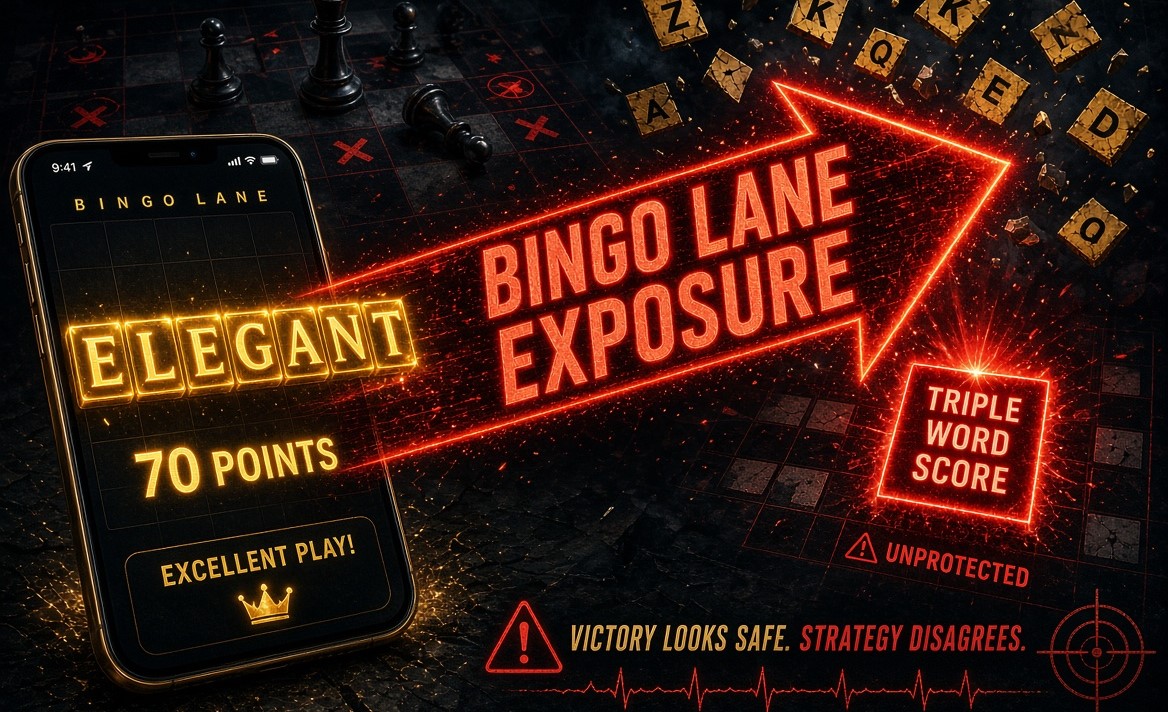
A 70-point move usually requires playing six or seven tiles across a vast stretch of the board. While clearing out your rack feels productive, stretching a word across the grid creates a brand-new highway of open vectors. If the tail or head of your beautiful new word stops exactly seven spaces away from a Triple Word Score, you have just laid down a perfect “bingo lane.” An opponent using a digital helper will effortlessly scan their rack and drop a devastating counter-word right onto that premium real estate.
3. Calculating the Net Point Differential
To evaluate the true worth of a move, you must look at the net transaction rather than the gross score. If you play a spectacular 70-point word, but that exact placement allows your opponent to immediately retaliate with an unblockable 85-point response, your net score for that sequence is actually negative 15 points. Conversely, making a quiet, defensive 30-point play that limits your opponent to a meager 12-point tile dump yields a positive net score of 18 points. The smaller move is mathematically superior.
4. Symmetrical Information and the Open-Board Vulnerability
In localized living-room environments, opening up a high-scoring lane was a calculated gamble based on whether your opponent had the vocabulary to find a matching word. In the modern online ecosystem, that gamble is obsolete. Assuming your opponent is utilizing a tool like wordmaster.pro means accepting that any open lane will be exploited. When tool access is symmetrical, exposing a premium square is no longer a risk—it is an outright concession of points.
5. Evaluating the Fragile Post-Bingo Rack
Scoring 70 points often requires playing a “bingo” (using all seven tiles). While the 50-point bonus is incredibly helpful, drawing an entirely new hand of seven random tiles introduces massive statistical variance. If your massive play leaves you with an unplayable, volatile mix of new letters right when the board is wide open, you have forfeited all control. High-level strategy involves keeping the board tight and restricted whenever your own rack state is highly unpredictable.
6. Managing Momentum and the Scoreboard Buffer
Your willingness to play high-risk, 70-point words should always be dictated by the current scoreboard. If you hold a comfortable 80-point lead, playing a sprawling, volatile word is a massive tactical error because it introduces the chaos your opponent needs to mount a comeback. When you are ahead, your goal is to minimize variance by closing lanes. Save the risky, explosive 70-point openings for when you are trailing and desperately need to inject volatility into the game geometry.
7. The Art of the Bait-and-Switch Play
Advanced players occasionally open up a high-scoring lane on purpose, but only as a calculated trap. They will drop a solid word that looks like a defensive mistake, inviting the opponent to rush in and claim a premium square. However, the baiting player has already calculated the exact letters remaining in the bag and balanced their own rack leave to guarantee they can execute an even larger counter-attack on the very next turn. If you cannot see the counter-trap, you are the one being baited.
8. Designing for Symmetrical Board Control
This tension between greedy point accumulation and disciplined positioning highlights the inevitable trajectory of digital game design. Next-generation word games are moving toward systems where word discovery is fully transparent, building search engines directly into the match interface. In this type of equalized ecosystem, a 70-point move is instantly visible to both players. The skill ceiling elevates entirely to spatial engineering, challenging players to determine if a massive score is worth the structural vulnerability it creates on the map.
Take Home Conclusion
A beautiful 70-point play is only an asset if it preserves your long-term board dominance. Chasing raw numbers on an unscrambler list without mapping out your opponent’s immediate vectors of retaliation is a recipe for sudden defeat. True mastery means subordinating your ego to the mathematics of the net point differential. When you stop treating word games as a race to drop individual high-scoring bombs and start treating them as an intricate game of territorial denial, you unlock an entirely new level of competitive performance.
Leave a Reply