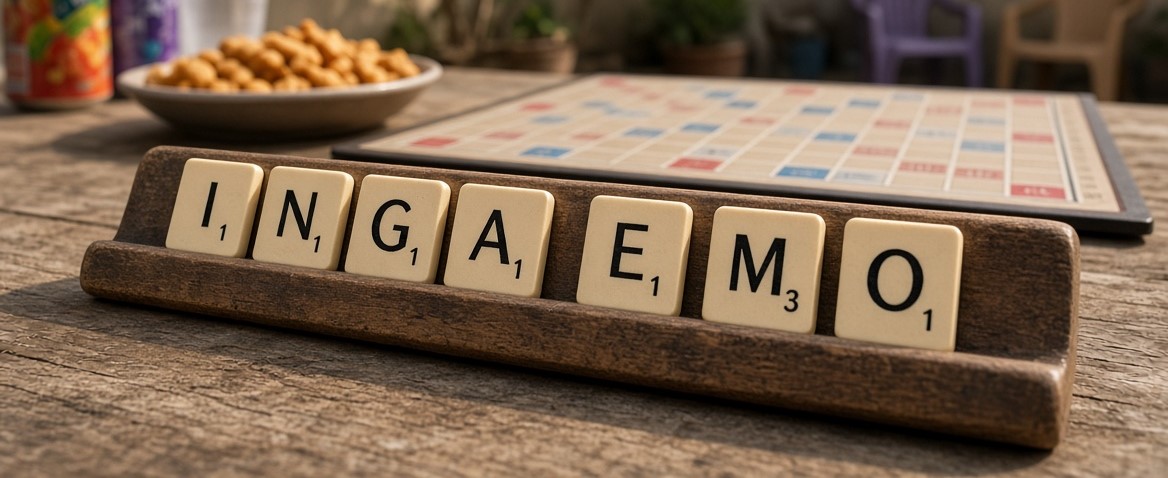
1. Executive Summary — Stop Reading the Rack as a Blur
Seven tiles can look like noise.
Noise burns clock.
Structure saves clock.
Pull the endings to one side.
Pull the beginnings to the other.
Let the middle reveal itself.
Wordmaster.pro examines how players can reduce rack clutter by physically grouping likely suffixes such as -ING, -ED, -EST, -ERS and likely prefixes such as RE-, DE-, UN- on their digital rack. The goal is not to force one exact play. It is to clear mental processing space, expose hidden word shapes faster, and help players make stronger scoring and bingo decisions under time pressure.
Most players make the same visual mistake: they stare at seven separate letters and try to solve the whole rack at once. That is harder than it needs to be.
Strong players often do something simpler. They partition the rack into three zones:
- Possible prefixes
- Flexible middle letters
- Possible suffixes
That one habit turns a chaotic rack into a working sentence fragment.
This article is not about memorizing thousands of words. It is about making your rack easier to read.
2. What Rack Partitioning Actually Means
Rack partitioning is the act of moving tiles into visual clusters before you start hunting for words.
Instead of looking at:
R E A D I N G
as seven loose tiles, you train yourself to see:
RE-AD-ING
That does not mean READING is always the answer. It means your eye has been given a useful frame.
Why this works
The brain struggles when too many possibilities compete at once. A raw rack offers:
- opening letters
- middle letters
- endings
- short dumps
- hooks
- bingo stems
all in one visual pile.
Partitioning reduces that mess.
When you isolate the likely ends, the middle letters become easier to test. Instead of asking, “What can all seven letters do?” you ask smaller questions:
- Can these two letters start something?
- Can these three letters end something?
- What belongs in the middle?
That is faster. It is also calmer.
3. The Two Families You Should See First
Suffix family
Suffixes are the letters that often sit at the end of a word.
Common examples worth physically grouping:
- -ING
- -ED
- -ER
- -ERS
- -EST
- -LY
- -ION when present
These are not guaranteed endings. They are visual shortcuts.
Prefix family
Prefixes are the letters that often sit at the front of a word.
Common examples worth grouping:
- RE-
- DE-
- UN-
- IN-
- OUT- when the rack supports it
- PRE- if the letters align
Again, the point is not rigid grammar. The point is pattern recognition.
The rack should become left edge, middle, right edge
When possible, arrange tiles like this:
| Zone | What goes there | What you are asking |
|---|---|---|
| Left | Possible prefixes like RE-, DE-, UN- | What can start cleanly? |
| Middle | Loose connector letters | What bridges the front and back? |
| Right | Possible suffixes like -ING, -ED, -EST, -ERS | What can finish strongly? |
Once the edges are tamed, the center usually becomes obvious.
4. How to Physically Arrange the Rack
This method works because it is physical. You are not just thinking differently. You are making the rack easier to scan.
Step 1: Pull obvious endings together
If you see:
I N GE DE RE S TE R S
slide them next to each other immediately.
Do not wait until the end of your search. The grouping itself is the search aid.
Step 2: Pull obvious beginnings together
If you see:
R ED EU NI N
test them at the opposite side of the rack.
Step 3: Leave the uncertain letters in the middle
These middle letters are often the real decision-makers:
- the consonant that turns
RE-into a word - the vowel that unlocks
-ING - the extra S that changes a dump into a bingo
Step 4: Re-scan as fragments, not as single tiles
Once grouped, stop reading letter by letter.
Start reading in chunks:
RE ... INGDE ... EDUN ... ERS... EST
That is how the rack stops feeling crowded.
5. Suffix Partitioning in Action
Suffixes are usually the easiest visual win because they are compact and familiar.
Example A — Seeing -ING
Raw rack:
G I N A R T E
Many players stare at this and feel overloaded. Partition it:
- possible suffix:
-ING - possible prefix/front material:
RE- - middle letter:
A
Now the rack becomes:
RE | A | ING
That instantly exposes REGAIN if the board wants six, and it sharpens your search for longer patterns if a hook is available.
Even when the final answer is not a full bingo, the rack becomes readable.
Example B — Seeing -ED
Raw rack:
D E A L T R S
Instead of scanning randomly, isolate:
- suffix:
-ED - remaining middle/front letters:
L A T R S
Now you can test:
- words ending in -ED
- words where D belongs elsewhere
- whether the rack is actually better treated as STARED plus an extra tile, or a short score plus a premium leave
The point is not that DE must be used as a suffix. The point is that testing that frame early removes guesswork.
Example C — Seeing -ERS or -EST
Raw rack:
E R S T A N I
This is a classic clutter rack because nearly every tile feels useful.
Group the endings first:
-ERS-EST
Then test what remains:
AINTANRATTIN
You are no longer solving seven tiles. You are solving a finish plus a core.
That is much easier on the clock.
6. Prefix Partitioning in Action
Prefixes are slightly trickier because they feel less final than suffixes. But they often reveal hidden plays, especially on open boards with hook lanes.
Example A — Seeing RE-
Raw rack:
R E T A I N S
This rack is already famous as a bingo family, but visual partitioning still helps.
Arrange it as:
- prefix:
RE- - middle:
TAIN - optional ending:
-S
Now you can scan front-first:
RETAINS- other rearrangements in the same family
The letters stop competing with each other.
Example B — Seeing DE-
Raw rack:
D E A R T H S
Slide DE- left and test the rest as body letters. This quickly reveals whether the rack supports a real front-loaded word or whether the D and E are better separated for a shorter score.
The value here is not certainty. It is early elimination.
Bad frames can be rejected quickly. Good ones deserve more time.
Example C — Seeing UN-
Raw rack:
U N T I E R S
Partition it as:
- prefix:
UN- - middle/right pool:
TIERS
You may not land on a front-loaded word every time, but grouping UN- stops those letters from floating uselessly in the middle where they create visual noise.
Sometimes partitioning reveals a real word. Sometimes it simply clears the view so a different play becomes obvious. Both outcomes are valuable.
7. Why This Helps Digital Rack Play Even More
On a physical board, players naturally touch and slide tiles. On a digital rack, many players do not.
That is a mistake.
If your app allows drag-and-drop rack movement, use it aggressively.
Digital racks create a false sense of order
Because the tiles sit in a neat line, players assume they are already organized. They are not. A neat line is not a useful structure.
Digital clutter is still clutter.
Movement creates memory
When you slide ING to the right or RE to the left, you create:
- a visual anchor
- a positional reminder
- a faster second scan
Your eye remembers where the likely endings live. That lowers search fatigue.
You should rearrange before you calculate
Many players do the reverse. They calculate first, then move tiles only when desperate.
Better habit:
- Rearrange the rack into likely chunks.
- Scan for clean fronts and backs.
- Test the middle.
- Only then compare scores.
That order saves time because it cuts noise before decision-making begins.
8. The Big Mistakes Players Make
Mistake 1: Treating every letter as equally important
They are not. Some letters are structural. Some are glue. Some are clutter. Partitioning helps you identify which is which.
Mistake 2: Overcommitting to the first fragment
Seeing -ING does not mean the play must end in -ING. It means -ING deserves to be tested early because it is information-rich.
Mistake 3: Never moving the rack
If your tiles stay in draw order all turn, you are giving away processing speed for free.
Mistake 4: Ignoring board fit
A beautiful prefix-suffix arrangement means nothing if the board only supports a short dump or a hook play. Rack order helps you search. It does not replace board geometry.
Mistake 5: Keeping dead fragments too long
Sometimes UN- is fake. Sometimes -ED leads nowhere. Break the frame and rebuild. Partitioning is a tool, not a prison.
9. A Training Routine That Actually Sticks
You can build this habit quickly if you practice the motion, not just the theory.
Drill 1 — The 3-second split
Take any seven-tile rack and give yourself three seconds to do one thing only:
- move a likely prefix left
- move a likely suffix right
No word search yet. Just structure.
Drill 2 — Name the middle
After splitting the rack, say out loud what the middle letters are doing:
- bridge
- blocker
- spare vowel
- extra consonant
This trains functional thinking instead of random scanning.
Drill 3 — Two arrangements per rack
For every practice rack, create two different partitions:
- a suffix-first version
- a prefix-first version
That prevents tunnel vision.
Drill 4 — Rebuild after every play
Do not leave the rack in the same order from turn to turn. Every fresh draw deserves a fresh partition.
10. Quick Reference: What to Isolate First
| Fragment | Usually isolate where? | Why it matters |
|---|---|---|
| -ING | Right edge | Very common ending; immediately reduces search space. |
| -ED | Right edge | Fast test for past-tense and adjective shapes. |
| -EST | Right edge | Useful for comparatives and dense finishing structures. |
| -ERS | Right edge | Adds plural and agent-ending possibilities. |
| RE- | Left edge | High-frequency front pair; often reveals hidden structure quickly. |
| DE- | Left edge | Worth testing early, then discarding if dead. |
| UN- | Left edge | Can unclog the rack or clarify that U/N should be split apart. |
11. The Prefix-Suffix Partitioning Checklist
- Scan the rack for any obvious -ING, -ED, -EST, -ERS ending.
- Slide that ending to the right side immediately.
- Scan for any obvious RE-, DE-, UN- beginning.
- Slide that beginning to the left side.
- Leave uncertain connectors in the middle.
- Re-read the rack as chunks, not individual letters.
- Test one suffix frame and one prefix frame before giving up.
- If both frames die, rebuild the rack and try a new partition.
- Compare the best word found with the best scoring board fit.
- Repeat this process every turn until it becomes automatic.
Final Takeaway
The goal of partitioning is not to be clever. It is to be clear.
When you isolate likely suffixes on one side and likely prefixes on the other, you stop forcing the brain to process seven competing letters at once. The rack becomes structured. The middle becomes readable. The search becomes faster.
That matters in casual play. It matters even more on the clock.
Do not stare at the rack as a blur.
Break off the front.
Break off the back.
Let the center speak.
Then make the play.


Leave a Reply