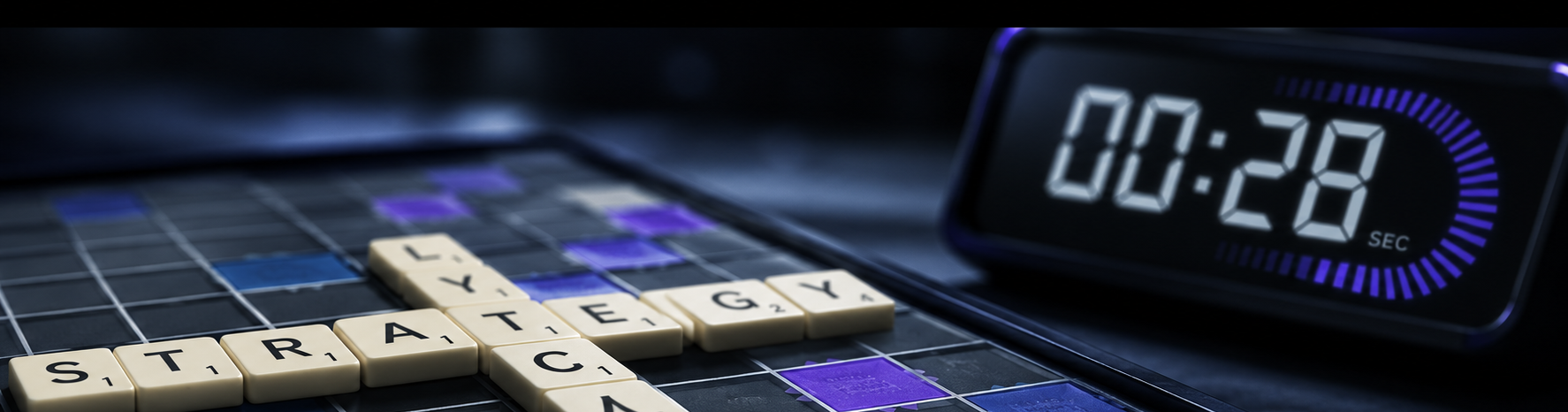
1. Executive Summary — The Cognitive Bottleneck
A 15-second blitz clock is not a softer Scrabble game.
It is a throughput contest under cognitive load.
Perfect plays that arrive late are worthless.
Precision means fast-enough precision.
Heuristics beat exhaustive search.
Digital blitz formats compress a full positional game into repeated micro-decisions. Whether your app enforces a hard 15-second turn timer or a similarly brutal countdown, the psychological pressure is identical: working memory floods, saccades scatter, and the fear of timeout overrides board literacy.
That pressure creates the Cognitive Bottleneck. Your brain can generate high-quality candidates. It cannot evaluate every candidate inside the clock. Players who refuse to accept that limit timeout, panic-dump, or burn their failsafe.
Points-Per-Second (PPS) Efficiency Ratio
Score moves by throughput, not raw ceiling:
PPS = Move Score ÷ Seconds Spent on the TurnProof under blitz constraints:
| Line | Score | Time | PPS | Clock outcome |
|---|---|---|---|---|
| Hunt for “perfect” 40 | 40 | 60s | 0.67 | Illegal/impossible on a 15s timer; timeout risk → 0 |
| Heuristic 28-point snap | 28 | 4s | 7.00 | Safe; leave time buffer; retain initiative |
Even if a platform allowed the 60-second hunt, the PPS gap is brutal:
7.00 ÷ 0.67 ≈ 10.4× throughput advantage for the heuristic lineUnder a hard 15-second constraint, the math collapses further. Spending 12–15 seconds chasing a maybe-bingo that never lands often yields:
PPS = 0 ÷ 15 = 0plus a tempo gift to the opponent.
Decision rule: Maximize expected PPS inside the remaining clock, not theoretical maximum score offline.
Speed Scrabble diagnostics train that substitution: visual-spatial heuristics, mental chunking, and pre-routing so calculation stays precise when latency is scarce.
2. The Mathematics of the Blitz Heuristic: Cognitive Chunking
Exhaustive anagram search scales factorially with rack complexity. Blitz play replaces that explosion with chunked recognition.
Visual Saccade Prioritization
A saccade is a rapid eye jump between fixation points. Under clock pressure, masters do not start on the rack. They prioritize board structure first.
Priority order (first glance):
- Open Triple Word / Double Word approaches.
- Loaded Triple Letter / Double Letter seats near power-tile paths.
- Dangerous corridors you must not feed.
- Only then: rack letters as raw material for those seats.
Why board-first beats rack-first:
- Rack-first invents beautiful words with nowhere legal to land.
- Board-first constrains the search space to playable geometry.
- Premium fixation in seconds 0–2 collapses illegal fantasies early.
Search space ≈ f(open premium seats × rack chunks)
not
Search space ≈ f(all rack permutations)
That is Visual Saccade Prioritization as throughput math: fewer candidates, higher PPS.
The 7-Letter Chunking Rule
Within the first 1.5 seconds of seeing your rack, isolate high-probability structural modules — do not shuffle seven independent letters.
Core chunks to lock instantly:
- Suffixes: -ING, -ED, -ER, -ERS, -IES
- Prefixes: RE-, UN-, IN-, DE-
- Stems: common consonant frames around one vowel hinge
Rule:
If a legal 3-letter module is visible, park it left or right immediately.
Solve the remaining 3–4 tiles — not all 7.
Example rack under clock: A E G I N R T
- Chaos read: 7! permutation fog.
- Chunk read: see -ING in ~1s → leftover
A E R T→ RATING / related shapes.
Chunking converts an intractable combinatorial burst into a two-step recognition task. That is why masters “find” bingos faster: they are not faster at brute force. They are faster at discarding non-chunks.
Decision-Latency Metrics
| Scan pattern | Time consumed | Average point yield | Cognitive stress index |
|---|---|---|---|
| Rack-first exhaustive shuffle | 10–15s+ | Volatile; high timeout rate | Extreme |
| Bingo or nothing hunt | 12–15s | 0–80 (bimodal disaster) | Extreme |
| Board-first premium saccades | 0–3s | Sets up high PPS options | Low |
| 7-letter chunking (suffix/prefix lock) | 1.5–4s | Strong when bingo exists | Low–Medium |
| Parallel 2/3-letter compound hunt | 3–7s | 18–35 typical | Low |
| Failsafe lock then upgrade | 2s + optional polish | Floor 12–20; ceiling higher | Minimal |
| Muscle-memory power twos (QI/ZA/XI/JO) | <2s | 16–30+ on premiums | Minimal |
Latency doctrine:
Patterns with low Cognitive Stress Index and stable average yield dominate blitz. Extreme-stress patterns are midgame tools wearing a blitz costume.
3. The 15-Second Operational Pipeline (Second-by-Second Runbook)
Treat the timer as a fixed compute budget. Allocate it deliberately.
Seconds 0–3 — The Structural Scan
Objective: Filter danger and map access. Do not anagram yet.
Execute:
- Eyes to open TW/DW corridors first.
- Mark Emergency lanes you must not arm for the opponent.
- Note accessible TL/DL seats for power tiles.
- Identify one dry zone for emergency dumps.
- Mentally tag: hot seats vs safe seats.
Output by second 3:
- Top 2 playable premium contacts.
- Top 1 corridor you refuse to open.
- Failsafe seat candidate (even before the word is chosen).
If you are still staring only at your rack at second 3, the pipeline has already failed.
Seconds 4–7 — The Rack Blueprint
Objective: Collapse combinations via chunks.
Execute:
- Apply the 7-Letter Chunking Rule immediately.
- Park -ING / -ED / -ER / RE- / UN- if present.
- Check whether chunks intersect hot seats from the Structural Scan.
- If a bingo fits a safe seat in this window, prepare it.
- If not, abandon bingo ego by second 7.
Output by second 7:
- 0–1 bingo candidate worth validating.
- Or a clear “no bingo” call that frees seconds 8–11 for parallels.
Seconds 8–11 — The Parallel Search
Objective: Hunt compound-scoring short plays with low calculation risk.
Execute:
- Scan one existing word for parallel overlay potential.
- Prefer 2-letter and 3-letter contacts that create multiple crosswords.
- Prioritize legal density over length.
- Validate crosses quickly — reject any dubious pair instantly.
- Compare parallel PPS against any unfinished bingo fantasy.
Why this window exists:
Parallels convert ordinary racks into 20–35 point turns without seven-letter miracle requirements. Under blitz, they are the primary scoring engine.
Seconds 12–15 — The Execution Vault
Objective: Commit. Clock safety over perfection.
Execute:
- Select the highest ready legal option already found.
- Do not start a new search family after second 12.
- Place tiles with deliberate motor control — misdrops waste the vault.
- Confirm submit with ≥1 second buffer when possible.
- If nothing upgraded, fire the Failsafe Play locked earlier.
Vault law:
After second 12, search gain ≈ 0 and timeout risk spikes.A 24-point play submitted at second 13 beats a hypothetical 38 that dies at second 15.5.
4. Spatial Visualization Under Pressure: Pre-Routing Moves
Blitz precision is mostly built on the opponent’s clock, not yours.
1. Opponent Turn Pre-Routing
Mission: Use their entire active timer to compute your reply branch so your own 15 seconds are validation-only.
Step-by-step:
- As soon as they submit, freeze emotional reaction.
- Update board danger corridors from their new word.
- Pre-solve 1–2 candidate replies against the new geometry.
- Re-chunk your rack against those seats.
- When your clock starts, validate legality and submit.
Throughput effect:
Your clock usage ≈ validation (2–6s)
Pre-routing on their clock ≈ deep work (their full turn)
Effective analysis time ≫ 15s without burning your PPS
Players who “start thinking” only when their timer starts are voluntarily playing with half a brain budget.
2. The Failsafe Play
Mission: Eliminate timeout panic by locking a guaranteed floor score in the first 2 seconds.
Step-by-step:
- During seconds 0–2, pick any clearly legal 12–18 point seat (hook, short parallel, or safe dump).
- Mentally stamp it: FAILSAFE.
- Continue searching for upgrades in seconds 3–11.
- If upgrade found, replace failsafe.
- If not, execute failsafe in the Execution Vault without debate.
Psychological function:
A locked floor removes the catastrophic 0. The brain stops thrashing. PPS stays positive.
Expected value with failsafe ≫ Expected value of perfection-or-timeout3. High-Value Muscle Memory
Mission: Install short power configurations so recognition latency approaches zero.
Core instinct set (validate in your lexicon):
| Instant weapon | Typical role under blitz |
|---|---|
| QI | Universal Q-relief; premium detonator |
| ZA | Fast Z dump / parallel spark |
| XI | Dense parallel / vowel contact scorer |
| JO | J-escape with O contact |
Drill protocol:
- On every practice board, force yourself to spot these before longer words.
- Pre-map which board letters legally cross them.
- Under the real clock, treat a clean QI/ZA/XI/JO premium hit as an auto-candidate in seconds 8–11.
- Do not “rediscover” them analytically each game — retrieve them.
Muscle memory is not anti-intellectual. It is cached computation. Blitz rewards cache hits.
5. Case Studies: The Paralysis Disaster vs. The Heuristic Blitz
Case Study A — The Paralysis Disaster
Constraint: Hard 15-second digital timer.
Player behavior: Sees a possible intricate 7-letter bingo path. Enters exhaustive shuffle mode. Ignores Structural Scan. Never locks a failsafe. Timer flashes red.
Outcome:
- Panic motor errors / incomplete placement.
- Timeout or forced illegal scramble.
- Score: 0.
- Opponent receives free tempo and board initiative.
Net loss:
Points: 0 instead of a ready 20–30 heuristic
PPS: 0
Clock: full burn
Psychology: elevated stress on subsequent turns (compounding latency debt)
Diagnostic failures:
- Bingo-or-nothing violated seconds 4–7 exit criteria.
- No Visual Saccade Prioritization.
- No Failsafe Play.
- Continued new search inside the Execution Vault window.
Correction: At second 7 with no confirmed bingo seat, switch to Parallel Search. Submit best legal compound by second 13.
Case Study B — The Heuristic Blitz
Constraint: Same 15-second environment. Complex board, incomplete bingo clarity.
Master behavior:
- Seconds 0–3: maps open parallel track near a letter premium.
- Seconds 4–7: chunks rack; no instant bingo lock — abandons hunt.
- Seconds 8–11: recognizes XI muscle-memory fit on the parallel.
- Submits in 3.1 seconds total for 24 points.
- Preserves rack balance; banks unused clock as psychological and practical margin in cumulative formats / next-turn readiness.
Accounting:
| Metric | Paralysis line | Heuristic Blitz |
|---|---|---|
| Score | 0 | 24 |
| Time | 15s (timeout) | 3.1s |
| PPS | 0 | ≈ 7.7 |
| Rack aftermath | Unchanged + panic | Balanced leave |
| Initiative | Surrendered | Retained |
Why this is elite speed play:
- Optimized PPS, not fantasy ceiling.
- Used chunking to kill dead-end bingo time.
- Leveraged High-Value Muscle Memory.
- Left cognitive headroom for the next pre-routing cycle.
Blitz doctrine: The win is often the move you can prove in three seconds, not the move you can dream in thirty.
6. The Speed Scrabble Diagnostic Framework
Audit yourself during live digital play. Improve one metric at a time.
Physical / interface diagnostics
- Tap latency: Are misdrops costing you vault seconds? Slow hands beat failed submits.
- Tile parking habit: Do you physically/mentally separate chunk letters within 1.5s?
- Submit buffer: Do you consistently retain ≥1s at confirm?
- Eye-start location: First fixation on board premiums or on rack? Board must win.
- Post-opponent routine: Do you pre-route during their clock every turn?
Cognitive throughput diagnostics
- Failsafe lock rate: Can you name a legal floor play by second 2 on ≥80% of turns?
- Bingo abandon discipline: Do you kill unconfirmed bingo hunts by second 7?
- Parallel hit rate: What fraction of turns find a 2/3-letter compound in seconds 8–11?
- Muscle-memory retrieval: QI/ZA/XI/JO spotted without conscious “search monologue”?
- PPS logging: For 20 turns, record score ÷ seconds. Track average PPS weekly.
- Timeout frequency: Any timeout is a pipeline failure — reconstruct which second-window broke.
- Stress cascade: After a panic turn, does the next turn also exceed 12s? If yes, install a mandatory failsafe ritual.
Optimization loop
Measure PPS → Identify failed pipeline window → Drill only that window → Re-measureExamples:
- Low failsafe rate → drill 2-second floor locks only.
- Slow parallels → drill overlay recognition on static boards.
- Timeout after bingo obsession → drill hard second-7 abandon reps.
One-line operating system
Under a fast clock, calculation precision is Points-Per-Second — not points in a vacuum.
Master these diagnostics and blitz stops being a panic format. It becomes a trained pipeline: board-first saccades, 1.5-second chunks, parallel compounds, pre-routed replies, and vault execution that keeps precision alive when the timer is already bleeding.
Leave a Reply