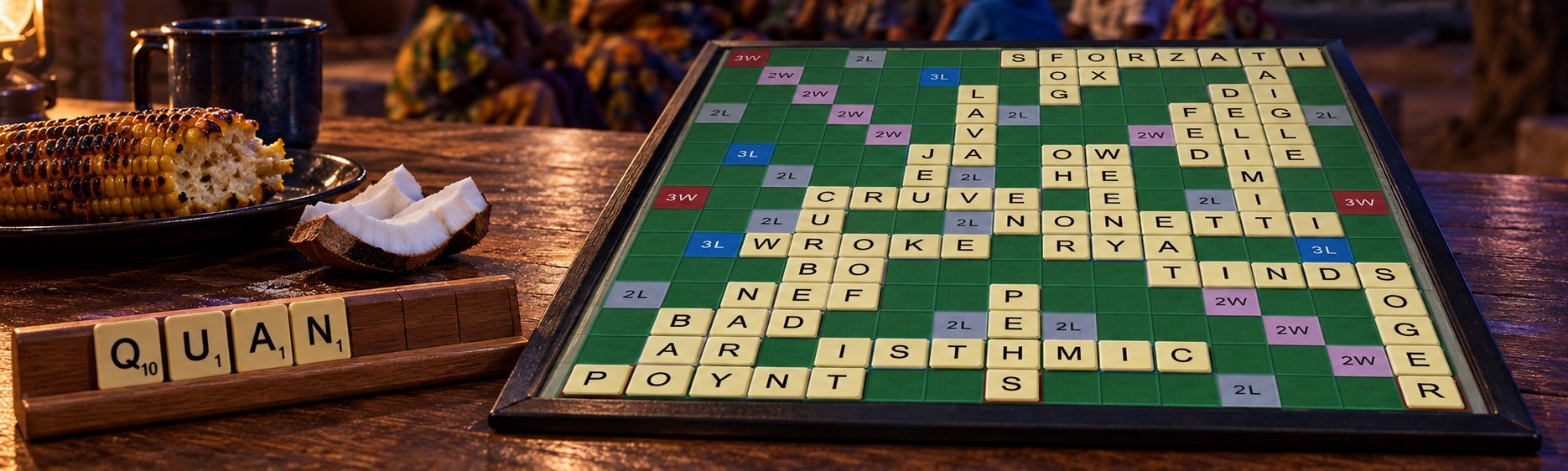
1. Executive Summary — Density Beats Drama
Bingos win screenshots.
Density wins matches.
Short parallels compound every turn.
Bingo hunting compounds risk.
Amateurs wait for seven.
Masters score with four.
Then leave a rack that still threatens seven.
Wordmaster.pro analyzes the absolute mathematical tradeoff between short parallel density scoring and bingo-hunting leave equity in order to provide competitive players with an unshakeable decision framework that spikes turn metrics without exposing dangerous open pathways to the opponent.
Every serious Scrabble and Wordfeud player eventually faces the same fork: take the available short parallel play now, or park tiles and hunt a bingo. One path monetizes the board immediately through overlapping geometry. The other path mortgages the present for a probabilistic 50–80 point spike.
This guide is the operating system for short parallel plays vs bingo hunting, Scrabble bingo strategy, Wordfeud overlapping words, rack leave equity, and when to bingo vs when to score short under real clock pressure.
2. Two Engines, One Board
Competitive word games run on two scoring engines. Confusing them is how intermediate players stall.
| Engine | Core mechanism | Typical turn | Board effect |
|---|---|---|---|
| Short Parallel Density | Flush overlaps; each new tile scores on two axes | 3–5 tiles, 22–45 pts | Wall builds; lanes starve |
| Bingo Hunting | Preserve leave shape until a 7–8 letter out appears | 0–2 tiles now, or a soft dump | Lanes stay open; volatility rises |
Bingo hunting is not evil. It is a variance instrument. Used when the board already contains a clean runway, when your leave is elite (AEINRST, AELNRST, AEINORT), and when the scoreboard forces a swing.
Short parallel play is the default midgame currency. It converts ordinary racks into elite point-to-tile efficiency without handing the opponent a free bingo corridor.
Doctrine
If the parallel is real and legal, take it —
unless the bingo equity clearly exceeds the parallel
AND the board geometry still supports the bingo.
Most club and app losses violate that sentence.
3. The Mathematics: SPY vs BEV
Short Parallel Yield (SPY)
Short Parallel Yield measures how hard a compact overlap scores relative to tiles spent.
SPY = Total Turn Score ÷ Newly Placed TilesElite short parallels routinely clear SPY ≥ 8. Soft open branches often sit near SPY 3–5.
Bingo Expected Value (BEV)
Bingo Expected Value prices the hunt.
BEV ≈ (P_bingo × Avg_Bingo_Score)
    + ((1 − P_bingo) × Continuation_Value)
    − Lane_Gift_Cost
Where:
- P_bingo = realistic probability of a bingo within the next 1–2 draws given bag + leave
- Avg_Bingo_Score = typical available bingo value on this board (not fantasy 90s)
- Continuation_Value = expected non-bingo score if the bingo fails
- Lane_Gift_Cost = expected opponent swing created by keeping lanes open
If you skip a 34-point parallel to protect a leave with P_bingo ≈ 0.25 and a realistic bingo of 62, the raw spike math looks attractive:
0.25 × 62 = 15.5 expected from the bingo event aloneBut that is incomplete. You also forfeit 34 now, absorb a weak dump turn, and often donate runway. Add a Lane_Gift_Cost of even 20 expected opponent points and the hunt collapses.
Volatility Tradeoff Index (VTI)
VTI = (Parallel_Score_Now − Soft_Dump_Score)
− (BEV − Lane_Gift_Cost)- VTI > 0 → take the parallel
- VTI < 0 → hunting is priced correctly
- VTI ≈ 0 → prefer the parallel unless you are trailing by a bingo swing
Amateurs maximize hope. Masters maximize VTI.
4. What Short Parallel Plays Actually Are
A short parallel play places a new word flush against an existing word so every overlapping column or row forms a second legal word—usually a 2-letter cross.
You are not “finding a cute side word.” You are building a compound sandwich: one main construction + N crosses in a single submission.
Teaching position (NWL-legal)
Existing board word: MAMA
You play flush beneath it: OXEN
X lands on a Double Letter Score.
| 1 | 2 | 3 | 4 | |
| Board | M | A | M | A |
| New play | O | X | E | N |
| Crosses | MO | AX | ME | AN |
All crosses are NWL-legal: MO · AX · ME · AN.
Main OXEN: O(1) + X(8×2) + E(1) + N(1) = 19
Cross MO:  4
Cross AX:  A(1) + X(8×2) = 17
Cross ME:  4
Cross AN:  2
Total      = 46
SPY        = 46 ÷ 4 = 11.5
Four tiles. One letter premium. No word premium. That is why short parallels beat romantic bingo waiting in midgame.
Lexicon note for Wordfeud / CSW tables
Some parallel walls that look natural online rely on CSW-only twos such as ST. Under NWL, do not ship those walls. Always validate every cross before treating a parallel as “free.”
5. What Bingo Hunting Actually Is
Bingo hunting is the deliberate preservation of a high-synergy leave—often at the cost of an immediately available dense score—because the player believes a 7- or 8-letter play is near.
Healthy bingo hunting
- Leave is already elite or one tile from elite
- Board has a real bingo lane you can use first
- Scoreboard requires a swing (you trail by ~40–80+)
- Opponent cannot trivially steal the same lane next turn
- Your alternative parallel / dump is weak (< 18)
Pathological bingo hunting
- Holding a muddy six “because it looks bingo-ish”
- Skipping a 30+ parallel to protect mediocre vowels
- Opening a triple-word runway while waiting
- Fishing one specific tile while the bag is hostile
- Confusing anagram vanity with match equity
Bingo culture is strongest in digital apps. Wordfeud feeds the dopamine loop: one 70-point alert feels like strategy. Over a full match, the player who banked three 28–40 parallels often outruns the player who missed twice hunting RETINA+S.
6. Rack Leave Equity: The Hidden Scoreboard
The correct comparison is never “34 now vs maybe 70 later” in isolation. It is 34 now + leave quality versus weak now + leave quality.
| Leave class | Examples | Parallel bias | Hunt bias |
|---|---|---|---|
| Elite | AEINRST, AELNRST, AEINORT | Take dense scores that keep shape | Hunt if runway exists |
| Good | AEIRST-, AELNOT- | Prefer SPY ≥ 8 overlaps | Soft hunt only |
| Muddy | AEUUIIC, BCFGKVW | Force short clears / exchanges | Do not hunt |
| Power-heavy | JQXZ + junk | Parallel power dumps first | Bingo only if clean lane + blank |
The Parallel-Compatible Leave Rule
A short parallel that scores 30+ and leaves AENRST is not “anti-bingo.” It is bingo preparation with cash flow.
A soft 12-point dump that leaves AEINRST on a closed board is often worse than a 26-point parallel that leaves AEINRS—because the second play both scores and still threatens.
7. Board Geometry: Who Owns the Runway?
Bingo hunting without runway audit is superstition.
Hunt when
- An open 7–8 column/row already exists through friendly hooks
- Premiums on that lane are reachable by you first
- Parallel options do not also seal your own lane
Parallel when
- The only “bingo lane” is a gift to both players
- Short overlaps sit on DLS / DWS clusters inside a wall
- Packing denies the opponent’s natural 8-letter corridors
- Midgame score is close and volatility favors the leader
The Lane Gift Problem
Skipping a wall to “stay flexible” often means:
- You score 10–16
- Opponent scores 28 through the gap you refused to pack
- Opponent then bingos for 70
- Your “hunt” never arrives
That sequence is the classic bingo-hunting autopsy.
8. Case Study A — Folly: The Romantic Hold
Score: You lead by 8. Midgame. Bag rich.
Rack: A E I N R S T
Available now: a fully legal 4-tile parallel for 38 that leaves A E N.
Folly line
Player thinks: “I already have bingo shape. Don’t break it.”
Plays a soft QI-style dump for 11, leaves full seven-letter hope, and keeps a side lane open.
| Result | |
| Your score this turn | 11 |
| Opponent reply through open lane | 34 |
| Your bingo arrives next? | Maybe / maybe not |
| Net board story | Lead evaporates; runway donated |
The leave was elite. The decision was not. Elite leaves do not require poverty turns when a dense parallel already exists.
9. Case Study B — Master: Cash Now, Threat Later
Same rack. Same board. Same 38-point parallel available.
Master line
Play the parallel. Bank 38. Leave A E N. Draw four. Recalculate.
Even if the next rack is imperfect, you:
- Extended the lead
- Tightened geometry
- Did not gift a corridor
- Still retained bingo-prone vowels/consonants
| Metric | Folly hold | Master parallel |
| Immediate score | 11 | 38 |
| SPY | ~5.5 | ~9.5 |
| Lane gift | High | Low |
| Future bingo still possible? | Yes | Yes |
Masters do not refuse bingos. They refuse unpriced bingo hunts.
10. Second Geometry Proof — Parallel Without Power Tiles
Existing word: LATE
Flush underplay: ONES
| 1 | 2 | 3 | 4 | |
| Board | L | A | T | E |
| New play | O | N | E | S |
| Crosses | LO | AN | TE | ES |
NWL-legal crosses: LO · AN · TE · ES.
No J, Q, X, or Z required. Ordinary tiles still compound when every column pays twice. Compare that to waiting two turns for a bingo that may never fit the remaining lanes.
11. Scoreboard States: When Hunting Is Mandatory
Short parallel doctrine is the default. It is not absolute.
| Match state | Preferred engine | Reason |
|---|---|---|
| Lead by 30+ midgame | Parallel / pack | Kill volatility |
| Within 15 either way | Parallel unless elite runway | Control pace |
| Trail by 40–70 | Hunt if P_bingo is real | Need a swing |
| Trail by 80+ late | Force bingo or block-out math | Soft parallels may be too slow |
| Pre-endgame, bag ≤ 7 | Tracking & outs beat romance | Bingo hunt becomes tile-count war |
Wordfeud-specific pressure
In many Wordfeud games, opponents are culturally aggressive bingo hunters. That does not mean you should match their variance. It means your parallels must also deny their favorite corridors. Density is counter-meta.
12. Decision Runbook (Clock-Ready)
Use this under a turn timer.
- Scan flush overlaps first. Any legal parallel ≥ 24?
- Compute SPY. If SPY ≥ 8, mark as candidate.
- Audit leave after that parallel. Still bingo-capable?
- Price the hunt. Realistic P_bingo × board bingo value.
- Subtract lane gift. If opponent can use the same opening harder than you, kill the hunt.
- Check scoreboard. Only trail-forced swings override dense cash.
- If both engines are weak, exchange or dump for rack repair—do not fake a bingo narrative.
- Never refuse 30+ density solely to keep a muddy six intact.
13. Final Checklist
- I know whether this turn is a density turn or a swing turn
- Every parallel cross is lexicon-legal (NWL default; CSW/Wordfeud labeled)
- My SPY is calculated, not vibed
- My BEV includes Lane_Gift_Cost
- Elite leave does not automatically mean soft dump
- Bingo hunt requires a real runway I can claim first
- Trailing is the main license for high variance
- Leading is a license to pack walls and starve drama
- Wordfeud dopamine alerts do not rewrite the math
- Next leave still threatens; this turn still pays
Final Takeaway
Bingos are weapons.
Parallels are payroll.
Hunt when the board and the bag price the swing.
Pack when the wall is already paying.
Cash density.
Keep shape.
Deny the runway.
Then bingo—on purpose.
Leave a Reply