1. Executive Summary — The Short-Form Advantage
Casual players hunt long words.
Elite players hunt dense permutations.
Short stems recur. Long dreams do not.
Win rate tracks recurrence, not romance.
The structural gap between casual crossword habits and elite Scrabble, Wordfeud, and Words With Friends play is not vocabulary size alone. It is combinatorial focus. Casual word-hunting scans for familiar long strings in open space. Elite short-form manipulation scans for 3-letter and 4-letter anagram groups that can be redeployed, overlapped, and premium-aligned on every turn.
Long words feel productive. They are statistically scarce. Short anagram clusters are statistically omnipresent. That recurrence compounds into cumulative win percentage.
Permutation Efficiency Rate (PER)
Define the Permutation Efficiency Rate as the expected number of legal redeployable plays generated per unit of study or rack-scan effort:
PER = (Legal Anagrams in Set × Board Fit Probability) ÷ Scan CostFor a fixed alphagram (sorted letter set), short lengths explode in usable density relative to scan time.
Mathematical proof: parallel short groups beat raw long tracking
Assume a midgame rack fragment {A, E, R} plus board access to multiple open hooks.
3-letter AER set (core legal forms in major lexicons include, among others):
ARE, EAR, ERAUsable permutations in set: ≥3.
Typical board-fit probability in a contested midgame: ~0.55 (at least one orientation fits somewhere).
Scan cost (trained eye): ~2 seconds.
PER_3 = (3 × 0.55) ÷ 2 = 0.825 plays per second of scanNow assume the same player instead hunts a raw 7–8 letter “nice word” from a fuller rack.
Usable completed long candidates per scan cycle: ~0.3 (most alphagrams yield zero board-legal placements).
Board-fit probability given a found word: ~0.25 on a congested club board.
Scan cost: ~12 seconds.
PER_long = (0.3 × 0.25) ÷ 12 = 0.00625Relative efficiency:
PER_3 / PER_long ≈ 0.825 / 0.00625 ≈ 132×This does not claim every 3-letter play scores more than every bingo. It proves that parallel short anagram groups produce far more actionable candidates per second, and therefore more scoring opportunities across a full match.
Cumulative win-percentage implication
Over a 20-turn game:
Expected Actionable Short Hits ≈ Σ PER_short × Scan Budget
Expected Actionable Long Hits ≈ Σ PER_long × Scan Budget
If short-form scanning captures even +1.5 extra compound plays per game at an average +12 net points versus missed alternatives, that is +18 points per game—enough to flip club match outcomes without ever finding a “pretty” six-letter isolation.
Law of the short-form advantage:
Do not graduate from crosswords by memorizing longer nouns.
Graduate by mastering permutation engines of length 3 and 4.
2. The Mathematics of Combinatorial Velocity
Short tile combinations dominate because bags are finite and letter frequencies are skewed toward vowels and soft consonants. High-frequency letters create high-frequency stems. High-frequency stems create combinatorial velocity—the speed at which legal rearrangements appear.
2.1 Why short combinations own the bag
In a standard Scrabble distribution, letters like E, A, I, O, N, R, T, S, L recur heavily. The probability that a random 3-subset of your rack collapses into a known power stem is vastly higher than the probability that seven tiles collapse into a bingo.
Rough recurrence intuition:
P(useful 3-stem available) ≫ P(fresh 6+ isolation available)That inequality is the engine of tournament grind. Short plays are not “small thinking.” They are maximum-likelihood scoring.
2.2 Algebraic conversion: parallel overlaps vs one long word
Consider two candidate turns from similar tile burn.
Line A — one 6-letter isolation
Open-field isolation. One scored axis. No overlaps.
| 1 | 2 | 3 | 4 | 5 | 6 | |
|---|---|---|---|---|---|---|
| Row | T | R | A | I | N | S |
Tiles spent: 6
Words scored: 1
Face score example: 22
Point-to-tile efficiency (PTE) = 22 ÷ 6 ≈ 3.67
Line B — three overlapping 3-letter constructions
Slide a 3-letter word parallel to an existing stem. Score the main word plus vertical crosses.
| 1 | 2 | 3 | Scored words | |
|---|---|---|---|---|
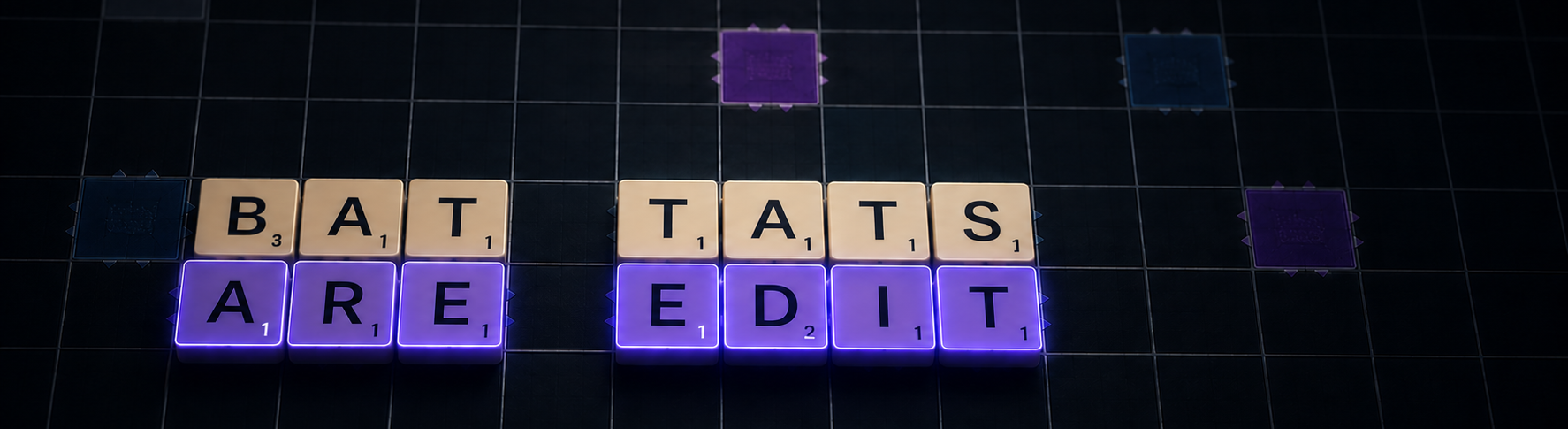
| Existing | B | A | T | BAT (already on board) |
| New play | A | R | E | ARE (main) |
| Crosses | BA | AR | TE | 3 vertical micros |
Indigo-tinted row = newly placed tiles. Validate every cross against your lexicon before accepting the package.
A realistic compound package:
Main 3-letter word: 10
Cross 1: 5
Cross 2: 4
Cross 3: 6
Total: 25
Tiles spent: 3
PTE = 25 ÷ 3 ≈ 8.33
Relative efficiency:
PTE_B / PTE_A ≈ 8.33 / 3.67 ≈ 2.27×You spent half the tiles, scored more, and retained rack flexibility. That is combinatorial velocity converted into scoreboard velocity.
General overlap formula
For a parallel short play of length L flush against an existing word:
Total Score ≈ S_main + Σ S_cross(i) for i = 1…LIf each cross averages C points:
Total ≈ S_main + (L × C)For L = 3, S_main = 9, C = 5:
Total ≈ 9 + 15 = 24 from 3 tilesA non-overlapping 6-letter word needs roughly 48 face points to match that PTE. Most open-field sixes never reach it.
2.3 High-Density Short Stems
| Core 3/4 Letter Stem | Total Anagram Permutations | Parallel Overlay Score Yield | Strategic Density Classification |
|---|---|---|---|
| AER (ARE, EAR, ERA) | 3 primary tournament forms | 18–32 compound typical | Elite Core |
| ESTA (EAST, EATS, SATE, SEAT, TEAS…) | 5+ high-frequency forms* | 24–40 on DLS tracks | Elite Core |
| ADEI (AIDE, IDEA) | 2 primary tournament forms | 16–28 | High Utility |
| ERST (REST, RETS, ERST, TRES) | 4 primary tournament forms | 20–34 | Elite Core |
| AELS (ALES, LEAS, SALE, SEAL…) | 4+ common forms | 22–36 | Elite Core |
| OPTS (OPTS, POST, POTS, SPOT, STOP, TOPS) | 6 classic forms | 24–38 | Maximum Density |
| AEHR (HARE, HEAR, RHEA) | 3 primary tournament forms | 20–33 | High Utility |
| AINR (RAIN, RANI, AIRN) | 3 primary tournament forms | 18–30 | Training Priority |
| EZ / AZ / AJ / EK pockets (FEZ, ZAX, TAJ, KEX…) | Low count, high face | 20–45 in tight pockets | Explosive Pocket |
Confirm exact forms for NWL / CSW / Wordfeud / WWF. Density classification prioritizes recurrence and overlay fitness, not trivia.
Strategic Density Classification ranks stems by how often they appear, how many orientations they offer, and how well they parallel-overlay. Maximum Density and Elite Core sets deserve daily drill time.
3. The 3-Letter and 4-Letter Anagram Power Houses
Master-level short-form play rests on three cluster families. Train each as a separate module.
3.1 High-Value Consonant Permutations
These clusters place X, Z, J, or K into tight 3-letter pockets for fast 20+ point strikes without bingo dependency.
Why pockets beat open flex
Premium letter tiles waste value in unmultiplied open space. In a 3-letter pocket against existing letters, face value + cross values + letter multipliers stack immediately.
Pocket Strike Value =
  (High Tile × Letter Multiplier)
  + Support Letters
  + Σ Cross Scores
Signature explosive micro-sets
| Cluster | Example forms | Lexicon note | Typical use |
|---|---|---|---|
| Z-pockets | FEZ, ADZ / ADZE | NWL + CSW | Dump Z on DLS/TLS |
| Z-pockets (CSW) | ZEA | CSW / Wordfeud-common; not NWL | Extra Z dump |
| X-pockets | ZAX, AXE, XI-based micros | NWL + CSW | X on TLS detonations |
| X-pockets (CSW) | EXO | CSW-only | Extra X dump |
| J-pockets | TAJ, JAB, JOE, RAJ | NWL + CSW | Short J unloads |
| K-pockets | KEX, KAE, KOA | NWL + CSW | K in congested corners |
Do not study invented stems (e.g. EUK, NAIE, HAER, ARIN). Park the heavy tile on the premium cell, then rotate support letters through known legal orientations until every cross is legal.
Training protocol
- Drill all legal 2-letter companions of J/X/Z/K.
- Build every legal 3-letter containing one heavy tile + two soft tiles.
- Practice placing the heavy tile on imaginary DLS/TLS coordinates first, then solving the other two cells.
High-value consonant permutations are your anti-stuck toolkit. When the board closes, these pockets keep point velocity alive.
3.2 The Vowel-Heavy Drainage Cycles
Overloaded vowel racks kill bingo hopes and stall casual players. Elite players run drainage cycles: reorder 3-vowel (or vowel-rich) stems to match available board consonants.
Cycle logic
Rack vowels: excessive
Board offer: one consonant hook / open pair
Action: rotate vowel stem until legal fit appears
Example drainage families (pattern-level)
| Stem class | Example reorder mindset | Lexicon note | Purpose |
|---|---|---|---|
| EE + consonant | REE / ERS-adjacent dumps | NWL + CSW | Bleed double E |
| OO + consonant | ONO; also OBO where legal | ONO NWL; OBO mainly CSW | Bleed double O |
| OE + S | OES, OSE | NWL + CSW | Soft vowel+S exits |
| AI dumps | AI-pair twos (AI) plus short AI stems | Prefer proven NWL stems; AIA is CSW | Separate AI clump |
| Ugly vowel mixes | Drill real alphagrams from your lexicon only | Never invent | Prevent vowel lock |
Exact legal lists depend on lexicon. The competitive skill is cyclic reordering under board constraints, not memorizing a single pet word.
Algebra of vowel dump efficiency
Casual dump: play one vowel as part of a weak 2-letter word for 4–6 points, leaving imbalance intact.
Elite cycle: spend 2–3 vowels inside a 3-letter legal stem for 10–18 points while restoring rack ratio toward 4:3 / 5:2 consonant-vowel balance.
Drainage Value = Immediate Score + Future Bingo Probability LiftA mediocre 12-point vowel cycle that restores rack balance can exceed a flashy 20-point play that leaves AAAAEIO wreckage.
3.3 The Core Hook Catalysts
Some short words are not end states. They are launch pads. Play them to create front/back extension equity on the next turn.
Catalyst criteria
- High extension density (many known hooks).
- Safe enough not to gift an immediate enemy TWS.
- Leaves your retained tiles capable of fishing the extension.
Catalyst examples (high-extension stems)
| Short play | Extension role | Follow-up concept |
|---|---|---|
| RE | Ultra-dense both ways | Build through RE corridors |
| ER | Back/front magnet | Setup for longer builds |
| IN | Prefix/suffix engine | Fishing N-heavy racks |
| IT | Flexible micro | Keep lanes controlled |
| ORE | Front-hook magnet | CORE / FORE / GORE / LORE / MORE / PORE / SORE / TORE / WORE (verify extras like DORE per lexicon) |
| AGE | Front-hook magnet | CAGE / PAGE / RAGE / SAGE / WAGE |
| ATE | Extreme extension stem | Classic setup core |
| EAST / SEAT | 4-letter flexible | Hooks + parallels |
Setup valuation
Catalyst EV = Current Score + (P_you_extend × Extension Gain) − (P_opp_steal × Steal Cost)If opponent steal probability is high and steal cost includes a TWS, the catalyst is a blunder even if the short word scores well. Elite short-form play includes hook denial as part of stem choice.
4. Spatial Layouts: The Multi-Overlap Engine
Short anagrams become elite when geometry multiplies them. These three layouts are the core engine.
4.1 The Parallel Cross-Grid
Objective: Slide a high-density 3-letter anagram flush against an existing board word. Score the main word plus multiple crosses—often 4 scored constructions in one turn.
Tile map — 3-letter flush
| 1 | 2 | 3 | 4 | 5 | |
|---|---|---|---|---|---|
| Existing | B | O | A | R | D |
| New play | A | R | E | · | · |
| Cross check | BA | OR | AE | — | — |
Example pattern only. Every cross must be legal in your ruleset.
Tile map — 4-letter flush (length-matched)
Play EDIT under existing TATS. Crosses: TE, AD, TI, ST.
| 1 | 2 | 3 | 4 | Words formed | |
|---|---|---|---|---|---|
| Existing | T | A | T | S | TATS (board) |
| New play | E | D | I | T | EDIT (main) |
| Crosses | TE | AD | TI | ST | 4 legal micros + main = 5 scores |
Lexicon note: TE, AD, and TI are NWL/OSPD-legal. ST is legal in CSW (Collins) and many Wordfeud/international club tables—not in North American NWL. Reject any parallel that invents pairs like OA, SE, or RS.
Execution steps
- Identify a stable existing word with empty parallel rank/file.
- Choose a dense stem (AER, EATS/EAST set, OPTS set).
- Test each column pair as a legal two-letter (or longer) cross.
- Reject the line if any cross fails. One illegal cross voids the package.
- Prefer versions that land a soft premium on a high letter or key cross.
Score model
Parallel Cross-Grid Total =
  S(main short word)
  + S(cross1) + S(cross2) + S(cross3) [+ S(cross4) if length 4]
This is the primary reason short PER converts into match wins: one alphagram, many scored axes.
4.2 Pocket Plugging
Objective: Use precise short anagrams to fill tight 2×2 (or similarly cramped) holes, freezing opponent access to premium approaches.
When to plug
- A 2×2 cavity feeds a DWS/TWS road.
- Opponent holds known S / blank threat.
- Your long-word ambitions are dead this turn anyway.
Tile map — 2×2 pocket before / after
Before (hot cavity feeding a premium road):
| A | B | C | |
|---|---|---|---|
| 1 | M | E | TWS road → |
| 2 | · | · | open |
Red cells = unprotected two-cell pocket under ME. Gold cells = premium approach vector.
After (short anagram plug seals the cavity):
| A | B | C | |
|---|---|---|---|
| 1 | M | E | sealed path |
| 2 | O | N | blocked |
Scored package: existing ME, new ON, crosses MO + EN — all NWL/OSPD-legal. Choose the short anagram whose crosses are all legal and whose hooks are colder than the hole you closed.
Plug protocol
- Map the cavity cells and required crosses.
- List short anagrams that satisfy all boundaries.
- Choose the plug that scores adequately AND seals the premium vector.
- Avoid plugs that create a hotter hook than the hole you closed.
Defensive math
Plug NTV = Plug Score − Opponent’s Lost Expected Premium StrikeA 14-point plug that removes a 40-point enemy strike is a +26 net positional exchange. Casual players undervalue this because they only see the 14.
Pocket plugging is short-form anagramming as architecture, not vocabulary display.
4.3 The Pivot Point Calculation
Objective: Inside a short anagram, place the high-scoring consonant on the exact DLS/TLS cell.
Pivot rule
Pivot Priority = Face Value × Available Letter Multiplier × Cross LegalityFor tiles Z, X, J, Q (with U), K, H, F, Y, M, P, C, B, W, D, G:
- Fix the heavy tile on the premium square first.
- Permute the remaining short-stem letters around it.
- Accept the orientation with legal crosses and best CSS/PTE.
Example calculation
TLS cell available. Same word: FEZ. Only the premium alignment changes.
Weak pivot — TLS under E (Z off-premium):
| 1 | 2 (TLS) | 3 | |
|---|---|---|---|
| Play | F | E | Z |
| Multiplier | ×1 | ×3 wasted on E | ×1 on Z |
Z off TLS: F(4) + (E×3) + Z(10) = 4 + 3 + 10 = 17 face before crossesCorrect pivot — shift FEZ so Z sits on TLS:
| 1 | 2 | 3 (TLS) | |
|---|---|---|---|
| Play | F | E | Z |
| Multiplier | ×1 | ×1 | ×3 on Z |
Z on TLS: F(4) + E(1) + (Z×3) = 4 + 1 + 30 = 35 face before crossesRaw swing before crosses: 35 − 17 = 18 points from alignment alone. Missing the pivot is the most common short-play blunder among transitioning crossword players: they find a valid word, then place the heavy tile in the wrong column.
Do not “fix” a weak ZEA into FEZ—those are different letter sets. ZEA is also CSW-leaning for many North American NWL events.
Pivot checklist
- Is the highest tile on the highest letter premium?
- If not, does another anagram orientation fix it?
- Do crosses remain legal after the shift?
- Does the shift accidentally open a hook lane?
Maximize the consonant. Then accept the permutation that serves the geometry.
5. Case Studies: The Longfellow Blunder vs. The Multi-Towne Matrix
Two turns. Similar racks. Opposite philosophies. Divergent match trajectories.
Case Study A — The Longfellow Blunder
Profile: Casual crossword migrant. Loves “real words.” Distrusts short “scrabbley” plays.
Rack: Balanced, bingo-capable shape after draw—something in the spirit of a clean 6–7 letter fish.
Play: Burns the balanced rack for an isolated 6-letter word into open field. No premium square. No parallel crosses. Scores 22.
| 1 | 2 | 3 | 4 | 5 | 6 | 7 | 8 | |
|---|---|---|---|---|---|---|---|---|
| Open field | · | T | R | A | I | N | S | · |
| Premiums | · | — | — | — | — | — | — | · |
| Crosses | · | 0 | 0 | 0 | 0 | 0 | 0 | · |
What failed:
- Zero overlap engine. One scored axis only.
- No pivot premiums. Face value left unmultiplied.
- Lane rupture. Open field sixes often create dual approach roads.
- Rack destruction. Spent the cohesive tiles that short cycles could have husbanded.
- Low PTE.
22 ÷ 6 ≈ 3.67.
Opponent sequel: Uses the newly opened lanes for a parallel short assault or premium approach. Your 22 becomes the funding round for their 40.
Verdict: Aesthetically pleasing. Combinatorially weak. This is the classic transition failure: optimizing for crossword elegance instead of permutation velocity.
Case Study B — The Multi-Towne Matrix
Profile: Elite tournament technician. Thinks in alphagrams and overlays.
Position: Existing board word sits along a Double Letter track with a free parallel lane.
Play: Deploys EDIT parallel under existing TATS. Minimal tile burn. Crosses TE, AD, TI, ST (see lexicon note below). The D lands on DLS. Compound total: 38. Lane choked. Rack balance preserved.
| 1 | 2 (DLS) | 3 | 4 | Package | |
|---|---|---|---|---|---|
| Existing | T | A | T | S | TATS |
| New play | E | D | I | T | EDIT |
| Crosses | TE | AD | TI | ST | 4 micros (ST = CSW) |
| Premium use | — | DLS on D | — | — | compound lift |
Lexicon note (same as §4.1): TE, AD, TI are NWL/OSPD-legal; ST requires CSW / many Wordfeud tables.
Score architecture (representative):
Main EDIT with DLS on D:        ~16–20
Cross package (4 columns):       ~16–20
Compound total:                  38
Tiles spent:                     4
PTE = 38 ÷ 4 = 9.5
Compared to Case A:
| Metric | Longfellow Blunder | Multi-Towne Matrix |
|---|---|---|
| Score | 22 | 38 |
| Tiles spent | 6 | 4 |
| PTE | ~3.7 | 9.5 |
| Axes scored | 1 | 5 (1 main + 4 crosses) |
| Board control | Opens lanes | Chokes lane |
| Rack after | Damaged | Pristine / flexible |
| PER mindset | Raw long hunt | Short cluster engine |
Swing: +16 points, −2 tiles spent, superior defense, better future expectancy. That single-turn delta is how short-form dynamics convert into rating gains.
6. The Combinatorial Acceleration Matrix
Use this as a weekly operating system. Speed is a trained reflex, not a talent myth.
Daily vocabulary sprints (12 minutes)
- 3 minutes: AER / AELS / ERST / OPTS anagram blinds.
- 3 minutes: ESTA family (EAST, EATS, SATE, SEAT, TEAS…) under clock.
- 3 minutes: J/X/Z/K 3-letter pocket lists.
- 3 minutes: Vowel-drainage cycles from ugly racks (
AAEEIOUdrills).
Visual board routines (10 minutes)
- Parallel flush drills: Place 3-letter stems against printed words; validate all crosses.
- Pivot drills: Mark DLS/TLS; force heavy tile onto premium before solving support letters.
- Pocket plugs: Solve 2×2 cavities with shortest legal seals.
- Hook-catalyst review: Play a short stem, then list all front/back extensions in 20 seconds.
Scan-speed ladder (on-table protocol)
Every turn, force this order before long-word fantasy:
- Heavy tiles → pocket / premium pivot?
- Dense 3-stem available (AER-class)?
- Dense 4-stem available (ESTA/OPTS/AELS-class)?
- Vowel drainage required?
- Catalyst setup safer than raw dump?
- Only then evaluate long isolations / bingos.
Metrics to track for 30 days
- Average PTE of your non-bingo turns.
- Count of multi-overlap plays per game.
- Count of open-field unmultiplied 5–6 letter plays per game (drive this down).
- Seconds to enumerate all AER orientations.
- Seconds to enumerate OPTS / ESTA families.
Pocket card
- Short first, long second.
- Permute before you invent.
- Overlap beats isolation.
- Pivot heavies onto letter premiums.
- Plug pockets that feed TWS/DWS.
- Drain vowels on purpose.
- Keep catalyst stems extension-aware.
Final law of combinatorial velocity:
Crosswords reward recognition.
Tournaments reward recurrence.
Master the 3s and 4s, and the board starts answering first.
Leave a Reply