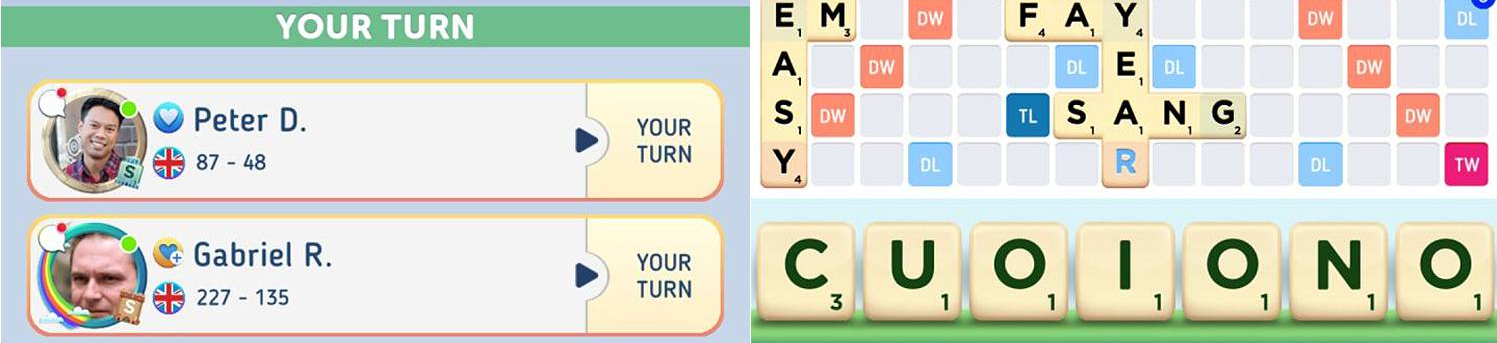
Every casual Scrabble, Wordfeud, and Words With Friends player knows the feeling. You draw seven tiles, shuffle them once, shuffle them twice, and stare at the rack like it is a single unsolvable puzzle. Your eyes bounce across the letters hunting for a whole word — a complete seven-letter bingo that unlocks the 50-point bonus and turns a crumbling position into a comeback.
That approach feels natural. It is also why most players miss the bingo sitting in plain sight.
Staring at seven chaotic tiles triggers cognitive fatigue. The human brain struggles to hold every permutation at once. Under pressure — a ticking clock, a trailing score, an opponent who just opened a premium lane — that fatigue becomes paralysis. You see fragments. You see almost-words. You see nothing.
Tournament masters do not read racks as monoliths. They use Rack Partitioning: an analytical technique that mentally breaks a seven-tile hand into movable chunks — prefixes, suffixes, stems, and hooks — then rebuilds the word from the edges inward. Instead of solving a seven-letter anagram, they solve a three- or four-letter problem twice. That is how elite players unmask high-value bingos from racks that look hopeless to everyone else.
This WordMaster Pro guide teaches the prefix/suffix framework, the stems-and-hooks matrix that powers club-level bingo vision, and the cognitive drills that train your brain to spot seven-letter plays faster when the rack is crumbling and the clock is running.
Section 1 — The Framework of Prefixes and Suffixes
Why edges beat the middle
English words are not random letter soup. They are built from recurring structural modules — beginnings and endings that repeat across thousands of dictionary entries. When you isolate those modules on your rack, you collapse the search space dramatically.
Think of your tile tray as a workbench, not a slot machine. Tournament players physically or mentally slide high-probability groupings to the far left (prefix zone) or far right (suffix zone). What remains in the center is a smaller, calmer puzzle.
Example rack: `A E G I N R T`
Chaotic read: seven tiles, dozens of permutations, mental fog.
Partitioned read:
– Suffix candidate: -ING → leaves `A E R T` → TEARING (bingo)
– Or suffix -IER → leaves `A G N T` → TANGIER (bingo)
– Or stem family with rearrangement → GRANITE, INGRATE
Same rack. Radically different cognitive load. You are no longer asking, “What seven-letter word is this?” You are asking, “What three or four letters complete -ING?”
That is Rack Partitioning in action.
High-probability suffix anchors
These endings appear in enormous numbers of legal seven-letter (and longer) words. Train your eye to spot them instantly and park them on the right edge of your tray.
| Suffix | Strategic note |
|---|---|
| -ING | The king of seven-letter endings; turns verbs and verb-like forms into bingos constantly (RATING, LOADING, STAGING). |
| -ED | Past-tense powerhouse; pairs with stems like RETAIN → RETAINED (8 letters) but also fuels 7s like WALKED-style patterns when tiles align. |
| -ER | Agent/noun ending; GRATING, HOPPER-family shapes; excellent partition anchor on crowded racks. |
| -EST | Superlative ending; smaller bingo pool but high clarity when E-S-T sit together on the right. |
| -TION | Not always a pure seven-letter fit alone, but T-I-O-N grouping signals longer-word potential and partial partitions. |
| -ABLE | Adjective ending; A-B-L-E on the right leaves a tight four-tile core to solve. |
| -IES | Plural/variant ending; I-E-S on the right reduces a seven-tile scramble to a four-letter core puzzle. |
| Prefix | Strategic note |
|---|---|
| UN- | Massive bingo multiplier; UN + 5-tile core appears constantly in tournament dictionaries. |
| DE- | Reverse/removal prefix; DE on the left turns a five-tile midword into a searchable unit. |
| RE- | Repeat/again prefix; pairs with stems like ACT, ACTS, LACE, LAY — high bingo density. |
| IN- | Negation/inside prefix; IN + five tiles is a classic partition pattern. |
| DIS- | Four-letter prefix block; when D-I-S are present, scan for DIS + four remaining tiles. |
| PRE- | Before/ahead prefix; PRE + four-tile core collapses search space cleanly. |
| OVER- | Less common as a pure seven-letter prefix, but OVER fragments signal extension plays and stem builds. |
The math of simplification
A seven-letter rack has 5,040 permutations if you treat all tiles as distinct. That is why whole-rack staring fails — your brain aborts the search.
Partition into a 3-letter suffix + 4-letter core? You are solving roughly 24 arrangements for the core (4!) while the suffix is locked. Add a known prefix on the left and the problem shrinks again.
Masters do not have better eyes. They have smaller problems.
Practical rule: On every rack, before you hunt a bingo, ask:
1. Is there a suffix anchor (-ING, -ER, -ED, -IES, -ABLE)?
2. Is there a prefix anchor (UN-, RE-, DE-, IN-)?
3. What 3–5 tiles remain once anchors are parked at the edges?
If you can answer question three with a known stem fragment, you are one step from a 50-point play.
Section 2 — The Stems and Hooks Matrix
Stems: the tournament’s secret vocabulary
Beyond generic prefixes and suffixes, competitive players memorize stems — six-letter combinations that convert into multiple seven-letter bingos when one tile is added. The most famous families include TISANE, RETAIN, and SATIRE.
A stem is not one word. It is a bingo engine. Add the right seventh tile and the stem blooms into a legal seven.
How stems shift with prefix/suffix loops
Stems do not sit still. They interact with the prefix and suffix modules from Section 1 — and with **board hooks**, where a single letter already on the grid attaches to your partition string to complete a longer play (or a seven that uses fewer rack tiles).
| Stem | Example 7-letter blooms (+1 tile) | Prefix loop | Suffix loop | Board hook cue |
|---|---|---|---|---|
| TISANE | STAINED, DETAINS, SAINTED, SEATING, STAGING, PANTIES, SALIENT | DE- on related 5–6 letter cores (DETAINS family) | -ED on verb extensions (STAINED); -ING on SEATING/STAGING paths | Hook D on board when rack holds STAIN + E but lacks D |
| RETAIN | RETINA, ENTRAIN, GRATINE, INGRATE, TRAINER, TERRAIN, RETAINS | RE- embedded in RETAIN; IN- on ENTRAIN fragments | -ER on TRAINER; -S plural on RETAINS | Hook S on board to pluralize RETAIN fragments |
| SATIRE | SATIRES, SATIRED, REALIST, SALTIER, STEALER (by anagram family) | RE- on REALIST / SALTIER rotations | -ED on SATIRED; -S on SATIRES | Hook D or S when rack holds SATIRE subset minus one letter |
| STARE (SATIRE subset) | STARED, STARER, ERASTS paths; bridges into SATIRE/TISANE families | RE- + STARE core (REAST?) | -ED on STARED; -ER on STARER | Hook D for STARED when D sits on the grid, not the rack |
| ANTIS (TISANE cousin) | STAIN, SAINT, INSTAR, NASTIES (via anagram rotation) | UN- on partial antis stems where legal | -ED / -ING on extended forms where dictionary allows | Hook T or R on board for cross-family STIR / STRIP bridges |
| Stem | Example 7-letter blooms (+1 tile) | Prefix loop | Suffix loop | Board hook cue |
|---|---|---|---|---|
| TISANE | STAINED, DETAINS, SAINTED, SEATING, STAGING, PANTIES, SALIENT | DE- on related 5–6 letter cores (DETAINS family) | -ED on verb extensions (STAINED); -ING on SEATING/STAGING paths | Hook D on board when rack holds STAIN + E but lacks D |
| RETAIN | RETINA, ENTRAIN, GRATINE, INGRATE, TRAINER, TERRAIN, RETAINS | RE- embedded in RETAIN; IN- on ENTRAIN fragments | -ER on TRAINER; -S plural on RETAINS | Hook S on board to pluralize RETAIN fragments |
| SATIRE | SATIRES, SATIRED, REALIST, SALTIER, STEALER (by anagram family) | RE- on REALIST / SALTIER rotations | -ED on SATIRED; -S on SATIRES | Hook D or S when rack holds SATIRE subset minus one letter |
| STARE (SATIRE subset) | STARED, STARER, ERASTS paths; bridges into SATIRE/TISANE families | RE- + STARE core (REAST?) | -ED on STARED; -ER on STARER | Hook D for STARED when D sits on the grid, not the rack |
| ANTIS (TISANE cousin) | STAIN, SAINT, INSTAR, NASTIES (via anagram rotation) | UN- on partial antis stems where legal | -ED / -ING on extended forms where dictionary allows | Hook T or R on board for cross-family STIR / STRIP bridges |
How to read the matrix: Do not memorize every cell as trivia. Memorize the pattern:
> Stem + one rack tile + optional board hook + optional prefix/suffix loop = bingo pathway.
Board hooks: the invisible seventh tile
A board hook is a single letter (or short fragment) already on the grid that your partitioned string can attach to — front hook, back hook, or parallel cross.
Examples of hook thinking:
– Rack holds TISANE subset STAIN + E remaining → board shows D at the end → STAINED (seven from six rack tiles + hook).
– Rack holds RETINA letters but board offers E hook at start → ENTRAIN / RETINAE paths depending on lexicon.
– Partition -ING on the right; board has R available as cross contact → rebuild left side into RATING, HARING-family checks.
Masters scan the board after partitioning the rack, not before. Partition first → then ask: Does the grid donate the missing letter?
The partition + stem workflow (tournament standard)
1. Park suffix (-ING, -ER, -ED, -IES) or **prefix** (UN-, RE-, DE-) at tray edges.
2. Identify stem residue — does what remains resemble TISANE, RETAIN, SATIRE, or a known sub-fragment?
3. Scan board hooks — can one grid letter complete the play with fewer rack tiles?
4. Verify dictionary — partition vision finds candidates; knowledge confirms legality.
5. Choose the bingo that preserves leave equity — not every seven is the best seven.
This workflow turns a crumbling rack into a structured search. Chaos becomes checklist.
Section 3 — Cognitive Drills for Crumbling Racks
Insight without repetition fails under pressure. These three drills are designed for real tables — club nights, timed Wordfeud turns, tournament clocks — when the rack is ugly and your first instinct is to panic-play a four-letter dump.
Drill 1 — The “Suffix First” Scan (15 seconds per rack)
Protocol:
1. Draw or shuffle seven tiles.
2. Start a timer: 15 seconds.
3. Before looking for any whole word, identify every suffix candidate present: -ING, -ED, -ER, -EST, -IES, -ABLE.
4. Physically move those tiles to the right edge of your tray.
5. Only after the suffix scan, read the remaining 3–5 tiles as a sub-anagram.
Why it works: It breaks the automatic whole-rack stare and forces edge-first partitioning — the same habit masters use unconsciously.
Progression: When -ING is automatic, add prefix scan (UN-, RE-, DE-) on the left edge in the same 15-second window.
Benchmark: Within two weeks of daily practice (10 racks/day), you should suffix-scan before “whole word” reading on at least 80% of racks.
Drill 2 — The “Consonant Consolidation” Shuffle
Protocol:
1. Take a crumbling rack heavy on consonants (e.g., `B C L N R S T`).
2. Consolidate all consonants to one side of the tray and vowels to the other — even if the split is not perfect.
3. Read the consonant cluster as a shape, not as individual letters: look for embedded prefixes (BR-, ST-, CR-) and suffix frames (-NT, -ST, -RST).
4. Better mixed example — `C D E I N O T`: consolidate consonants C D N T + vowels E I O → suffix scan finds -ED potential → rearrange to NOTICED (bingo).
Why it works: Vowel-consonant separation reduces visual noise. Consonant skeletons map to stems more reliably than mixed soup.
Rule of thumb: If you have five consonants, consolidation is mandatory before any bingo hunt.
Drill 3 — The “Stem Flash + Hook Hunt” (board-aware)
Protocol:
1. Pick one stem per session: TISANE, RETAIN, or SATIRE.
2. Draw seven random tiles from a practice bag (or use WordMaster Pro’s solver input).
3. Spend **20 seconds** asking only: *Can this rack plus one tile form this stem’s bingo family?*
4. Open a sample board image (or your active game) and spend 20 more seconds asking: Does any hook on the board replace a rack tile I lack?
5. Log hits and near-misses in a notes app — near-misses teach as much as hits.
Why it works: It trains two-phase vision — rack partition first, board hook second — under time pressure.
Weekly rotation:
– Monday/Wednesday/Friday: TISANE
– Tuesday/Thursday: RETAIN
– Saturday: SATIRE
– Sunday: mixed stems + suffix-first review
Bonus habit — The “One Bingo Rule” in live play
During casual games, impose a personal rule: before playing any turn, you must spend five seconds on suffix/prefix partitioning. You will miss the rule sometimes. Keep it anyway. The goal is not perfection; it is rewiring default rack reading from monolith to modules.
Under clock pressure, five seconds of partitioning beats forty-five seconds of fruitless whole-rack staring — because partitioning produces candidates, and candidates become points.
Closing: Partition the Chaos, Collect the Bonus
Crumbling racks are not bad luck. They are **unstructured data**. Casual players try to swallow all seven letters at once and choke on the permutations. Tournament masters slice the rack into prefixes, suffixes, stems, and hooks — then solve what is left.
Internalize the blueprint:
1. Park high-probability suffixes (-ING, -ED, -ER, -EST, -ABLE, -IES) and prefixes (UN-, DE-, RE-, IN-, DIS-, PRE-) at the tray edges.
2. Map stem residue to engines like TISANE, RETAIN, and SATIRE — then check board hooks for the invisible seventh tile.
3. Train daily with Suffix First scans, Consonant Consolidation shuffles, and Stem Flash + Hook Hunt drills.
The 50-point bingo is rarely hiding in the whole rack. It is hiding in a three-letter problem you have not separated yet.
Partition the rack. Reduce the math. Play the word that was there all along.
That is how masters see seven letters — and find one word.
Leave a Reply