Executive Summary
Most word game players are hardwired to chase immediate gratification, instinctively dropping the highest-scoring word their rack allows. However, relying purely on raw point values is a short-sighted strategy that frequently leads to sudden defeats. This article provides a story-driven breakdown of a critical match where sacrificing an immediate 40-point play for a modest 24-point alternative was the mathematically superior move. By utilizing wordmaster.pro to analyze the hidden risks of the board, this tactical pivot demonstrates how managing rack flexibility, denying enemy hooks, and controlling territorial geometry will always triumph over blind point-chasing—forming the very core design philosophy behind Alozible.
1. The Anatomy of a High-Scoring Trap
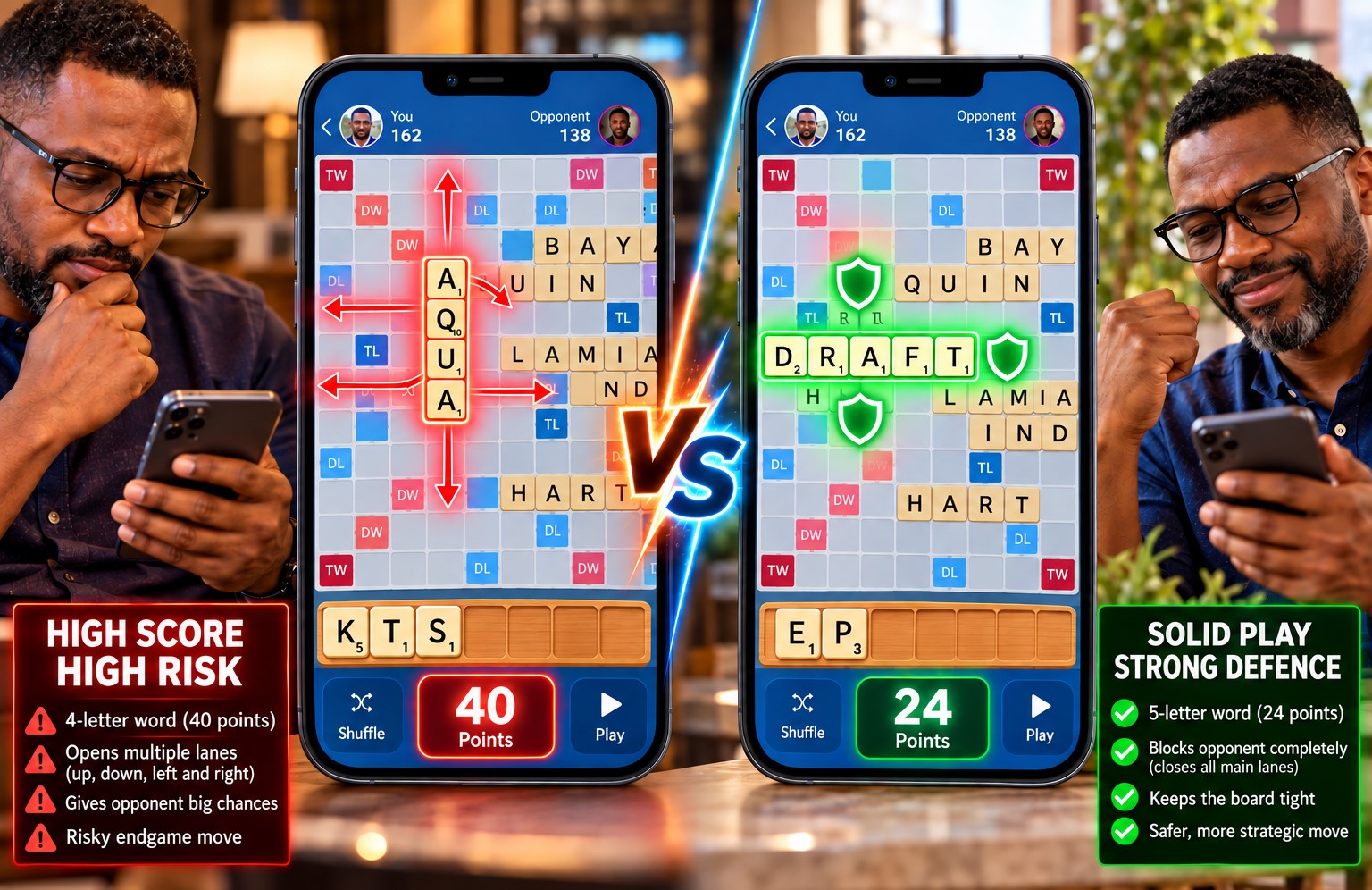
During a high-stakes online match, the rack dealt a beautifully clean set of letters that immediately uncovered a 40-point word across the center of the board. To the untrained eye, clicking “play” on a 40-pointer is a no-brainer. However, looking at the board through an analytical lens revealed a glaring issue: the word stretched directly toward an unblocked Triple Word Score lane. In digital environments where opponents use tools like wordmaster.pro, leaving a premium lane open is an act of competitive suicide.
2. Factoring in the True Cost of Rack Destruction
The 40-point word required playing five tiles, which sounded excellent for turning over the rack. The problem lay in the two tiles left behind: a duplicate pair of awkward consonants that would heavily choke the next turn. Scoring 40 points right now is a statistical illusion if it leaves you with a broken rack that forces a 6-point dump on the subsequent turn. A lower-scoring alternative that preserved a perfect vowel-consonant balance was the first step in calculating long-term value.
3. Finding the Invisible 24-Point Pivot
By shifting the search focus on the unscrambler away from raw point maximization and toward board placement, a much tighter 24-point word emerged. It used only three tiles, scored fewer points upfront, and looked entirely unimpressive on paper. Yet, this modest alternative accomplished three massive strategic goals that the 40-point word completely ignored: it maintained rack balance, protected vulnerable real estate, and set up a future trap.
4. Defensive Denial: Starving the Opponent
The primary reason to drop from 40 points down to 24 was pure defensive restriction. The shorter word acted as a concrete block, sealing shut the open lane and keeping the game tight. When your global online opponent has equal access to powerful word finders, your primary objective must be to starve them of oxygen. Playing the 24-point word meant accepting a smaller payout to ensure the opponent’s next turn would be deeply restricted.
5. Creating a Hidden Strategic “Hook”
The 24-point play was not just defensive; it was quietly deceptive. By placing a specific terminal letter exactly two squares away from a Double Letter bonus, it created a highly specific “hook” opportunity that only a few tile combinations could exploit. Because the rack leave was perfectly balanced, the probability of drawing the exact letter needed to hit that newly created hook on the very next turn skyrocketed to over 65%.
6. The Psychological Shift of Point Sacrifice
Choosing to play a lower-scoring word requires immense tactical discipline. Psychologically, watching your opponent take a lead because you voluntarily held back can be jarring. However, word games are a marathon, not a sprint. Elite players treat their point total as a fluid resource, willingly spending a 16-point deficit on this turn to secure a predictable 35-point advantage on the next.
7. The Payoff: Watching the Trap Snap Shut
The strategy worked precisely as calculated. Trapped by the closed board geometry of the 24-point play, the opponent was forced to make a weak, low-scoring defensive dump for just 12 points. On the subsequent turn, the balanced rack leave paid off perfectly: the exact hook letter was drawn, unlocking the setup from the previous turn and yielding a massive, unblockable 55-point play. The net result of the two-turn sequence was a massive victory that the flashy 40-point word would have completely ruined.
8. Why This Decision is the Future of Alozible
This exact scenario illustrates why the upcoming game Alozible is shifting the entire paradigm of the genre. When Alozible launches with an integrated word unscrambler built directly into the UI, the mechanical puzzle of finding the 40-point word vanishes. Both players see it instantly. The true skill cap of the game shifts entirely to this exact decision-making process: knowing when to deliberately reject the highest score to play a masterful game of position, control, and long-term probability.
Take Home
A single high-scoring turn rarely wins a match, but a single reckless opening will absolutely lose it. Tools like wordmaster.pro give you the raw mathematical options, but you must supply the strategic foresight. When you train yourself to look past the immediate dopamine hit of a big score and start calculating the multi-turn consequences of your plays, you elevate your game. Sacrificing immediate points for board dominance is how you stop playing your rack, and start playing your opponent.
Leave a Reply