Executive Summary
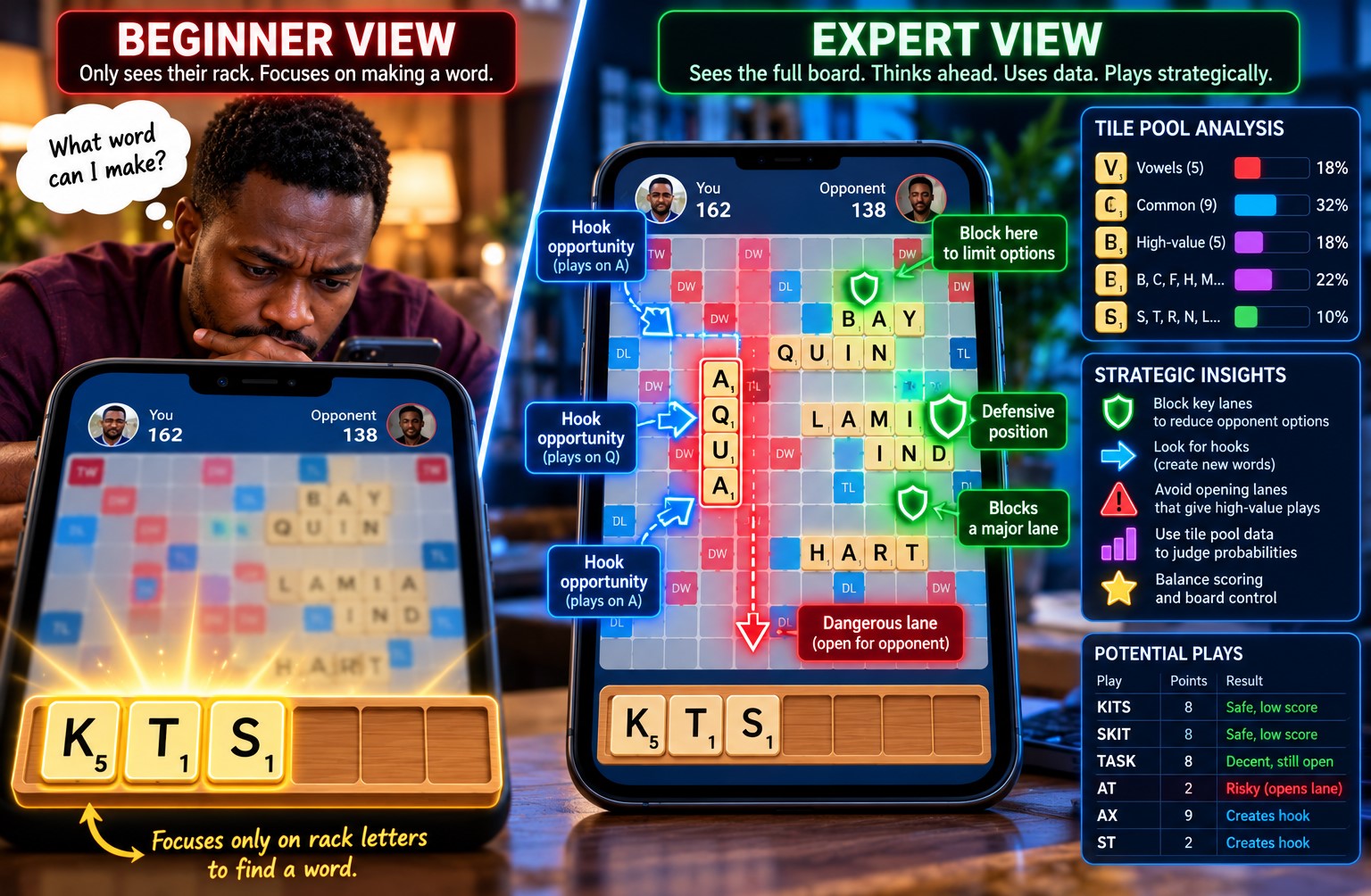
To a beginner, a word game looks like a simple exercise in spelling the longest word possible from a random hand of letters. To an expert, the exact same board looks like a dynamic network of geometric vectors, tile mathematics, and psychological traps. While novices waste their time looking down at their racks, elite players are looking up at the grid and into the future. By utilizing tools like wordmaster.pro to handle the raw mechanics of word discovery, top-tier players free up the mental energy needed to spot subtle match dynamics. This article breaks down the seven critical variables that separate casual players from seasoned tacticians, highlighting the core principles of next-generation strategic game design.
1. Rack Balance (The Vowel-to-Consonant Ratio)
Beginners celebrate playing a high-scoring 5-letter word, entirely ignoring the fact that they left themselves with a rack of four consecutive vowels. Masters know that your turn doesn’t end when you place your tiles—it ends when you draw your new ones. Good players constantly calculate their rack leave, intentionally playing sub-optimal scoring words if it preserves a healthy mix of vowels and consonants. They look at their rack as an engine that requires continuous tuning to avoid stalling on the next turn.
2. High-Value “Hooks” and Unseen Real Estate
A “hook” is a single letter that can be appended to the front or back of an existing word on the board to create an entirely new word (such as adding an ‘S’ to the end of “TRAIN” to make “TRAINS”). While a beginner only looks for completely open spaces, an experienced player treats every word on the board as a potential anchor point. They scan the grid for sneaky hook opportunities, knowing that a tiny 10-point word placed perpendicular to a hook can yield massive premium square payouts.
3. Open vs. Closed Board Geometry
Every move made on the grid changes the physical physics of the map. Good players immediately categorize the current state of the board as either “open” or “closed.” An open board features long, sprawling words with plenty of accessible hooks—ideal for aggressive, high-scoring comebacks. A closed board is dense, packed, and congested. If a master holds a comfortable lead, they will intentionally choose words that clog up open lanes, starving their opponent of space.
4. Symmetrical Tool Leverage and Open Lanes
In the modern digital landscape, smart players operate under the assumption that their global online opponents have access to external unscramblers like wordmaster.pro. Because of this, leaving an open lane to a Triple Word Score is no longer a calculated risk—it is a guarantee of punishment. Good players notice when a flashy move creates an opening for an equally well-equipped opponent. They will gladly shave 15 points off their current turn to permanently seal an aggressive lane shut.
5. Tracking the Power Tiles (The J, Q, X, and Z)
Novices panic when they draw high-value letters like the ‘Q’ or ‘Z’, desperately trying to dump them at the first opportunity. Experts view these power tiles as lethal weapons. They track whether these letters have been played yet in the match. If the ‘Z’ is still in the bag, a good player will deliberately hold open a path to a Double or Triple Letter Score, waiting to strike the moment the letter drops into their hand.
6. The Psychological Value of the Score Differential
The clock and the scoreboard dictate strategy just as much as the tiles on your rack. Beginners play the exact same way whether they are winning by 50 or losing by 100. Good players constantly adjust their risk tolerance based on the score differential. When trailing, they take massive, volatile risks to open up the board. When leading, they slow the tempo down, squeezing the board geometry to minimize variance and secure a predictable victory.
7. The Trap of the Inflexible “Bingo” Search
A “bingo” (using all seven tiles on your rack for a massive point bonus) is the dream of every casual player. Beginners will waste three consecutive turns hoarding specific letter groups in hopes of drawing a miracle combination. Good players recognize when a bingo search is counterproductive. If the board is too closed to physically fit a 7-letter word, holding onto inflexible tiles is a waste of time. They pivot instantly, choosing consistent, mid-tier scoring plays that maintain momentum.
Take Home Conclusion
The difference between a casual word-game enthusiast and a true master comes down to situational awareness. Tools like wordmaster.pro level the vocabulary playing field, but they cannot teach you how to read the grid. When you train your eyes to spot rack balance, board geometry, and defensive openings, you stop playing a basic spelling game. You begin playing a deep, multi-layered mind sport—proving that the ultimate winner isn’t the person who knows the most words, but the person who reads the board best.
Leave a Reply