
Executive Summary
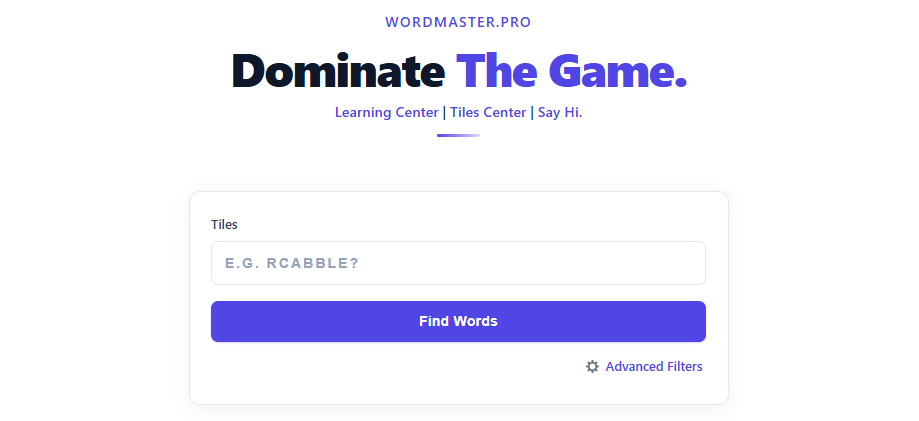
The debate over whether external word finders constitute cheating is the most polarizing conversation in modern word gaming. While traditionalists argue that tools like wordmaster.pro destroy the integrity of vocabulary recall, this perspective misses a massive cultural and technological shift. With millions of players now competing globally across digital screens, the old social contracts of the physical board game have evaporated. This article deconstructs the cheating narrative by exploring different play contexts—from strict competitive leagues to casual apps—and argues that we are simply defining the core skill of word games incorrectly. By shifting our perspective, tool usage transitions from a taboo shortcut into a foundational mechanic for a brand-new generation of strategic digital design.
1. The Real-World Friction of the Clandestine Tool
In the digital age, a silent friction exists between players who treat word games as closed-book exams and those who view them as open-ended puzzles. Because matches are played across smartphones over vast distances, millions of players quietly consult an external word unscrambler on a separate tab. Traditionalists view this hidden assistance as a breach of ethics that invalidates a victory. However, the sheer scale of tool usage suggests it is not a temporary lapse in morality, but a permanent shift in how modern players interact with the genre.
2. Context is King: The Four Tiers of Word Play
To understand the ethics of word finders, we must separate the community into logical contexts. In physical, sanctioned tournament play, tools are strictly forbidden because the established rule set specifically tests memory capacity under time pressure. In casual, family play, a tool acts as a bridge to prevent a massive vocabulary gap from ruining the fun. For practice and study, unscramblers are universally accepted as essential training aids. Finally, in modern digital ecosystems, tool access is fast becoming an ambient reality that players must assume their opponent is utilizing.
3. Deconstructing the “Cheating” Label
Cheating is defined as breaking an agreed-upon rule to gain an unfair advantage. When an app does not explicitly block external tools, or when both players are secretly using them, the advantage ceases to be unfair—it becomes symmetrical. Labeling an unscrambler as “cheating” is often a defensive reaction from veteran players who have invested years into memorizing dictionary lists and feel threatened when technology democratizes that knowledge instantly.
4. Shifting the Core Metric of Word Game Mastery
The real problem isn’t the technology; it’s our outdated definition of what makes a player “good.” If a word game is merely a test of who can memorize the most obscure jargon, then an unscrambler completely breaks it. But if a word game is a test of spatial geometry, risk calculation, and tactical positioning, then a tool doesn’t break the game—it actually enhances it. True mastery should be judged by how you deploy a word on the grid, not how well you can rearrange scrambled plastic tiles in your head.
5. Embracing the Chess Analogy
Imagine a game of chess where players were forced to blindly guess which moves were legally permitted on every turn, and the player who memorized the most legal movements won. That is how traditional word games operate for casual players. Using a tool like wordmaster.pro is equivalent to showing a player all their legal chess moves instantly. It doesn’t tell you which move to make; it simply clarifies your options so you can focus entirely on out-thinking your opponent’s long-term strategy.
6. The Educational Value of Discovery Over Memory
Purists often fear that tools make players lazy, but linguistic data suggests the opposite. Staring at an unplayable rack of letters causes frustration and leads to player abandonment. Using a word finder exposes players to high-scoring, real words they have never seen before, serving as an interactive learning engine. It fosters pattern recognition and contextual discovery, which teaches vocabulary far more effectively than reading a dry dictionary cover to cover.
7. The Futility of Digital Enforcement
From a purely practical standpoint, trying to prevent players from using external unscramblers on their digital devices is an impossible, losing battle. Screen-recording blocks, app-switching detection, and strict timers only irritate users without stopping someone from simply holding a second phone in their hand. Since you cannot reliably police the behavior behind the glass, the most logical design evolution is to design games around the tool’s permanent presence.
8. The Inevitable Shift Toward Equalized Interfaced Design
This exact philosophical evolution is driving a major conceptual pivot in modern game design. Rather than ignoring the reality of word finders or fighting an unenforceable war against them, the next generation of strategic word games will inevitably build an optimal unscramble engine directly into the game user interface for both players. By formalizing tool access natively, the genre removes the stigma entirely. It proudly declares that vocabulary is a solved problem, challenging players to prove their superiority through pure, unfiltered tactical skill on the grid.
Take Home
Word unscramblers are only considered cheating if you believe word games should be glorified spelling bees. If you view them as dynamic mind sports, tools like wordmaster.pro are simply the evolution of the game. Trying to force millions of global digital players to adhere to the living-room rules of the 1950s is a dead end. By leveling the playing field and integrating discovery tools natively, we elevate the entire genre—transforming word games from a tedious test of memory stamina into a thrilling, modern battle of wits.
Leave a Reply