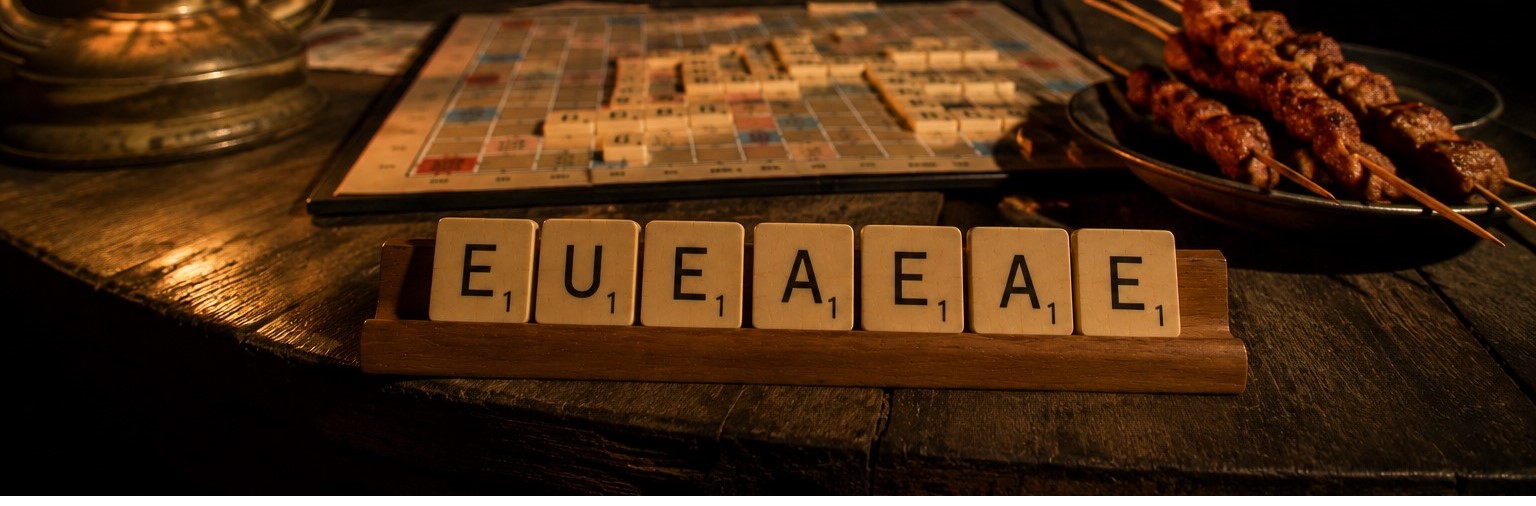
1. Executive Summary — Zero Now Can Be Worth More Than Twelve
A twelve-point play feels productive.
An exchange feels like surrender.
That instinct loses games.
Some racks cannot be rescued by a weak dump.
They must be rebuilt.
Trade when the leave is poison. Keep when the leave is alive.
Wordmaster.pro examines when exchanging tiles beats forcing a low-scoring play, how many tiles to swap, what to keep, and when the bag is too thin to fish. The goal is practical: help players stop treating exchange as a last resort for the hopeless and start treating it as rack surgery timed against bag depth and board state.
In standard Scrabble, you may exchange any number of tiles on your turn if at least seven tiles remain in the bag. You score 0 that turn. The price is tempo. The prize is a healthy rack.
This article is about when that trade is correct.
2. What an Exchange Actually Buys
An exchange is not “skipping.” It is buying a new leave at the cost of one turn’s score.
The real comparison
Every turn, compare:
| Option | Immediate score | Leave quality | Hidden cost |
|---|---|---|---|
| Soft dump (e.g. 12 points) | 12 | Often still broken | You may stay stuck for 2–3 turns |
| Exchange | 0 | Reset toward balance | Opponent gets a free turn |
The soft dump wins only if 12 + future leave beats 0 + rebuilt rack − opponent’s reply.
If the dump leaves you with UUQ, CCVW, or IIII, you did not fix the problem. You postponed it and scored almost nothing.
The exchange thesis
Exchange when the best playable word leaves a rack that still cannot score or bingo.
Play when the best play restores balance even if the score is modest.
That is the whole doctrine. Everything else is timing and count.
3. The Bag Rule — When Exchange Is Even Legal
Standard Scrabble rule:
- You may exchange only if seven or more tiles remain in the bag.
- If fewer than seven remain, exchange is closed. You must play or pass.
Practical bag thresholds
| Tiles in bag | Exchange bias |
|---|---|
| 40+ | Exchange freely when the rack is structurally broken. Turn over many tiles. |
| 20–39 | Exchange still strong, but weigh opponent’s open lanes more carefully. |
| 10–19 | Be selective. Prefer plays that score and repair leave. Exchange only for true disasters. |
| 7–9 | Last-chance exchanges. Keep any tile with endgame scoring value (X, J, Z if playable). |
| 0–6 | Exchange illegal / closed. Survive with dumps, blocks, and out-in-two math. |
Rule: Early bag = rebuild hard. Late bag = score and control.
4. When Trading Beats a Bad 12-Point Play
Exchange is usually better than a weak dump when two or more of these are true:
1. The leave after the dump is still poison
Examples of poison leaves:
- Q without U (and no Q-without-U word available)
- Duplicate I or U floods still intact
- C + V, V + W, or other rigid pairs remaining
- All vowels or all consonants after the play
A 12-point play into QIUU is not progress.
2. The board cannot absorb the awkward tiles
If your only playable word uses your best letters and parks the clunkers, you paid tempo to keep garbage.
3. The dump opens a dangerous lane for little score
A 12-point play that gifts a Triple Word corridor can be worse than scoring zero and redrawing.
4. You are not desperately behind on the clock of the match
If you need an immediate swing this turn, exchange may be too slow. If the set or game still has room, rebuild.
Quick decision gate
| Question | If yes |
|---|---|
| Is the best score under ~15 with a bad leave? | Strongly consider exchange |
| Would exchanging let me keep S / blank / ERST? | Favor exchange |
| Are 7+ tiles in the bag? | Exchange is legal |
| Will opponent likely bingo into an open lane this turn? | Prefer a blocking play over exchange |
| Is the bag under 10? | Prefer scoring dumps unless the rack is catastrophic |
5. How Many Tiles to Exchange
This is where most players under-trade.
Early game (fat bag)
Bias toward exchanging many.
- Broken rack with no keepers → exchange 6 or 7
- One useful tile (e.g. X or S) → keep it, exchange the rest
- Strong stem fragment (ERS, RET, EST) → keep 3, exchange 4
Turning over more tiles early raises your chance of drawing S and blanks — the two highest-equity tiles in the set.
Midgame
Be more surgical.
- Keep scoring anchors if premiums are open (X, J, Z when playable soon)
- Keep bingo synergy (E R S T N A)
- Still dump duplicates and rigid consonants aggressively
Pre-endgame (thin bag)
Exchange fewer tiles, or none.
- Keep anything that scores in a closed board
- Do not fish for blanks that are already gone
- A 12-point play that unloads Q may beat an exchange that redraws into nothing useful
The keep list vs the dump list
| Usually keep | Usually exchange |
|---|---|
| Blank | Duplicate I / U / V / C / W |
| S (one of them) | Second S when you already keep one |
| E, R, T, N, A (balanced mix) | Q without U and no play |
| One flexible high-scorer if bag is mid/late (**X**) | Clunky piles: **G G**, **UU**, **IIOOU** |
6. Worked Examples
Example A — The 12-point trap
Rack: Q U U I I V C
Best “play”: a forced short word for ~12 that still leaves Q / U / V problems
Better plan: exchange hard — keep nothing, or keep one I only if you must
Why: The soft dump does not restore bingo shape or Q safety. You spend a turn and remain broken.
Example B — Keep the knife, trade the junk
Rack: X V V W W U U
Plan: keep X, exchange the rest
Why: Early/mid bag, X still scores on premiums. The rest is a multi-choke disaster. A 10–14 point dump using X might also be correct if it clears two W/V tiles and lands on TLS — compare both.
Example C — Do not exchange a living leave
Rack: A E I N R S T
Board: no bingo fit this turn
Best play: a modest score keeping ERS or AERS, not an exchange
Why: This rack is already elite. Trading it is vandalism. Find any legal play that preserves stem quality.
Example D — Thin-bag refusal
Bag: 8 tiles left
Rack: awkward but playable for 18 with a neutral leave
Plan: play, do not exchange
Why: Opponent’s free turn matters more when few redraws remain. Score and contest the endgame.
Example E — Duplicate S clarity
Rack: S S A A I I U
Plan: exchange vowels/duplicates; consider keeping one S and A or I, not both S tiles as sacred
Why: Two S tiles compete. One S is currency. The vowel flood is the emergency.
7. Exchange vs Dump vs Fish
These three are not the same.
| Action | What you do | Best when |
|---|---|---|
| Dump | Play a short word to clear junk and score a little | Board accepts the awkward tiles; leave improves |
| Exchange | Score 0; redraw selected tiles | No play repairs the rack; bag is deep enough |
| Fish | Score little while keeping 6 for a specific draw | Stem is real; lane is open; needed tiles remain unseen |
Common mistake: fake fishing
Keeping six terrible tiles because “maybe the seventh will save me” is not fishing. Fishing requires a named stem and a real lane.
If you cannot name the target letter and the board line, exchange or dump instead.
8. Opponent Tempo — The Hidden Cost of Exchange
When you exchange, your opponent plays twice in a row relative to your scoring.
That matters most when:
- a Triple Word lane is open
- they just kept a bingo-prone leave
- the score is close late
In those cases, a defensive 16-point block can beat an exchange even if your leave stays imperfect.
Anti-gift rule
Do not exchange into an open detonation lane unless you first ask whether a modest blocking play exists.
Zero for you plus eighty for them is not rack improvement. It is self-sabotage.
9. Case Studies
Case Study A — Prideful Twelve
Player forces a 12-point play from I I U U C V W, keeps three clunkers.
Next two turns: still stuck; opponent bingoes twice.
Diagnosis: The 12-point “activity” hid a multi-turn collapse. Early exchange was correct.
Case Study B — Correct Full Refresh
Bag: 45 tiles left. Rack: Q U U U I I I with no playable Q word.
Player exchanges all seven.
Result: redraws into balanced tiles; scores normally afterward.
Diagnosis: Zero now, oxygen later. Correct.
Case Study C — Wrong Exchange of Gold
Rack: A E R S T L N — no bingo fit.
Player exchanges three “useless” tiles and wrecks the stem.
Diagnosis: This was a board problem, not a rack problem. Play a modest word. Keep the leave.
Case Study D — Late Panic Trade
Bag: 7 tiles left. Score: close. Rack: ugly but has a 22-point out-lane block.
Player exchanges anyway. Opponent scores 40 and seizes control.
Diagnosis: Thin bag + open threat = play/block, do not fish.
10. Wordfeud / Digital Notes
- Confirm the platform’s exchange rule. Most follow the seven-in-bag requirement.
- On digital clocks, decide the exchange in one pass: mark keepers, dump the rest, stop second-guessing.
- In multi-game online sets, do not refuse exchanges out of ego after a loss. Broken racks compound mental stacking.
11. Training Routine
Drill 1 — The 12-point test
For any ugly rack, force two candidates:
- best play under 15 points
- best exchange keep-set
Choose by leave quality and bag depth, not by fear of scoring zero.
Drill 2 — Keep-three discipline
Practice naming a maximum of three keepers before every exchange. If you cannot justify a fourth, trade it.
Drill 3 — Bag counting
Before exchanging, say out loud:
- tiles remaining
- blanks unseen
- S tiles unseen
No unseen blanks + thin bag = weaker exchange equity.
Drill 4 — Threat scan first
Before every exchange, scan opponent bingo lanes for five seconds. If a lane is hot, look for a block.
12. The Exchange Timing Checklist
- Are there 7+ tiles in the bag? If no, exchange is off the table.
- What is my best playable score and the leave it creates?
- Is that leave still poison (Q trap, vowel flood, rigid pairs)?
- If I exchange, which 1–3 tiles am I keeping — and why?
- Early bag? Bias toward exchanging more tiles.
- Thin bag? Bias toward scoring / blocking.
- Does exchanging hand the opponent a free shot at an open premium?
- Am I “fishing” without a named stem and open lane? Stop. Exchange or dump properly.
- Do I still hold blank or one S after the plan? Good.
- After the decision, commit. Do not spend three minutes converting a correct exchange back into a cowardly 8-point play.
Final Takeaway
A bad twelve-point play is not automatically better than zero.
Twelve points into a dead leave can cost thirty over the next two turns. An exchange that restores balance can repay the skipped score immediately.
Read the rack.
Count the bag.
Keep the currency tiles.
Trade the poison.
Block when the lane is hot.
Zero is sometimes the highest-equity number on the sheet.
Leave a Reply