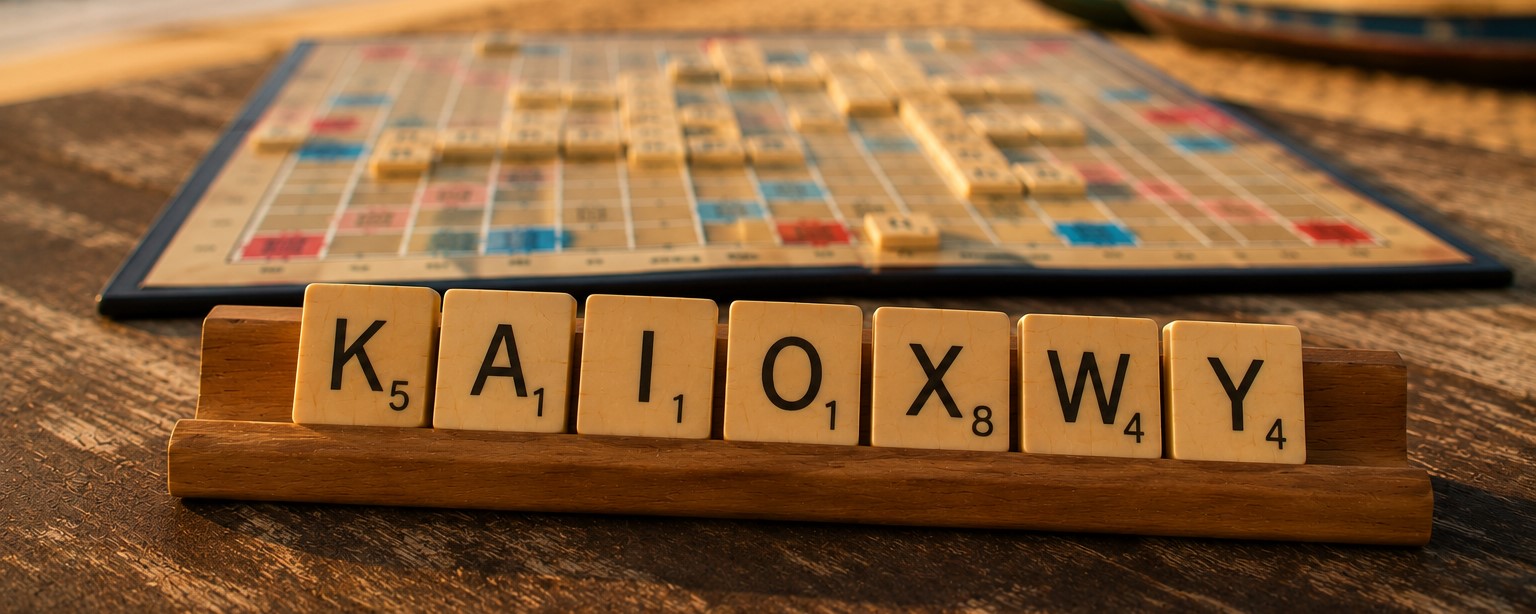
1. Executive Summary — Five Points That Cut Without a Seven-Letter Word
K is not a bingo tile.
It is a knife.
Two letters. One premium. Clean exit.
Amateurs hold K waiting for a miracle seven.
Masters put it on a Triple Letter and move on.
Wordmaster.pro examines how competitive players should treat the K tile — not as a stubborn power consonant to nurse toward a bingo, but as a short-play scoring weapon. The goal is practical: help players memorize the KA/KI/OK family, land K on letter premiums, and clear the tile before it locks the rack.
Standard Scrabble includes one K tile, worth 5 points. That scarcity is part of the edge. You will not draw K every game. When it appears, the correct instinct is usually a short, sharp dump — not a multi-turn fishing expedition.
This article is about cutting with K, not waiting on it.
2. Why K Rewards Short Plays
K sits between the flexible one-point tiles and the true power tiles (J, Q, X, Z). It scores enough to matter on a Double Letter or Triple Letter. It does not score enough to justify wrecking your leave for three turns while you hunt a seven-letter word that may never come.
The NWL two-letter K toolkit
Under NWL2023, K participates in only three two-letter words:
KAKIOK
| Word | Meaning | Strategic use |
|---|---|---|
| KA | Egyptian spiritual self | K beside A; classic parallel and dump |
| KI | Life force (variant of QI) | K beside I; second primary exit |
| OK | All right | Terminal K after O; easy endgame dump |
That is a thin list — but it is enough. Unlike C and V, K can parallel. Unlike W, its partners are common vowels you actually hold.
CSW note — do not import these into NWL
International play adds:
- KO — Maori digging stick
- KY — cattle (Scots)
Do not play KO or KY in an NWL tournament. They are CSW-only.
3. The Knife Doctrine
Rule 1: Prefer the short cut over the long hunt
A KA, KI, or OK on a letter premium often beats a mediocre five-tile word that keeps K “for later.”
Later is when the only open edges sit beside consonants K cannot touch.
Rule 2: Put K on the multiplier
K’s best job is sitting on a Double Letter or Triple Letter square inside a two- or three-letter word.
Rough math without board bonuses:
| Play | Base face | With K on TLS (×3 letter) |
|---|---|---|
| KA | 6 | 16 |
| KI | 6 | 16 |
| OK | 6 | 16 |
| KEX | 14 | 24 before word premiums |
Those are knife cuts — short, clean, high return per tile.
Rule 3: Do not marry K to a bingo fantasy
K appears in fewer high-probability bingo stems than S, R, T, N, E. Holding an otherwise broken rack because “K might make something long” is usually a tempo loss.
Rule 4: Spend K when it also clears another problem
WOK, SKY, IRK, and KAY are dual-purpose tools. The knife can cut two problems at once.
4. High-Utility K Dump Words (NWL-Verified)
The core two-letter family
Memorize these cold. They are your first scan every time K appears.
KAKIOK
Essential three-letter K dumps
| Word | Why it helps |
|---|---|
| KAF | Hebrew letter; strong F pairing. |
| KAS | Back-hooks KA; spend S only if the delta justifies it. |
| KAT | Simple A/T dump; easy fit. |
| KAW | Clears K and awkward W together. |
| KAY | Clears K and Y together. |
| KEA | Vowel-friendly New Zealand parrot. |
| KEF | Another strong F dump. |
| KEG | Clears K and G; common letters. |
| KEN | Simple E/N pairing. |
| KEP | Useful P dump. |
| KEX | High face value; excellent X + K knife cut. |
| KEY | Clears K and Y; natural English shape. |
| KID | Easy I/D clearance. |
| KIN | Extremely common; reliable midgame dump. |
| KIP | Simple I/P dump. |
| KIR | Useful when R is spare. |
| KIT | Easy I/T dump. |
| KOA | Hawaiian tree; O/A pairing. |
| KOI | Clean O/I dump. |
| KOS | Indian measure; O/S dump when S should go. |
| ILK | Terminal-K dump; useful after I/L. |
| IRK | Terminal-K dump with R. |
| OAK | Natural English terminal-K shape. |
| ASK | Common letters; easy placement. |
| SKY | Clears K and Y; strong consonant dump. |
| WOK | Clears W and K together. |
Useful four-letter K clearances
Anchor on these first:
- BAKE, CAKE, DARK, DESK, FORK, HIKE, JUNK, KEEP, KEPT, KITE, KNEE, KNOW, LAKE, LIKE, MAKE, MARK, MILK, PARK, PEAK, RAKE, RISK, SACK, SEEK, SILK, SINK, TAKE, TALK, TASK, WALK, WAKE, WEAK, WEEK, WORK, YANK, YORK
You do not need all of them. If you can land TAKE, LIKE, MAKE, WALK, or WORK with K on a letter premium, take the cut.
5. Premium Placement — Where the Knife Earns Its Keep
K is wasted on a plain square when a letter premium is available two cells away.
Priority landing spots
- Triple Letter under K inside KA, KI, or OK
- Double Letter under K inside a three-letter dump (KIN, KIT, KEG, KEX)
- K crossing two words so the five points are counted more than once
- Only then: longer words that also improve leave
What to avoid
- Parking K on a dead edge that opens a Triple Word for the opponent
- Using K solely to “make a word longer” when a two-letter premium play scores more with a healthier leave
- Holding K off a wide-open TLS because you are waiting for a bingo stem that does not include K
6. When K Combines With Other Problem Tiles
K is a dual-clearance specialist.
| Word | Also clears | Why it matters |
|---|---|---|
| KAY / KEY | Y | Rigid Y leaves with K |
| SKY | Y | Consonant-heavy dual dump |
| KAW / WOK | W | Thin-exit W leaves with K |
| KEX | X | Two high-value tiles in three letters |
| KAF / KEF | F | Awkward F relief |
| IRK / ILK | R or L | Terminal-K shapes from common leaves |
Decision order
- Can K land on a letter premium in KA / KI / OK?
- Can a three-letter dump clear K plus W, Y, or X?
- Can a natural four-letter word score well without wrecking leave?
- Only then consider holding K for one turn — and only if the rest of the rack is already excellent.
7. Case Studies
Case Study A — The Bingo Mirage
Rack: A E I N R T K
Board: open TLS available for KA or KI
Player decision: holds K for two turns fishing for a seven-letter word
Result: never bingos; eventually dumps K for low value on a plain square
Diagnosis: The knife was available on turn one. Fantasy replaced geometry.
Case Study B — The Clean TLS Cut
Rack: K A E S T N R
Play: KA with K on Triple Letter for 16, keep ESTRN-shape leave
Result: strong score-per-tile; rack remains bingo-capable
Diagnosis: Classic knife play. Short word, premium K, healthy leave.
Case Study C — The Dual Clearance
Rack: K W O A E I S
Play: WOK
Result: W and K leave together; rack simplifies immediately
Diagnosis: When two rigid tiles meet, search the overlap before separate dumps.
Case Study D — The CSW Trap
Rack: includes K and O
Player in an NWL club game plays KO
Result: challenged off; turn lost
Diagnosis: KO is international-only. Under NWL, use OK, KOA, KOI, or KOS instead.
8. Tracking the Single K
There is only one K in the bag.
| Situation | Implication |
|---|---|
| K still unseen | Opponent may be holding it — respect open TLS edges near A/I/O |
| You hold K | Default to short premium play unless a true bingo is present now |
| K already played | Stop planning K-hooks; move on |
Because K is unique, holding it “just in case” has less redraw backup than holding S. If you miss the window, there is no second K coming.
9. Training Routine
Drill 1 — Two-letter flash
KA KI OK
Add CSW extras only if you play international: KO KY
Drill 2 — Three-letter knife flash
KAF KAS KAT KAW KAY KEA KEF KEG KEN KEP KEX KEY KID KIN KIP KIR KIT KOA KOI KOS ILK IRK OAK ASK SKY WOK
Drill 3 — Premium visualization
On an empty practice board, place K on every Triple Letter and ask:
- Which of KA / KI / OK fits?
- Which three-letter dump fits?
- What leave remains?
Drill 4 — Anti-bingo discipline
For any rack with K, force yourself to name:
- the best two-letter K play
- the best three-letter K play
- the best bingo / long play
Then choose by score + leave — not by romance.
10. The K-Tile Knife Checklist
- Do I hold K? Scan KA, KI, and OK first.
- Can K sit on a Double Letter or Triple Letter?
- Can a three-letter dump clear K plus another problem tile?
- Am I holding K only for a bingo that is not on the rack now? Dump instead.
- Would spending S via KAS or KOS earn enough to justify losing S equity?
- Am I accidentally thinking of KO or KY in an NWL game? Stop.
- Does the short K play open a dangerous Triple Word for the opponent? Recalculate.
- Has the single K already been played by either side? Update tracking.
- After the dump, is the leave balanced — or did I keep junk just to “save K options”?
- If no legal short play exists and the board is closing, exchange before K becomes stranded.
Final Takeaway
K is not waiting for a seven-letter masterpiece. It is waiting for a premium square and two honest partners.
KA. KI. OK.
Three-letter dumps.
Letter multipliers.
Dual clearances with W, Y, and X.
Use the knife.
Take the cut.
Rebuild the rack.
Short plays win more K games than long fantasies.
Leave a Reply