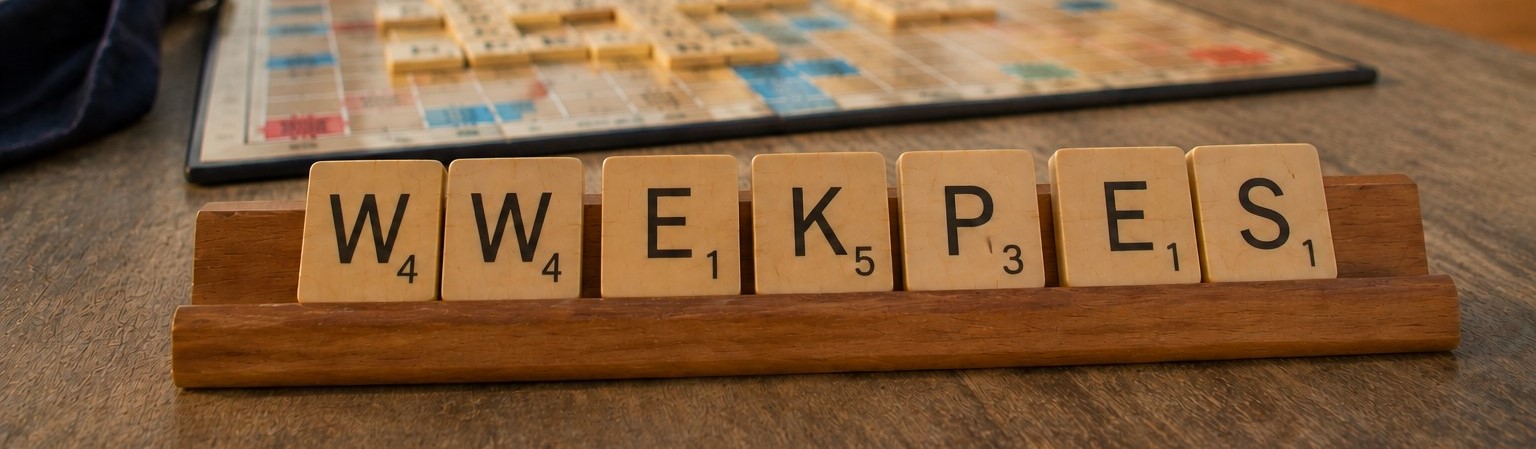
1. Executive Summary — Four Points, Five Exits
W looks playable.
It is not flexible.
Five two-letter partners.
Almost none of them are consonants.
Hold it into a clogged board and the rack freezes.
Dump it while three-letter lanes still exist.
Wordmaster.pro examines why the W tile creates a parallel-play dead zone, which short dumps clear it before the board closes, and how W combines with other awkward consonants into multi-tile lockdowns. The goal is practical: help players stop treating W like a normal four-point tile and start treating it like a timed clearance problem.
Standard Scrabble includes two W tiles, each worth 4 points. That face value tempts players to hold W for a “better” premium later. The geometry usually disagrees. W can form two-letter words — unlike C and V under NWL — but those exits are so narrow that midgame and endgame parallel packing still reject it.
This article is about getting W off the rack before the dead zone wins.
2. Why W Lives in a Dead Zone
Parallel plays require every overlapping pair to be legal. Most of those pairs are two-letter words.
The five NWL two-letter W words
Under NWL2023, W participates in exactly five two-letter words:
AW, EW, OW, WE, WO
That is the entire parallel toolkit.
| Word | Meaning | Parallel use |
|---|---|---|
| AW | Exclamation of protest | W beside A |
| EW | Exclamation of disgust | W beside E |
| OW | Exclamation of pain | W beside O |
| WE | Pronoun | W before E |
| WO | Woe (archaic) | W before O |
What those five exits do not allow
If your intended parallel sits beside B, C, D, F, G, H, J, K, L, M, N, P, Q, R, S, T, U, V, X, Y, or Z, W cannot form a two-letter cross with that letter under NWL.
So W is not as hopeless as C or V. It is still hostile to dense boards. On a packed midgame grid, “almost no consonant partners” behaves like a dead zone.
Quick comparison with other rigid consonants
| Tile | Face value | NWL 2-letter partners | Parallel verdict |
|---|---|---|---|
| C | 3 | None | Zero-exit lockdown |
| V | 4 | None | Zero-exit lockdown |
| W | 4 | AW, EW, OW, WE, WO | Thin-exit dead zone |
| Y | 4 | AY, BY, MY, OY, YA, YE, YO | Limited but wider than W |
Rule of thumb: Treat W closer to C/V than to S. Clear it early.
3. The W Clearance Doctrine
Rule 1: Prefer a clean three-letter dump over a future fantasy
A modest WET, WIN, WAR, or WOE that removes W and restores rack balance often beats a higher-scoring play that keeps W “for a Triple Letter later.”
Later is where consonant walls appear.
Rule 2: Aim the W at a letter premium when the dump is short
Because W is already four points, a Double Letter or Triple Letter under the W turns a clearance play into real score. Do not invent a long word just to justify holding it.
Rule 3: Do not fish for a W bingo while the board is closing
W is a weak bingo citizen compared with S, R, T, and N. If the board still accepts three- and four-letter W words, spend it. Waiting for WATERED while lanes disappear is how dead zones form.
Rule 4: Watch W beside other rigid tiles
W + C, W + V, or W + Y is a multi-choke rack. Search double-clearance words before you protect a “pretty” leave.
4. High-Utility W Dump Words (NWL-Verified)
Essential three-letter W dumps
| Word | Why it helps |
|---|---|
| WAD | Simple A/D pairing; easy placement. |
| WAG | Clears W and G together. |
| WAN | Common letters; flexible fit. |
| WAR | Strong when R is spare. |
| WAS | Uses S; only spend if S equity is justified. |
| WAX | High face value; excellent X + W dump. |
| WAY | Clears W and Y together. |
| WEB | Useful B dump with E. |
| WED | Easy E/D clearance. |
| WEE | Double-E vowel relief. |
| WET | Extremely common; reliable midgame dump. |
| WHO | Clears H and W; strong face value. |
| WHY | Clears W, H, and Y in one shot. |
| WIN | Simple I/N pairing. |
| WIT | Easy I/T dump. |
| WIZ | Strong Z + W clearance. |
| WOE | Clean O/E dump. |
| WOK | Clears awkward K with W. |
| WOW | Double-W emergency valve. |
| VOW | Terminal-W dump that also clears V. |
| YAW | Clears Y and W together. |
| YOW | Another Y/W relief valve. |
Useful four-letter W clearances
Start with these high-frequency shapes:
- AWAY, CREW, DRAW, GREW, SHOW, SLOW, SNOW, SWAN, WADE, WAGE, WAKE, WALK, WALL, WAND, WANT, WARD, WARE, WARM, WARN, WART, WASH, WASP, WAVE, WAWL, WEAR, WEED, WEEK, WELD, WENT, WEPT, WERE, WEST, WHAT, WHEN, WHET, WHIR, WHIT, WIDE, WIFE, WILD, WILL, WILT, WIND, WINE, WING, WINK, WIPE, WIRE, WISE, WISH, WITH, WOLF, WOOD, WOOL, WORD, WORE, WORK, WORM, WORN, WOVE
You do not need the whole list. Anchor on WENT, WEST, WHAT, WHEN, WIDE, WINE, WIRE, WISE, WITH, WORD, WORK.
Double-W emergencies
If both W tiles arrive:
| Word | Notes |
|---|---|
| WOW | Shortest double-W dump |
| WAW | Another short double-W shape |
| WAWL | Extends the double-W clearance |
Do not wait for elegance. Two W tiles on one rack is a structural crisis.
5. When W Combines With Other Choke Tiles
W rarely arrives alone as a problem. It arrives with company.
Priority multi-clearance words
| Word | Clears | Why it matters |
|---|---|---|
| WHY | W, H, Y | Best everyday triple involving W and Y |
| WAY | W, A, Y | Short W+Y dump |
| YAW | Y, A, W | Alternate W+Y shape |
| YOW | Y, O, W | Alternate W+Y shape |
| VOW | V, O, W | Clears zero-exit V with thin-exit W |
| WAX | W, A, X | High-scoring dual dump |
| WIZ | W, I, Z | High-scoring dual dump |
| WOK | W, O, K | Clears W and K together |
| CREW | C, R, E, W | Useful when C and W both present |
| WAVE | W, A, V, E | Clears W and V in four letters |
Decision order
- Can I clear W plus another choke tile now?
- If not, dump W alone with a three-letter word while lanes exist.
- If W will not fit, dump the worse partner (often V or C) and keep hunting for W.
- If the bag is deep and nothing fits, exchange W before the board seals.
Never carry W + V + Y deep into a closed endgame unless the score gap forces desperation.
6. Parallel-Play Reality Check
Why W “refuses” to parallel
W does not refuse every parallel. It refuses most of them.
A parallel column that asks W to sit beside T, N, R, S, or L will usually die under NWL, because none of those pairs make a two-letter word. Players feel this as “W never fits,” even though AW / EW / OW / WE / WO exist.
How to use the five exits
Scan the board for open A, E, or O edges first. Those are the only vowels W can touch as a two-letter cross. Then check whether WE or WO can start a short parallel.
If those five shapes are unavailable, stop hunting two-letter miracles. Switch to a standalone three-letter dump.
Defensive note
Leaving an open A / E / O beside a hot premium can gift the opponent an easy AW / EW / OW reply with their W. Do not open those edges carelessly when a W remains unseen.
7. Case Studies
Case Study A — The Premium Fantasy
Rack: A E R S T W N
Board: open early midgame
Player decision: skips WET / WAN / WAR to save W for a future Triple Letter
Next two turns: board densifies; no legal parallel for W remains
Result: forced exchange or ugly dump under pressure
Diagnosis: Four points of face value were treated as future treasure. The geometry expired first.
Case Study B — The Clean Dual Clearance
Rack: A E W Y T S R
Play: WAY or YAW through an open lane
Leave: balanced residual tiles
Result: W and Y both gone; rack breathes again
Diagnosis: Spending three tiles to remove two rigid consonants can beat a longer word that keeps W.
Case Study C — The VOW Escape
Rack: V O W A E I N
Play: VOW
Result: zero-exit V and thin-exit W leave together
Diagnosis: When V and W meet, search the overlap words before separate dumps.
Case Study D — The WAS Trap
Rack: includes W and one valuable S
Play: WAS for a modest score
Result: W is gone, but S equity was spent cheaply
Diagnosis: Clearing W is good. Paying for it with a poorly spent S can still be wrong. Prefer WET, WIN, WAR, or WOE when S should be kept.
8. CSW / Digital Notes
Under CSW24, W does not gain new two-letter partners. The five exits remain:
AW, EW, OW, WE, WO
So the international lexicon does not rescue W the way CH rescues C. The dead zone stays real.
On a digital rack, slide W to one end and force a three-second dump scan before you anagram the pretty tiles. Do not bury W between bingo-looking letters where the eye skips the problem.
9. Training Routine
Drill 1 — Two-letter flash
AW EW OW WE WO
Say them until parallel scanning becomes automatic.
Drill 2 — Three-letter dump flash
WAD WAG WAN WAR WAX WAY WEB WED WEE WET WHO WHY WIN WIT WIZ WOE WOK WOW VOW YAW YOW
Drill 3 — Multi-choke scramble
Build practice racks with W plus C, V, or Y. Force:
- a dual-clearance word
- a W-only dump
- the healthiest leave after each option
Drill 4 — Board filter
Before every W play, ask:
- Am I using one of the five two-letter exits?
- If not, is this a true three-letter dump?
- Am I opening an A/E/O edge that gifts their W?
10. The W-Tile Dead-Zone Checklist
- Do I hold W? Search three-letter dumps immediately.
- Can I use AW / EW / OW / WE / WO for a parallel? Check A, E, O edges first.
- Do I also hold V, Y, C, K, X, or Z? Search dual-clearance words (VOW, WHY, WAY, WAX, WIZ, WOK, CREW).
- Is the board still open enough for WET / WIN / WAR / WOE? Spend W now.
- Am I saving W only for a future premium? Recalculate — lanes die faster than premiums appear.
- Do I hold both W tiles? Prioritize WOW, WAW, or WAWL.
- Would the dump spend a precious S for little gain? Prefer a non-S clearance.
- Are unseen W tiles still in the bag? Avoid gifting open A/E/O edges beside premiums.
- Is the bag thin and the board sealed? Exchange before W becomes unplayable.
- After clearing W, rebuild toward flexible stems — do not immediately re-hoard the next rigid consonant.
Final Takeaway
W is not a zero-exit tile. It is a thin-exit tile — and on a real board, that is often the same problem wearing better clothes.
Five two-letter partners, mostly vowels. Four points of face value. Two tiles in the bag. Poor synergy with dense parallel packing.
See W early.
Dump it while three-letter lanes exist.
Combine it with other choke tiles when you can.
Do not worship a premium that may never open.
Clear the dead zone.
Restore the rack.
Return to letters that cooperate.
Leave a Reply