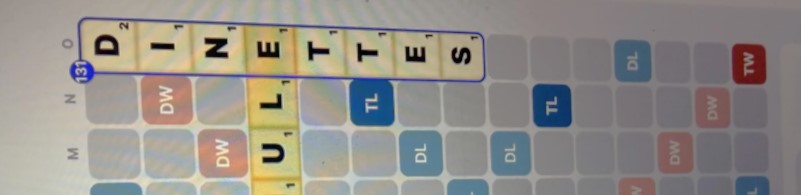
1. Executive Summary — The Nine-Timer Doctrine
A single Triple Word Score is a weapon.
Two Triple Word Scores in one word are a detonation.
Face value × 3 × 3 = ×9.
That is the triple-triple.
Amateurs wait for miracles.
Masters engineer the lane.
Seed. Span. Detonate. Convert.
Wordmaster.pro maps how dual Triple Word Score bridges stack to ×9, how to seed and measure the rare eight-cell edge corridors that make those bridges possible, and how to decide when a low-scoring setup is worth more than a greedy dump — so players can engineer 100+ point nine-timers instead of waiting for them, and shut the same lanes down when the opponent arms them first.
The triple triple scrabble play — also called a nine-timer — is the highest-leverage single turn in standard Scrabble geometry. One word covers two fresh Triple Word Score (TWS) squares. Word multipliers stack sequentially. A modest twenty-point face path becomes 180. Add a bingo bonus and you enter the 100 point scrabble play stratosphere — often 200–350+ in live tournament conditions.
Why the holy grail is rare — and engineerable
| Requirement | Constraint |
|---|---|
| Two unused TWS on one line | Only edge corridors qualify |
| Exact span length | Usually 8 letters between mid-edge and corner TWS |
| Rack + board synergy | Typically 7 rack tiles + 1 board letter |
| Fresh premiums | Both TWS must still be unused |
| Legal crosses | Every orthogonal join must hold |
This guide is the operating system for nine timer scrabble construction, two triple word scores bridging, scrabble bingo setup toward edge lanes, and multiplier stacking under clock.
2. The Mathematics of Dual TWS Bridging: Multiplier Stacking Velocity (MSV)
Multiplier Stacking Velocity (MSV)
Multiplier Stacking Velocity (MSV) measures how fast face value converts into turn score when word premiums compound.
MSV = (Face Path × Word Mult Product) + Bingo Bonus + Cross Totals
      ÷ Tiles Newly Placed
For a clean triple-triple:
Word Mult Product = 3 × 3 = 9Worked detonation
Assume an 8-letter bridge with face path 24 (letter premiums already applied), bingo-eligible clear, no major crosses:
Word score  = 24 × 9 = 216
Bingo       = +50   (Scrabble)
Total       = 266
Tiles used  = 7 from rack (+ 1 board letter)
MSV         ≈ 38 per rack tile
A normal midgame bingo through one TWS:
(24 × 3) + 50 = 122
MSV ≈ 17 per rack tile
The nine-timer more than doubles efficiency. That is why premium lane bridging justifies multi-turn setup spend.
Geometry census — where ×9 is possible
On the classic 15×15 Scrabble board, eight TWS sit at:
Corners: A1, A15, O1, O15
Mid-edges: A8, H1, H15, O8
Achievable dual-TWS spans (empty-lane ideal):
| Line | TWS pair | Empty gap between | Word length to cover both |
|---|---|---|---|
| Row 1 | H1 ↔ A1 | 7 | 8 |
| Row 1 | H1 ↔ O1 | 7 | 8 |
| Row 15 | H15 ↔ A15 | 7 | 8 |
| Row 15 | H15 ↔ O15 | 7 | 8 |
| Col A | A8 ↔ A1 | 7 | 8 |
| Col A | A8 ↔ A15 | 7 | 8 |
| Col O | O8 ↔ O1 | 7 | 8 |
| Col O | O8 ↔ O15 | 7 | 8 |
| Row 8 / Col H | mid-edge pairs | 7 | 8 |
Corner-to-opposite-corner (A1–O1) spans 15 cells. That requires a board already half-built. The practical holy grail is the 8-letter mid-edge ↔ corner bridge.
Triple-Triple Feasibility Matrix
| Setup state | Rack need | Hit probability | Defensive risk if left open |
|---|---|---|---|
| Empty 8-lane, no hook | 8 letters (impossible from rack alone) | Near zero | Low |
| One hook letter in lane | 7-letter bingo through hook | Low–moderate | Extreme |
| Two+ support letters | Flexible 7–8 spans | Moderate | Extreme |
| Soft vowel hooks + open S | High bingo connectivity | Elevated for opponent | Catastrophic |
| Rigid block in lane | — | Denied | Safe |
3. The Holy Grail Directory: Setup Architectures
Triple-triples are not found. They are built. Three architectures dominate.
3A. The Hook-Seed Bridge — 7 Rack + 1 Board
Role: Classic tournament path to ×9.
Plant or inherit one letter inside the 8-cell corridor between two TWS. Next turn, fire a 7-tile bingo through that seed so the word starts on one TWS and ends on the other.
Structural rules
- Choose an edge corridor (rows 1/8/15 or columns A/H/O).
- Ensure both TWS cells are still virgin.
- Seed a high-frequency hook — S, E, R, D, A, I, N, T — on a non-TWS cell inside the span.
- Keep a bingo-prone leave: SATIRE / RETAIN / TISANE families when possible.
- Fire only when the eight-letter string is fully legal and all crosses hold.
Hook liabilities
| Seed letter | Setup power | Opponent theft risk |
|---|---|---|
| S | Highest connectivity | Extreme — block or race |
| E / R / D | High | High |
| A / I / N / T | Strong | High |
| Hard V / C / J | Weak for you | Safer denial |
Spatial footprint
[TWS] · · · [SEED] · · · [TWS]
  1   2 3 4    5    6 7 8   ← 8 occupied cells after bingo
You place seven tiles. The seed is already there. Both TWS receive new coverage in one turn.
3B. The Lane-Opener Cascade — Two-Turn Engineering
Role: Spend Turn N to unlock Turn N+1 detonation.
Protocol
- Turn N: Play a short or medium word that opens access toward an edge TWS pair without gifting an easy opponent nine-timer.
- Prefer openers that keep your private hook letter on rack.
- Score enough to stay solvent — typically 12–22 — while maximizing setup EV.
- Turn N+1: Cash the bridge if the lane survives.
Setup EV algebra
EV_setup = Score_N + P(lane survives) × Score_triple_triple
           + P(lane dies) × Score_fallback
           − Best_immediate_alternative
If EV_setup exceeds the best one-turn cash-out, the setup is correct. A 15-point seed that enables a 40% shot at 220 beats a sterile 32-point dump:
15 + 0.40×220 + 0.60×25 − 32 = 15 + 88 + 15 − 32 = 86 EV advantageHook liabilities
Lane openers often create soft edges. Audit:
- Opponent 8-letter threats through your seed
- Parallel overlays beside the corridor
- Alternate TWS pair on the same edge
Spatial footprint
Keep the corridor one move from completion for you, awkward for them. Private hooks beat public S gifts unless you can fire immediately.
3C. The Pre-Built Spine — Using Existing Edge Words
Role: Convert a half-filled edge into a sudden ×9.
Sometimes the board already holds two or three letters on row 1/15 or column A/O. You do not need a pure empty 8-span. You need the missing cells — including both TWS — filled by your play so one continuous word covers both premiums.
Structural rules
- Trace the candidate edge word fragments.
- Confirm both TWS remain empty.
- Count empties you must fill from rack.
- If empties ≤ 7 and a legal string exists, calculate ×9.
- Validate every new cross on the edge.
Hook liabilities
Pre-built spines are public. Both players see them. Race or block — do not daydream.
Spatial footprint
More board letters mean more crossword constraints. Feasibility rises for length; legality difficulty rises for crosses. Elite scanners win here.
Directory synthesis — scrabble bingo setup toward ×9
| Architecture | Best when | Primary risk |
|---|---|---|
| Hook-seed bridge | You hold bingo stem + private hook plan | Opponent steals seed |
| Lane-opener cascade | Ahead/even with strong future rack | Setup overinvestment |
| Pre-built spine | Edge already half-filled | Shared visibility |
4. Spatial Geometry: Building and Denying the Corridor
4.1 The Eight-Cell Measuring Tape
Objective: Verify that your intended bridge truly covers two TWS.
Protocol
- Put a finger on the first virgin TWS.
- Count through to the second virgin TWS on the same line.
- Confirm the inclusive length is 8 for mid-edge ↔ corner pairs.
- Mark which one cell is (or will be) the board seed.
- Confirm seven rack tiles complete the string.
| Cell | 1 | 2 | 3 | 4 | 5 | 6 | 7 | 8 |
| Content | TW | · | · | · | S | · | · | TW |
| Role | Premium | Rack fill | Seed | Rack fill | Premium | |||
Teaching sketch: one seed + seven new tiles → eight-letter dual-TWS cover.
4.2 The Edge-Only Law
Objective: Stop hunting nine-timers in the interior.
Interior DW diagonals create double-doubles (×4). They do not create triple-triples. Only lines that already contain two TWS can host ×9.
Scan order every mid/late game
- Row 1 left span and right span
- Row 15 left span and right span
- Column A upper/lower spans
- Column O upper/lower spans
- Row 8 / Column H mid-edge pairs
If none show a viable seed + stem, abandon holy-grail fantasy for this turn.
4.3 Denial Geometry — Blocking the Opponent’s Grail
Objective: Delete their corridor before they cash it.
Denial tools
| Tool | Method | Best use |
|---|---|---|
| Lane plug | Occupy a cell between the two TWS | Immediate freeze |
| Seed theft | Take their public hook yourself | If you can score / transform |
| Soft-hook starve | Avoid leaving S/E gifts on the edge | Prevention |
| Rigid terminal | End nearby plays on V/C/J facing the lane | Long-term choke |
| Race | Fire your own bridge first | When EV favors offense |
Rule: An open seeded 8-lane is an emergency — treat it like an unguarded TWS with rocket fuel.
5. Case Studies: The Passiveful Fish vs. The Engineered Detonation
Case Study A — The Wishful Fish
Board: no real dual-TWS corridor; one lonely edge TWS.
Player decision: Hold a near-bingo rack for three turns “waiting for a triple-triple.”
Result: Opponent scores steadily. Player finally dumps for 18. No ×9 ever appeared.
Autopsy
| Metric | Result |
|---|---|
| Setup turns | 3 wasted |
| Actual dual-TWS lane | Never existed |
| Opportunity cost | ~60–90 |
| Outcome | Self-inflicted stagnation |
Diagnosis: Holy-grail delusion. Without an 8-cell edge span and a seed plan, fishing for nine-timers is just slow play.
Case Study B — The Engineered Detonation
Turn N: Master scores 16 placing a private-friendly seed structure that opens the H1–O1 corridor while keeping the critical hook timing on their side of the bag.
Turn N+1: Fires an 8-letter bridge covering both TWS.
| Component | Value |
|---|---|
| Face path after letter premiums | 28 |
| ×9 word stacking | 252 |
| Bingo bonus | +50 |
| Minor crosses | +12 |
| Turn total | ~314 |
Two-turn package
| Turn | Score | Board effect |
|---|---|---|
| Setup | 16 | Lane armed |
| Detonation | ~314 | Match swing |
| Combined | ~330 | Momentum locked |
Diagnosis: Engineered detonation. Setup EV crushed the greedy one-turn alternative. That is elite scrabble bingo setup toward two triple word scores.
Extraction principle: A 16-point seed that enables a realistic nine-timer beats a 35-point dump that permanently closes the only ×9 corridor on the board.
6. The Triple-Triple Scan & Setup Runbook
Every turn — 10-second grail scan
- List virgin TWS remaining.
- Check edge pairs with inclusive span 8.
- Count board letters already inside each span.
- Ask: can seven rack tiles complete a legal bridge?
- If yes, calculate ×9 + bingo + crosses.
- If almost, ask whether a ≤20-point setup creates the missing seed.
- If the lane is opponent-ready, deny or race immediately.
Setup decision gate
| Question | If yes |
|---|---|
| Is there a real 8-span edge pair? | Continue |
| Are both TWS unused? | Continue |
| Do I have stem + hook path within one turn? | Arm or fire |
| Is opponent closer to cashing than I am? | Block first |
| Is EV_setup > best immediate score? | Setup |
| Am I fantasizing without a corridor? | Stop fishing |
Ultra-scannable checklist
- Edge line identified?
- Two TWS confirmed virgin?
- Span length = 8?
- Seed present or plantable?
- Bingo stem alive on rack?
- All future crosses plausible?
- Opponent theft EV priced?
- If all clear — engineer or detonate.
- If not — take normal points. Do not worship ghosts.
Wordfeud / mobile note
Wordfeud and other custom grids may relocate TWS. The ×9 stacking rule still holds wherever two unused TW sit on one line at a spannable distance. Remeasure the map. Do not import Scrabble coordinates blindly. Bingo bonus may be +40 instead of +50 — still explosive under ×9.
Final operating rule
The triple-triple is not luck.
It is multiplier stacking on a measured edge corridor.
Eight cells. Two TWS. One seed. Seven tiles.
Setup when EV demands it.
Deny when they arm it first.
Detonate when the span is real.
When the holy grail appears, do not admire it.
Bridge the premiums.
Take the hundred.
Take the match.
Leave a Reply