1. Executive Summary — The Grandmaster Unification
Tactics win turns.
Systems win matches.
Grandmasters do not “find words.”
They run a unified decision engine.
The jump from strong club player to true strategic dominance is not another word list. It is synthesis. You already know hooks, overlaps, premiums, and rack shape. The grandmaster layer fuses those modules into one turn-by-turn operating system: tile tracking, board geometry, score-spread variance, and opponent psychology—computed together, not in sequence.
Dynamic Game-State Matrix (DGSM)
On every turn, elite players solve the same three-axis matrix before they touch a tile:
DGSM Decision =
f(Unseen Tile Distribution, Board Geometry Equity, Score-Spread Variance Policy)| Axis | Input | Output |
|---|---|---|
| Tracking | Bag + opponent rack inference | What futures are still probable |
| Geometry | Open lanes, hooks, premiums | What futures the board allows |
| Meta / variance | Score gap + clock + series context | How much chaos you should buy |
A pretty bingo that opens two Triple Word Score corridors can be correct when trailing by 70 and wrong when leading by 40. Same word. Opposite DGSM outputs. That is the unification.
Law of grandmaster play:
Never ask only “What is my highest score?”
Ask “What distribution of future scores does this move create—for both players?”
2. Mid-Game Differential Tile Tracking
Basic tracking counts letters. Differential Tracking adjusts policy from the remaining pool’s shape—especially with 20–40 tiles left in the bag (classic mid-to-late midgame window in a 100-tile Scrabble bag, after both racks are accounted for).
2.1 Differential Tracking — definition
Unseen Pool = Bag Remaining + Opponent Rack (inferred range)You do not need perfect opponent-rack certainty. You need directional concentration:
- Too many unseen vowels → bingo fish and vowel-dump defense matter more.
- Too many unseen consonants → fishing for pretty leaves becomes self-harm.
- Unseen
S/ blank density → hook and bingo threat radius expands. - Unseen power tiles (
J/Q/X/Z) → pocket and TLS pivots stay hot.
Differential means: when two candidate plays score within ~8–12 points, the unseen pool breaks the tie.
2.2 Vowel-to-Consonant Inversion Ratio (VCIR)
Standard Scrabble distribution (100 tiles) contains 42 vowels (A9 E12 I9 O8 U4) and 56 consonants, plus 2 Y tiles (semi-vowel; track separately). For midgame balance math, treat Y as neither pure vowel nor pure consonant—park it in a third bucket.
Define remaining unseen counts:
V = unseen A/E/I/O/U
C = unseen pure consonants (exclude Y)
Y = unseen Y
B = tiles still in bag (after subtracting what you hold)
VCIR = V ÷ max(C, 1)Interpretation bands (midgame, 20–40 in bag)
| VCIR band | Pool shape | Opponent likelihood | Your adjustment |
|---|---|---|---|
| ≥ 0.90 | Vowel-heavy unseen | Higher bingo / dump volatility | Keep lanes colder if leading; fish vowels if trailing |
| 0.55–0.89 | Near-normal | Standard grind | Optimize PTE + rack leave |
| ≤ 0.54 | Consonant-heavy inversion | Bingo rate collapses; clunky racks rise | Prefer lane starvation; avoid opening for phantom bingos |
Worked example (fact-checked arithmetic)
Bag has 28 tiles. You hold 7. Opponent holds 7. Unseen beyond your rack = 35 (28 bag + 7 opponent).
Suppose your tracking shows unseen:
V = 11, C = 22, Y = 2 → VCIR = 11 ÷ 22 = 0.50That is a consonant inversion. Opponent is statistically more likely to choke on awkward leaves than to explode a clean 7-letter bingo—unless blanks/S remain unseen in volume. If you lead, opening a wide bingo lane is often negative equity. If you trail deeply, you may still open—but you are buying chaos against a hostile distribution, not a friendly one.
2.3 Mid-Game Risk Adjustments
| Bag Composition | Score Deficit / Surplus | Variance Strategy | Optimum Play Action |
|---|---|---|---|
| VCIR ≤ 0.54 (consonant-heavy) | Lead +25 to +50 | Zero variance | Parallel chokes; seal TWS approaches; accept sub-peak scores |
| VCIR ≤ 0.54 | Trail −40 to −70 | Selective chaos | Open only lanes that also dump your worst consonants |
| VCIR ≥ 0.90 (vowel-heavy) | Lead +25 to +50 | Threat denial | Pre-block bingo corridors; do not gift hooks near premiums |
| VCIR ≥ 0.90 | Trail −40 to −70 | Positive variance | Fish for bingo leaves; open one controlled TWS vector |
| VCIR 0.55–0.89 + blanks/`S` live | Dead heat ±15 | Equilibrium grind | Max PTE with safe leave; micro-pokes only |
| Power tiles unseen (J/Q/X/Z ≥ 3) | Any lead | Pocket vigilance | Deny TLS/DLS pockets; track heavy-tile float |
| Bag 20–24 (pre-endgame) | Lead ≤ 20 | Pre-endgame tighten | Count outs; avoid creating opponent 2-tile setups |
| Bag 20–24 | Trail ≥ 50 | Forced detonation window | Open dual premiums if no legal catch-up path exists |
Differential Tracking is not mysticism. It is policy selection under a changing prior.
3. Variable Variance Playstyle: Flipping the Lever
Score spread is a lever. Flip it deliberately. Do not play one personality all match.
Define spread:
Spread = Your Score − Opponent Score3.1 The Positive Variance Engine (Trailing by 60+)
If Spread ≤ −60 AND no quiet catch-up path → Maximize outcome varianceYou are not trying to “play well” in the grind sense. You are trying to create a board where a low-probability spike can erase a large deficit.
Structural behaviors
- Sacrifice rack purity if it opens a detonation lane.
- Open TWS / dual-premium geometry even at low immediate score.
- Prefer volatile leaves (keep
S/blank fishing chances) over pretty 4:3 balance when balance cannot win slowly. - Accept opponent counterplay risk—you are already losing the quiet game.
Tile map — intentional lane rupture (illustrative)
Existing stem sits mid-board. You spend a cheap parallel that does not maximize points; it clears approach roads toward two TWS cells.
| 1 | 2 | 3 | 4 | 5 | 6 | 7 | |
|---|---|---|---|---|---|---|---|
| Existing | · | B | A | T | · | · | TWS |
| Chaos play | · | A | R | E | · | · | open |
| Crosses | · | BA | AR | TE | · | · | lane live |
NWL-legal package: BAT / ARE with crosses BA, AR, TE. Immediate score is modest. Strategic product is variance: a corridor toward premium geometry remains alive for a later spike.
Math frame
EV_quiet ≈ almost surely lose by ~60
EV_chaos ≈ (P_spike × Win) + (1 − P_spike) × Worse Loss
If P_spike is only 15% but quiet loss is ~100% in match terms, chaos can be +EV for winning the game, even if average point margin looks uglier.
3.2 The Zero Variance Lock (Leading by 40+)
If Spread ≥ +40 → Minimize opponent’s maximum attainable swingYour score becomes secondary. Their ceiling becomes primary.
Structural behaviors
- Parallel defensive blocks over flashy isolations.
- Lane starvation of TWS/DWS approach roads.
- Hook coverage after every play (especially back-
Snear premiums). - Decline bingo fish that opens a return highway.
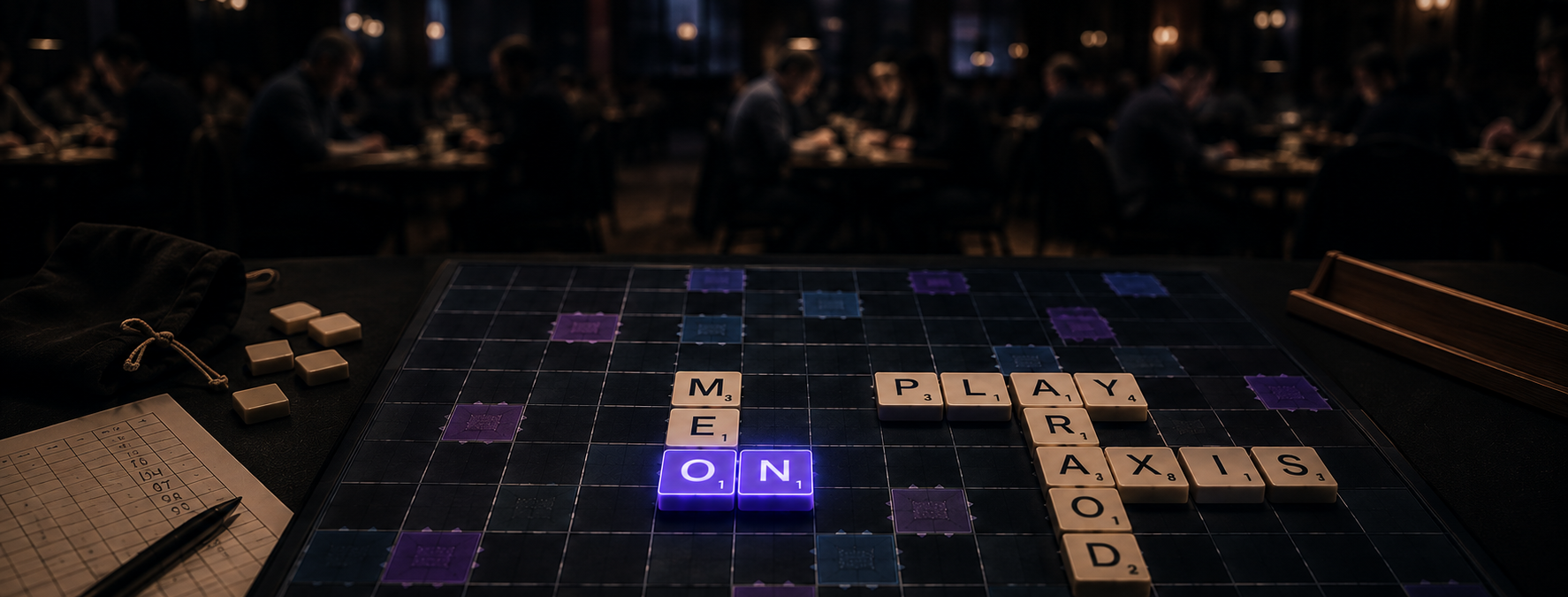
Tile map — cold parallel choke
| A | B | C | |
|---|---|---|---|
| 1 | M | E | TWS road |
| 2 | O | N | sealed |
NWL-legal choke: ME / ON with crosses MO, EN. Often scores in the low teens or less after board constraints—and that is a feature when you are locking a lead.
Math frame
Lead NTV = Your Score − Opponent’s Expected Best ReplyA 12-point choke that removes a 45-point enemy strike is a +33 exchange, even if spectators hate the “small” play.
3.3 The Equilibrium Grind (Dead Heat ±15)
If |Spread| ≤ 15 → Optimize PTE + leave + mild geometry pressureNo panic opens. No premature lockdown that concedes equity.
Structural behaviors
- Keep rack efficiency near standard targets (often ~3–4 vowels / 7, context-dependent).
- Take compound short overlaps when PTE beats long isolations.
- Apply micro-pokes: one-cell hooks, soft blocks, controlled float tiles.
- Recompute VCIR every turn; flip to chaos or lock only when spread exits the band.
Equilibrium scorecard
| Priority | Question |
|---|---|
| 1 | Best PTE among safe leaves? |
| 2 | Does this create a Critical hook for them? |
| 3 | Does VCIR favor fishing or sealing? |
| 4 | Clock: am I earning or burning precision? |
The grind is where most tournament games are actually decided—not in the highlight bingo.
4. The Psychological Meta-Game & Tournament Endurance
Tiles are only half the match. The other half is decision quality under fatigue, information warfare on the clock, and series psychology.
4.1 Managing Cognitive Fatigue (7–12 round schedules)
Precision decays. Grandmasters budget cognition like tiles.
Structural methods
- Pre-board ritual (90 seconds): recount unseen power tiles,
S, blanks; state spread band (chaos / grind / lock). - Turn template: Tracking → Geometry → Variance policy → Word choice. Never reverse the order when tired.
- Simplify under fatigue: If decision latency exceeds your clock budget, take the top PTE play that does not fail the Defensive Hook Coverage check.
- Between-round reset: No postmortem spirals before the next pairing. One note max, then physiological reset (water, walk, eyes off boards).
- Error logging after the day—not during it. Mid-event analysis burns the resource you need for Round 9.
Fatigue diagnostic
| Symptom | Likely failure mode | Countermeasure |
|---|---|---|
| Missing easy 3–4 overlaps | Tunnel vision on long words | Force short-stem scan first |
| Opening lanes while leading | Variance policy drift | Re-state spread band aloud |
| Challenge / pass tilt | Emotional decisioning | 10-second mandatory pause |
| Clock collapse late rounds | Over-calculation | Use emergency template only |
4.2 Clock Decoy Tactics
Your body leaks information. Manage the leak.
Modulation rules
- Steady baseline tempo on routine chokes—do not speed-reveal that the play was forced.
- Deliberate extra 15–40 seconds before a bland dump when you want to imply a harder rack than you have.
- Do not stare at the bingo lane after fishing; look at a neutral sector, then place.
- Never rush a setup leave in a way that advertises “I kept the blank for next turn.”
- Under Double Challenge club rules, hesitation after their play is a tell—practice neutral verification posture.
Decoys are not magic. Strong opponents track board equity more than your face. Still: do not donate free volatility reads.
4.3 The Intimidation Profile (multi-game series)
Early in a series, one airtight defensive game can shift an opponent’s risk appetite for the remaining cards.
Protocol
- Game 1 (or early board): prioritize clean parallel locks and lane starvation when spread allows.
- Show that flashy opens will be punished.
- Force them to self-create chaos against a closed grid.
- Exploit the resulting low-probability lunges in later games with standard grind EV.
Series equity idea
Series Pressure ≈ Opponent’s Induced Over-Variance − Your Maintained Grind EVYou win series not only on raw rating, but by making them play your preferred variance regime.
5. Case Studies: The Chaotic Surge vs. The Airtight Reign
Case Study A — The Chaotic Surge
State: Trail by 75. Bag has 24 tiles. Quiet catch-up math is dead.
Grandmaster read:
- Spread band = Positive Variance Engine.
- VCIR roughly neutral-to-vowelish; spike still plausible.
- Need dual-premium access more than a 20-point salve.
Action: Play a low-scoring but lane-rupturing parallel—ARE under BAT—keeping approach geometry alive toward separate TWS threats rather than banking a sterile isolation elsewhere.
| 1 | 2 | 3 | Lane effect | |
|---|---|---|---|---|
| Existing | B | A | T | stable stem |
| Surge play | A | R | E | opens float / approach options |
| Crosses | BA | AR | TE | all NWL-legal |
Immediate score: modest.
Strategic product: board volatility.
Sequel: Draw lands on a bingo-capable rack. Next turn detonates a ~90-point premium bingo through the opened geometry. Deficit flips. Statistical defeat becomes a win—not because the first play scored, but because DGSM demanded chaos.
Accounting:
Quiet line win probability ≈ near 0
Chaos line win probability ≈ small but real (e.g. 0.10–0.20 depending on pool)
Correct choice = chaos when that P × match value exceeds quiet resignation EV
Case Study B — The Airtight Reign
State: Lead by 28. Tracking shows remaining unseen pool is consonant-heavy (VCIR ≤ 0.54). Bingos are scarce. Clunky racks are plentiful.
Grandmaster read:
- Spread band = Zero Variance Lock (approaching).
- Do not need a 35-point vanity play.
- Need consecutive turns that remove oxygen from the grid.
Action: Four straight turns of sub-15 parallel chokes and pocket seals. Example turn archetype:
| A | B | Role | |
|---|---|---|---|
| Existing | M | E | anchor |
| Choke | O | N | starve approach |
| Crosses | MO | EN | NWL-legal |
Repeat the philosophy across sectors: overlapping micros, hook denial, premium starvation—not point theater.
Sequel: Opponent faces consecutive low-upside replies, burns tempo, and eventually passes or weak-dumps. Lead freezes into the endgame. The “boring” sequence was the highest-EV line under consonant inversion + modest lead.
Comparison
| Metric | Case A — Chaotic Surge | Case B — Airtight Reign |
|---|---|---|
| Spread band | −75 (chaos) | +28 (lock) |
| Primary resource | Board volatility | Lane oxygen |
| Score this turn | Low by design | Sub-15 by design |
| Tracking input | Spike still plausible | Consonant-heavy VCIR |
| Success look | Later ~90 bingo | Opponent passes / freeze-out |
| DGSM lesson | Buy variance when behind | Sell variance when ahead |
6. The Grandmaster Strategic Directory
Pre-match ritual. Read top to bottom. Then play.
A. Unification
- Run DGSM every turn: Tracking × Geometry × Variance policy.
- Optimize future score distributions, not highlight reels.
B. Tracking & micro-math
- Enter midgame with power tiles,
S, blanks, and VCIR under active watch. - At 20–40 in bag, let pool shape break close score ties.
- Recalculate after every draw—priors go stale fast.
C. Variance lever
- −60 or worse: Positive Variance Engine—open, fish, accept chaos.
- +40 or better: Zero Variance Lock—choke, starve, cover hooks.
- ±15: Equilibrium Grind—PTE + safe leave + micro-pokes.
D. Geometry modules (series roadmap)
- Two-letter fluency — the overlap engine’s fuel.
- Rack balance blueprints — leave quality before greed.
- Multiplier mastery — premiums as contested territory.
- Anagram rack partitioning — split to conquer.
- Defensive word warfare — NTV over raw score.
- Q-without-U shield — power-tile contingency.
- Vowel-heavy salvage — drainage cycles under pressure.
- Wordfeud random-grid adaptation — scrambled multiplier literacy.
- WWF / empty-bag endgame tactics — out-count and out-tempo.
- Speed & calculation diagnostics — clock-grade precision.
- Hooks for victory — CSS / front-back extension theft.
- Phoney management (club dialects only) — BVE under challenge rules.
- Short-length anagram dynamics — PER, overlaps, pivots.
- Lane geometry & parallel overlays — multi-axis scoring.
- This blueprint — synthesize all modules under DGSM.
E. Psychology & endurance
- Protect decision quality across 7–12 rounds.
- Use clock tempo as information control—not theater alone.
- Early-series airtight locks can force opponent over-variance later.
F. Final gate (every turn)
- What is my spread band?
- What is my VCIR / unseen threat?
- What does the board allow them next?
- Is my candidate chaos, grind, or lock?
- If those disagree, veto the word.
Final law of the grandmaster blueprint:
Words are ammunition.
Distributions are the war.
Track the pool, measure the spread, choose the variance—
then—and only then—place the tiles.
Leave a Reply