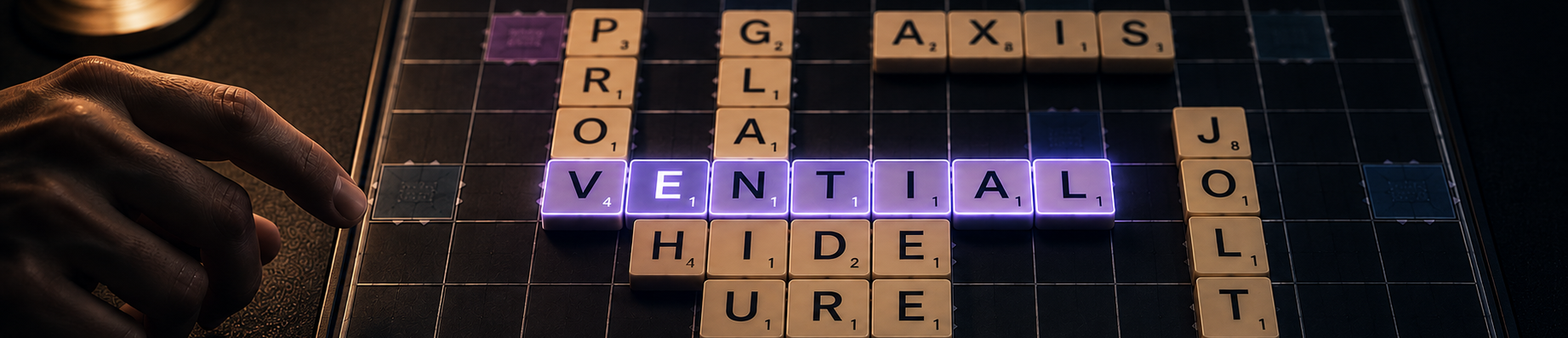
1. Executive Summary — The Theory of Asymmetric Information
A phoney is not a mistake by default.
It is an information weapon.
You know the doubt. They must price the challenge.
When reward exceeds challenge tax, the bluff is rational.
In competitive Scrabble and club Wordfeud structures, a phoney is any played string that is not legal under the agreed lexicon (NWL, CSW, or local club list), yet is offered as if it were. Online adjudicated engines reject phoneys automatically. Loose club rules do not. The board becomes a negotiation under incomplete information.
That negotiation is pure asymmetric information. You hold private knowledge about your confidence in the string. Your opponent holds private knowledge about their lexicon depth, challenge appetite, and clock pressure. Neither side sees the other’s full decision function. The play succeeds not because the word is real—but because the opponent’s expected value of challenging falls below the expected value of accepting.
The Bluff Valuency Equation (BVE)
Treat every unverified candidate as a tactical variable. Score it with the Bluff Valuency Equation:
BVE = (P_accept × R_success) − (P_challenge × C_fail)Where:
| Symbol | Meaning |
|---|---|
| P_accept | Probability opponent does not challenge |
| R_success | Net reward if the phoney stands (points + positional equity) |
| P_challenge | Probability opponent challenges (1 − P_accept) |
| C_fail | Cost if challenged and the word is ruled illegal |
Under most club challenge dialects, a successful challenge removes the phoney and costs you the turn (you score 0 that turn; tiles return). So:
C_fail ≈ Turn Loss + Forfeited Best Legal Alternative + Positional LeakProof: when phoneys are legitimate variables
Assume Double Challenge rules. Your phoney is worth 42 points and seals a TWS corridor (positional equity valued at +18). Total success reward:
R_success = 42 + 18 = 60You estimate opponent challenge probability at 25% (they are unsure; they fear losing their turn on a valid word).
P_accept = 0.75
P_challenge = 0.25
C_fail = 0 (score this turn) + 28 (best legal alt you skipped) + 10 (lane left open) = 38
BVE = (0.75 × 60) − (0.25 × 38)
BVE = 45 − 9.5
BVE = +35.5Positive BVE means the phoney is mathematically superior to walking away—even though the string is illegal. The lexicon is not the only scoring system. The challenge rule is the other.
Proof: when the bluff is irrational
Same 42-point phoney. Void-Only rules. Opponent is a strong club lexicon player. Challenge probability rises to 80%. Failed challenge costs them nothing. Your fail cost remains ~38.
BVE = (0.20 × 60) − (0.80 × 38)
BVE = 12 − 30.4
BVE = −18.4
Negative BVE. The bluff is a donation. Play the legal line.
Law of asymmetric play:
Phoneys are not “cheating theater.”
They are EV calculations under club adjudication.
Bluff only when BVE > 0 and no cleaner legal line matches the equity.
2. The Mathematical Risk Matrix by Challenge Rule Dialect
Challenge rules rewrite bluffing viability more than rack strength does. Same phoney. Opposite correctness. Always identify the dialect before the first unverified tile hits the board.
2.1 The Double Challenge Rule
Definition: If the opponent challenges and the word is valid, the challenger loses their turn. If the word is invalid, the phoney is removed and the player who laid it loses the turn / scores nothing for that play (club wording varies; the core asymmetry remains).
Why challenge rates collapse
The challenger faces a two-sided penalty:
Challenge EV =
  (P_illegal × Benefit_of_removal)
  − (P_legal × Cost_of_lost_turn)
If the opponent is only 60% sure your word is fake:
Assume Benefit_of_removal = 40
Cost_of_lost_turn = 35 (their expected next score + tempo)

Challenge EV = (0.60 × 40) − (0.40 × 35)
             = 24 − 14
             = +10
Still positive. Raise their uncertainty. Drop perceived legality to a coin flip:
Challenge EV = (0.50 × 40) − (0.50 × 35)
             = 20 − 17.5
             = +2.5
Near indifference. At 40% confidence the word is illegal:
Challenge EV = (0.40 × 40) − (0.60 × 35)
             = 16 − 21
             = −5
They should not challenge. Your phoney’s survival probability spikes. Double Challenge is the primary enabler of high-frequency phoney tactics in club play.
Strategic implications
- Plausibility matters more than truth. Looks legal → suppresses challenge EV.
- Mid-value phoneys outperform greedy bombs. Extreme scores invite scrutiny.
- Defensive phoneys gain extra equity. Blocking a lane while bluffing stacks R_success.
- Track opponent challenge history. Players who never challenge are soft targets.
2.2 The Single / Void-Only Rule
Definition: A challenge that fails (word is valid) carries zero turn penalty for the challenger. An illegal word is simply voided/removed. The challenger’s risk approaches 0.
Why bluffing requires emergency conditions
Challenge EV ≈ P_illegal × Benefit_of_removalThere is almost no downside. Rational opponents challenge anything remotely suspicious. Therefore:
P_challenge → high (0.70–0.95 for non-elite-looking strings)For BVE to stay positive, you need either:
- Extreme R_success (game-deciding points + board lock), or
- Extreme time pressure that prevents verification, or
- Opponent lexicon collapse (novice / exhausted / tilted).
Minimum threshold proof
Void-Only. Conservative estimates:
P_accept = 0.20
R_success must satisfy:
0.20 × R_success − 0.80 × C_fail > 0
0.20 × R_success > 0.80 × C_fail
R_success > 4 × C_fail
If C_fail = 30, you need:
R_success > 120That is not a cute 28-point stem fake. That is endgame detonation territory—or a board-lock that ends the match. Under Void-Only, casual phoneys are statistical suicide.
2.3 Phoney Viability Index (PVI)
Use this matrix as a pre-play gauge. PVI is a qualitative composite of rule format, margin, point bait, and opponent strength. Higher PVI → more viable bluff.
| Rule Format | Score Margin | Phoney Point Value | Opponent Lexicon Proficiency | Risk / Reward Ratio |
|---|---|---|---|---|
| Double Challenge | Behind 20–40 | 30–45 (plausible) | Club intermediate | Favorable (PVI High) |
| Double Challenge | Ahead 15+ | Any flashy 50+ | Strong club / expert | Poor (PVI Low) |
| Double Challenge | Tied / ±10 | 18–28 defensive block | Risk-averse club player | Strong (PVI High) |
| Void-Only | Behind 50+ | Game-deciding 60–80 | Fatigued / low lexicon | Conditional (PVI Mid) |
| Void-Only | Any comfortable lead | Any phoney | Any competent challenger | Toxic (PVI Near-Zero) |
| Void-Only | Clock < 1 min each | 35–50 obscure-looking | Average club | Situational (PVI Mid-High) |
| Double Challenge | Endgame, bag empty | Out-score / block hybrid | Unsure on rare stems | Elite window (PVI Peak) |
| Either dialect | Any | Obvious garbage string | Any | Forbidden (PVI Collapse) |
Operating rule: If PVI is Low or Near-Zero, do not bluff. If PVI is High or Peak, compute BVE explicitly. If Mid, bluff only with spatial camouflage and strong plausibility.
3. The Behavioral Cognitive Scan: Reading Hesitation Patterns
Phoneys live or die on opponent psychology. Lexicon knowledge is incomplete. Decision latency leaks the gap.
3.1 The Tile-Shuffling Tell
Observation target: After you play, watch their hands and eyes—not their face.
Signal taxonomy
| Behavior | Latency pattern | Inference | Your response |
|---|---|---|---|
| Immediate challenge | < 3 seconds | High confidence illegal | Expect void; have backup plan next turn |
| Instant accept / hit clock | < 2 seconds | Did not parse threat | Phoney likely stands; do not celebrate visibly |
| Tile-shuffle + stare | 8–25 seconds | Partial stem recognition | Hold stillness; do not offer discussion |
| Shuffle → reach for challenge → retract | Oscillation | Incomplete mastery of the root | Bluff is working; P_accept rising |
| Long silence, then accept | 30–60+ seconds | Challenge EV went negative | Confirm Double Challenge fear if applicable |
Analytical read
Repeated physical “re-checking” of the word—reordering mental letters, mouthing suffixes, scanning similar board stems—indicates incomplete mastery of that specific root. They suspect. They cannot prove. Under Double Challenge, that state is your highest P_accept zone.
Hesitation Index (HI) ≈ Seconds of Unresolved Verification- HI < 5: Either know it is fake, or did not care.
- HI 10–30: Uncertainty peak. Do not interrupt.
- HI > 45 under clock: Time tax alone may force accept.
Never coach them. Never say “it’s good.” Silence preserves asymmetry.
3.2 The Plausibility Coefficient
A phoney’s survival rate tracks how closely it mimics real morphology—not how clever the anagram looks.
Define the Plausibility Coefficient (PC):
PC = (Legal Root Familiarity × Legal Affix Fit × Length Normality × Board Camouflage)Scale each factor 0–1. Multiply. Target PC ≥ 0.55 before risking club bluffs under Double Challenge. Target PC ≥ 0.75 under Void-Only emergencies.
Construction rules that raise PC
- Start from a real root. Prefer known stems your club has seen (
VENT,FORM,NAT,RAD,LOC). - Attach standard suffixes. High-camouflage endings: -ATE, -IAL, -OUS, -IVE, -ISM, -ERY, -TOR.
- Respect phonotactics. Avoid illegal clusters (
BK-,QwithoutUpatterns your club knows are rare, triple-letter nonsense). - Keep length boring. 5–8 letters looks “dictionary.” 11-letter fantasy strings look challenged.
- Avoid celebrity fakes. Famous phoneys die faster in clubs that share war stories.
Examples of morphological camouflage (illustrative patterns, not recommended spellings)
| Pattern class | Structure | Why it masks illegitimacy |
|---|---|---|
| Suffix graft | Real-looking root + -ATE / -IAL / -OUS | Mimics adjective/verb factory output |
| Agentive mask | Stem + -ER / -OR | Feels occupational / agent noun |
| Scientific gloss | Stem + -IC / -OID | Borrows academic texture |
| Plural of near-word | Almost-legal noun + S | Exploits S-hook habits |
Critical constraint: This section analyzes detection and risk. In rated tournament play with strict adjudication, intentional phoneys violate event ethics and can draw penalties. This guide addresses loose club rules where challenge mechanics make unverified strings a contested EV decision—not a license for bad-faith spam.
Affix checklist before placement
- Does the suffix regularly attach to this word class?
- Would a club intermediate “feel” it in a study list?
- Is there a famous real neighbor that makes it look remembered?
- Would you challenge it on defense?
If the last answer is “instantly yes,” PC is too low.
3.3 The Score-Pressure Factor
Risk aversion is not constant. It flips with margin and clock.
Leading opponent (they are ahead)
Leaders protect tempo. Under Double Challenge, they hate losing a turn that preserves their lead.
Challenge appetite ↓ as Lead ↑ (Double Challenge)Exploit: mid-value plausible phoneys that do not look like desperation bombs.
Trailing opponent (they are behind)
Trailers must create swings. They challenge more aggressively—especially under Void-Only.
Challenge appetite ↑ as Deficit ↑Exploit window shrinks. Only high-PC, spatially camouflaged bluffs remain viable.
Tight clock constraints
Clock converts verification into a tax.
Effective Challenge Cost += (Verification Seconds × Position Volatility)Under 2 minutes, many club players accept mid-plausibility strings they would challenge with 12 minutes left. Bingo-length obscurities burn clock even when eventually challenged—useful if you are ahead on time and need to force errors.
Pressure matrix
| Opponent state | Clock | Challenge tendency | Best phoney style |
|---|---|---|---|
| Leading, calm | Comfortable | Selective / cautious (DC) | Quiet defensive extension |
| Leading, anxious | Low | Avoids turn-loss risk | Plausible mid-score block |
| Trailing, fighting | Any | Aggressive | Only peak-PC or skip bluff |
| Trailing, tilted | Low | Erratic (challenge spam or freeze) | Bingo bait to burn clock |
| Novice lexicon | Any | Under-challenges | Broader PVI window |
4. Spatial Camouflage: The Geometry of a Phoney
A naked phoney on open grid is a billboard. A camouflaged phoney is a forensic problem. Geometry changes P_challenge.
4.1 The Parallel Hide
Objective: Embed the questionable string inside a dense parallel cluster so the opponent cannot isolate and verify it cleanly.
Setup logic
Primary axis:   [P H O N E Y S T E M]
Parallel axis:  overlapping 2-letter crosses on most columns
Each legal cross forces the opponent to verify N+1 strings instead of one.
Verification Load = 1 (main word) + K (crosses)As K rises, clock burn rises, confidence falls, challenge EV falls—especially under Double Challenge.
Execution steps
- Choose a phoney with high PC (morphology first).
- Park it parallel to an existing word or inside a congested quadrant.
- Ensure every cross is genuinely legal. Illegal crosses get challenged even if the main stem would have passed psychologically.
- Avoid spotlight premiums on the fake stem unless endgame-forced.
- Keep face score mid-range. 22–38 points looks “normal.” 70+ looks audited.
Why it works
Human verification is serial. Parallel overlays force parallel mental tabs. Club players drop tabs under pressure. That is spatial camouflage: not hiding the tiles—overload the checker.
4.2 The Bingo Bait-and-Switch
Objective: Drop a fake 7-letter string that looks like an obscure study-list anagram. Force freeze. Tax the clock. Raise acceptance under time debt.
Design specs
| Attribute | Target |
|---|---|
| Length | 7 (bingo silhouette) |
| Look | Alphagram-ish; no clown letters |
| Score | Strong but not cartoonish |
| Purpose | Clock burn + P_accept, or swing if accepted |
Tactical sequence
- Play with routine tempo. No apology body language. No “is this good?” tells.
- Announce score cleanly. Hesitation in scoring signals self-doubt.
- Let them cook. Do not table-talk.
- If challenged and voided: absorb the loss; you may still have inflicted 45–90 seconds of clock damage.
- If accepted: convert the tempo into board restriction next turn.
When to deploy
- Opponent under 3 minutes.
- Double Challenge format.
- You need either points or a freeze.
- Your legal bingo alternatives are weak.
When not to deploy
- Void-Only + sharp lexicon opponent + comfortable clock.
- You are ahead and only need safe legal tempo.
- The string’s PC is garbage (random letter salad).
Bingo bait is a psychological instrument. Treat it like a timed tactic, not a personality trait.
4.3 The Multiplier Sacrifice
Objective: Avoid parking phoneys on high-exposure Triple Word Scores unless the position is an absolute endgame emergency.
Why TWS phoneys die
Premium squares raise scrutiny. Opponents allocate challenge budget to explosive scores.
P_challenge ∝ (Point Spike × Premium Visibility × String Weirdness)A 18-point camouflaged extension may live. The same illegality on an open TWS for 50+ invites the finger to the challenge call.
Policy tiers
| Placement | Default policy | Exception |
|---|---|---|
| Open TWS | No phoney | Match-ending swing; bag empty; BVE strongly positive |
| DWS | Rare / high PC only | Defensive lock + Double Challenge |
| DLS / TLS only | Conditional | Parallel hide present |
| Non-premium congested area | Preferred zone | Standard club bluff habitat |
Endgame emergency clause
If you are behind beyond legal comeback range, Void-Only or Double Challenge, and a TWS phoney is the only path to a reachable score band:
Emergency Bluff Gate =
  (Deficit > Max Legal Outplay Estimate)
  AND (PC ≥ threshold for dialect)
  AND (BVE > 0)
Only then violate the Multiplier Sacrifice rule. Otherwise, keep fakes off the fireworks.
5. Case Studies: The Greedy Collapse vs. The Unchallenged Lock
Same conceptual skill—phoney management. Opposite discipline. Opposite outcomes.
Case Study A — The Greedy Collapse
Format: Void-Only club rules.
State: Midgame. Open Triple Word lane. Player trails by 12.
Rack impulse: Force a swing now.
Play: A glaringly artificial 50-point string slammed onto the open TWS. Low Plausibility Coefficient. No parallel camouflage. Score spike advertises itself.
Opponent response: Instant challenge. Verification load = 1. Confidence high. Challenge cost ≈ 0 under Void-Only.
Result:
- Word wiped.
- Player scores 0.
- Turn burned.
- TWS lane remains raw and exposed.
- Opponent seizes the same corridor next turn for a legal premium detonation.
Net accounting:
Direct score swing:     −50 opportunity (failed attempt)
Tempo loss:             −1 full turn
Positional leak:        opponent TWS takeover ≈ +40 to −60 against
Psychological tell:     you are now marked as a phoney-hunter’s target
Verdict: Complete tactical devastation. This was not “unlucky.” It was negative BVE theater. Greedy Collapse is what happens when point hunger overrides dialect math.
Case Study B — The Unchallenged Lock
Format: Double Challenge club match.
State: Late midgame. Trailing player needs a defensive seal on a dangerous approach road.
Legal options: Soft blocks scoring 12–16 that leave residual hooks.
Unverified option: A plausible morphological extension (high PC) that fully seals the lane for ~24–30 points.
Play: Quiet extension. No TWS circus. Parallel crosses mostly legal and dense. Body language flat. Score announced without ceremony.
Opponent read:
- String looks study-list adjacent.
- Challenge might be wrong.
- Wrong challenge = lost turn while already managing a volatile board.
- Hesitation Index climbs into the 20–40 second band.
- Challenge EV flips negative.
Result: Opponent declines. Bluff sticks. Lane locks. Trailing player stabilizes, then outplays the restricted board.
Net accounting:
R_success ≈ points + full defensive equity of the seal
P_challenge realized = 0
BVE realized = full R_success
Match path: board control → comeback corridor
Comparison table
| Metric | Case A — Greedy Collapse | Case B — Unchallenged Lock |
|---|---|---|
| Rule dialect | Void-Only | Double Challenge |
| Plausibility Coefficient | Low | High |
| Spatial camouflage | None (TWS spotlight) | Congested / quiet seal |
| Point presentation | Flashy 50 | Modest mid-score |
| Opponent challenge EV | Strongly positive | Negative / near-zero |
| Outcome | Void + lane gift | Bluff stands + board lock |
| BVE realized | Deeply negative | Strongly positive |
Swing lesson: The winning phoney is rarely the biggest fake. It is the least challengeable fake under the active rule dialect.
6. The Phoney Risk Profile Assessment Checklist
Run this diagnostic before any unverified string touches the board. If you fail a hard gate, play legal.
Gate A — Rules & ethics context
- Is this loose club / agreed challenge play—not online auto-adjudication?
- Do I know the exact challenge dialect? Double Challenge vs Void-Only vs local hybrid?
- Would this violate the event’s posted code if rated/formal? If yes, stop.
Gate B — Bluff Valuency math
- What is R_success (points + positional equity)?
- What is C_fail (turn loss + skipped legal best + leak)?
- What is my honest P_challenge estimate?
- Is BVE clearly positive? If no, stop.
Gate C — PVI snapshot
- Score margin: desperation, grind, or lead-protect?
- Phoney point value: mid-plausible or spotlight greedy?
- Opponent lexicon proficiency: novice, club, expert?
- Does the PVI table read High / Peak—not Low / Toxic?
Gate D — Plausibility Coefficient
- Real-looking root?
- Standard affix fit (
-ATE,-IAL,-OUS, etc.)? - Boring length (not clownish)?
- Would I personally hesitate to challenge it?
- PC above dialect threshold?
Gate E — Behavioral timing
- Opponent leading and risk-averse?
- Opponent trailing and hyper-challenging?
- Clock tight enough to tax verification?
- Any prior tell that they under-challenge obscure stems?
Gate F — Spatial camouflage
- Can I Parallel Hide with legal crosses?
- Am I avoiding open TWS unless Emergency Bluff Gate passes?
- Is score spike modest enough to reduce audit heat?
- Bingo bait only if clock burn is a real objective?
Gate G — Post-play discipline
- Neutral tempo and no speech tells?
- Backup plan if challenged?
- Am I prepared to stop phoney-spamming after one exposure? (You become marked.)
Pocket card (print-ready)
- Dialect known?
- BVE > 0?
- PVI not toxic?
- PC high enough?
- Camouflage present?
- TWS avoided (unless emergency)?
- Silence ready?
Final law of asymmetric information:
The lexicon judges truth.
The challenge rule judges risk.
Club victories often hinge on the second court.
Bluff the word only when the math—and the psychology—clear the checklist.
Leave a Reply