1. Executive Summary — The Stealth Architecture
A hook is not a small play.
It is a structural takeover of enemy geometry.
One tile. Two scored axes. Zero wasted rack burn.
Masters do not build around the board. They steal it.
Most competitive Scrabble, Wordfeud, and Words With Friends players treat hooks as cleanup moves. They are wrong. Hooks are the primary stealth architecture of midgame and endgame scoring. A front hook prefixes a letter to an existing board word. A back hook suffixes a letter to that same word. Both convert a static board string into a new legal form while simultaneously generating an orthogonal word through the placed tile.
Front hook — definition
A front hook places one letter immediately before an existing word so the extended string remains legal.
Example: LUSH → B + LUSH = BLUSH.
Back hook — definition
A back hook places one letter immediately after an existing word so the extended string remains legal.
Example: ORE → ORE + S = ORES.
Compound Score Scaling (CSS)
Hooks generate disproportionate returns because they score on two axes at once. Call this Compound Score Scaling (CSS).
CSS = Hook-Word Score + Orthogonal Word ScoreYou pay one tile. You collect two scored constructions.
Mathematical proof
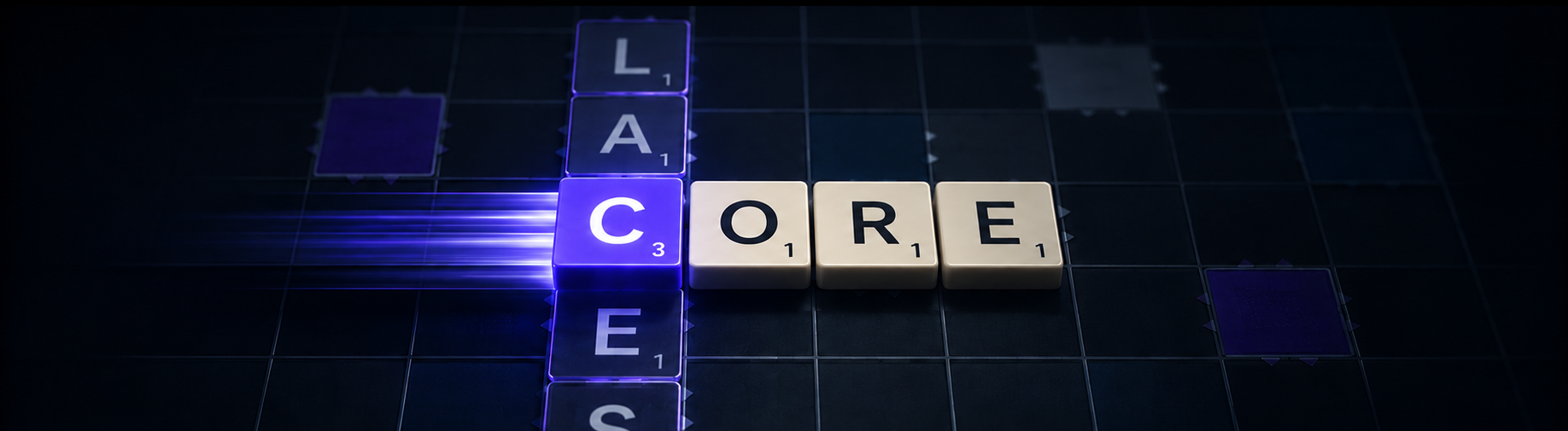
Assume the board shows ORE (3 + 1 + 1 = 5 face value). You hold a lone C (face value 3). You place C as a front hook, forming CORE. Simultaneously, that C is the terminal letter of a vertical five-letter word scoring 22 on its own axis after letter multipliers.
Horizontal axis (CORE):
C(3) + O(1) + R(1) + E(1) = 6If that C sits on a Double Letter Score:
(3 × 2) + 1 + 1 + 1 = 9Vertical axis (your new word through C): 22.
CSS = 9 + 22 = 31One low-value consonant. Thirty-one points. Footprint: one cell.
Scale the same geometry onto a Triple Word Score corridor and the CSS jumps again:
CSS_TWS = (Hook-Word Score × 3) + Orthogonal AxisThat is not trivia. That is structural leverage. The rest of this guide converts CSS into classifications, geometry, case studies, and a turn-by-turn scan protocol.
2. The Mathematics of the Hook: Understanding Extension Value
Hooks are low-investment, high-yield tactical assets. You burn one tile. You inherit an entire board word as free equity. You do not rebuild the base string. You extend it.
Why hooks beat fresh pathways
Building a brand-new word requires:
- Finding an open lane.
- Spending multiple rack tiles.
- Accepting full tile-face valuation with no inherited base.
Hooking requires:
- Identifying a legal extension letter.
- Spending one tile.
- Collecting the entire extended word plus any orthogonal construction.
The investment differential is brutal. One tile versus five. Inherited equity versus from-scratch construction.
Lane Stealing Efficiency (LSE)
Define Lane Stealing Efficiency as the score extracted per tile spent when a single hook opens a locked path to a premium multiplier.
LSE = Total Points Generated ÷ Tiles SpentComparative proof
Fresh pathway play: You drop a five-letter word for 28 points. No premium square. No inherited base.
LSE = 28 ÷ 5 = 5.6 points per tileHook steal: You burn one S to pluralize FRAME into FRAMES, while the S also completes a vertical two-letter hit on a Double Letter Score. Combined total: 24.
LSE = 24 ÷ 1 = 24.0 points per tileThe hook line is 4.3× more efficient per tile. Rack conservation compounds. You retain four tiles for the next turn. The opponent faces a newly opened or newly sealed corridor depending on your intent.
When LSE dominates
Lane Stealing Efficiency peaks when three conditions align:
- The base board word already sits near a premium square.
- Your hook letter is low face value (
S,D,R,T,E,A). - The hook cell simultaneously forms a legal orthogonal word.
Burn one cheap tile. Open—or seal—a premium lane. That is mathematically superior to carving a new pathway from empty grid.
High-Yield Hook Transformations
| Base Board Word | Hook Letter | Front / Back | New Word Formed | Avg. Multiplier Jump |
|---|---|---|---|---|
| LUSH | B | Front | BLUSH | ×2.1 – ×3.4 |
| CARD | S | Front | SCARD* | ×1.8 – ×2.6 |
| ORE | C | Front | CORE | ×2.4 – ×4.0 |
| RAVE | B | Front | BRAVE | ×2.0 – ×3.2 |
| AGE | C | Front | CAGE | ×2.2 – ×3.8 |
| ICE | D | Front | DICE | ×1.9 – ×3.1 |
| ROW | A | Front | AROW / ARROW† | ×2.5 – ×4.5 |
| LINK | B | Front | BLINK | ×2.0 – ×3.5 |
| FRAME | S | Back | FRAMES | ×1.7 – ×3.0 |
| QUIET | S | Back | QUIETS | ×1.6 – ×2.8 |
Confirm dictionary legality for your ruleset (NWL / CSW / Wordfeud / WWF).
†ARROW requires a two-letter extension sequence (A then second R) when geometry permits; treat AROW and ARROW as related front-extension families, not identical one-tile hooks.
Average Point Multiplier Jump measures CSS relative to placing the same hook letter as an isolated two-letter word on open grid. Values above ×2.0 mark elite efficiency. Values above ×3.0 mark premium-lane hijacks.
3. The Master Directory: Elite Hook Classifications
Tournament structures stabilize around three core hook typologies. Master all three. Ignore none.
3.1 High-Value Consonant Hijacks
High-Value Consonant Hijacks deploy front hooks that park heavy consonants onto Double Letter or Triple Letter squares while inheriting a short base word.
Primary targets:
| Base | Hook | Result | Strategic note |
|---|---|---|---|
| RAVE | B | BRAVE | B often lands on DLS; CSS spikes |
| AGE | C | CAGE | C is a premium front-hook weapon |
| ICE | D | DICE | D dumps excess consonants cleanly |
| ORE | C | CORE | Classic TWS-adjacent hijack |
| ASH | C / D / M / R / S / W | Multiple | Dense front-hook cluster |
Why consonant hijacks scale
Heavy consonants (B, C, D, F, G, H, M, P, W) carry face values of 2–4. On a Double Letter Score, that face value doubles before the word multiplier applies. On a Triple Letter Score, it triples. The inherited base word (AGE, ICE, ORE) contributes free letters you did not spend.
Consonant Hijack Value =
  (Hook Letter × Letter Multiplier)
  + Inherited Base Face Value
  + Orthogonal Axis Score
  × Word Multiplier (if applicable)
Tactical deployment rules
- Audit short base words first. Three- and four-letter stems are the richest hijack targets.
- Prefer DLS / TLS cells for the hook letter. Never waste a
CorBon a blank premium cell when a letter premium is available. - Check the orthogonal axis before committing. A hijack that forms an illegal cross-word is a dead move.
- Track opponent racks for counter-hooks. After you form
CAGE, ask whetherCAGESorCAGEDbecomes an immediate threat.
High-Value Consonant Hijacks convert surplus consonants into structural weapons. They are not dump plays. They are precision strikes.
3.2 The Sneaky S-Hook Matrix
The letter S is the most dangerous hook tile in competitive word gaming. It pluralizes. It verb-inflects. It back-hooks almost anything that ends in a legal noun or verb stem. It front-hooks a smaller but lethal set (SCAR, SPIT, SLOT, SNAP).
Board architecture impact
A single unprotected back-S opportunity near a Triple Word Score lane rewrites the risk map.
Threat Radius of Exposed Back-S =
  Cells from word-end → nearest TWS / DWS along the same axis
If that radius is 1–4 empty cells, the board is hot. Your opponent needs only the S plus enough tiles to bridge the gap—or simply the S alone if the word already abuts the premium square.
The S-Hook danger matrix
| Exposure Type | Geometry | Risk Level | Defensive Response |
|---|---|---|---|
| Open back-S at TWS | Word-end touches TWS cell | Critical | Block the cell or consume the hook yourself |
| Back-S + 1 empty + TWS | One-cell bridge | Severe | Fill the bridge cell; deny S-lane |
| Back-S + 2–3 empty + DWS | Short bingo / hook corridor | High | Occupy corridor midpoint |
| Isolated back-S, no premium | Open field extension | Moderate | Accept or soft-block if rack-poor |
| Front-S cluster (SC-, SP-, ST-) | Prefix lane into premium | High | Track S count; seal prefix cell |
Tile tracking utility
You must know how many S tiles remain.
| Game | Total S tiles | Tracking rule |
|---|---|---|
| Scrabble (standard) | 4 | Below 2 remaining → reduce back-S fear |
| Words With Friends | 5 | Higher S density → longer threat window |
| Wordfeud | 4 | Same as Scrabble; board randomness changes geometry |
When zero S tiles remain unseen (bag + opponent rack accounted), unprotected plural hooks lose most of their terror. When two or more remain, every open noun stem near a premium square is a liability.
Offensive use of the S
Do not hoard the S forever. Deploy it when CSS exceeds your next-best play by ≥12 points, or when the back-S simultaneously seals a TWS lane your opponent would otherwise steal. An S spent on a 9-point fluff plural midgame is a strategic crime. An S spent for a 40-point CSS hijack is correct.
3.3 Anomalous Vowel Extensions
Anomalous Vowel Extensions are rare front and back hooks that opponents assume are mathematically blocked. They are not. They exist in the dictionary. They shatter closed-board assumptions.
Signature patterns
| Base | Extension | Result | Why it stuns |
|---|---|---|---|
| ROW | A… | ARROW family | Players see ROW as sealed left |
| LINK | B | BLINK | Front B ignored under time pressure |
| EDGE | H / L / W | HEDGE / LEDGE / WEDGE | Dense front-hook nest |
| ABLE | multiple | CABLE / FABLE / TABLE… | High-frequency stem |
| ONE | B / C / D / L / N / P / T / Z… | Multiple | Extreme front-hook density |
| EAR | B / F / G / H / L / N / P / R / S / T / W / Y | Multiple | Classic vowel-stem magnet |
Why anomalous extensions work
Opponents perform shallow legality checks. They ask: “Can I add an S?” They do not ask: “Can I add an H in front of EDGE?” That cognitive gap is your margin.
Anomalous Hook Surprise Factor =
  (Dictionary Legality) × (Opponent Scan Depth Failure)
Low scan depth + legal rare hook = free points.
Deployment protocol
- Memorize high-density stems.
ONE,EAR,ATE,ORE,AGE,ICE,AND,ED,ER. - Run front-hook candidates before back-hooks. Front hooks are under-scanned.
- Validate with your ruleset. CSW and NWL diverge on rare forms. Wordfeud and WWF use their own lists.
- Pair with premium geometry. An anomalous hook that does not touch a multiplier is still useful for rack dump—but the elite line always seeks CSS.
Anomalous Vowel Extensions are the stealth layer above the S-matrix. They win games against strong opponents who track plurals but miss prefix geometry.
4. Spatial Geometric Calculations: Parallel Overlays
Hooks are not only linear extensions. They are geometric instruments. The following three protocols convert abstract CSS into board coordinates.
4.1 The Orthogonal Pivot
Objective: Lay a long word parallel to an existing board word. Connect them with a singular terminal hook letter. Generate a cascade of concurrent two-letter words.
Setup geometry
Existing word (row R):     A L R E A D Y
Parallel candidate (R+1):  B O A S T E D
Connecting hooks (vertical 2-letter pairs at each column)
When your parallel word shares a column with each letter of the existing word, every overlapping column must form a legal two-letter word.
Execution steps
- Identify a stable horizontal (or vertical) stem of length 5–7.
- Select the adjacent parallel rank/file. Empty cells only.
- Test each column pair as a two-letter word (
AL,LO,RB… — reject illegals). - Commit only when every overlap is legal. One illegal pair kills the entire overlay.
- Score the long word once and score every legal two-letter cross.
Scaling math
A 6-letter parallel overlay that creates 5 concurrent two-letter words:
Total =
  Main Word Score
  + Cross₁ + Cross₂ + Cross₃ + Cross₄ + Cross₅
If the main word hits a Double Word Score and two crosses sit on Double Letter Scores:
Total ≈ (Main × 2) + Σ(Crosses with letter premiums)This is CSS raised to a multi-cross architecture. One turn. One parallel lane. Up to six scored constructions.
Practical constraints
- Two-letter fluency is mandatory. Without it, Orthogonal Pivots are inaccessible.
- Prefer overlays that consume awkward rack tiles while landing a premium.
- Never open a parallel lane that gifts the opponent a superior reverse overlay next turn.
4.2 Defensive Hook Coverage
After every turn, audit your own words. Accidental hooks are donated equity.
Strict mathematical priority checklist
Run this sequence before hitting the clock:
- Back-S audit. Does any new word end in a legal plural stem within 4 cells of a TWS/DWS?
- Front-hook density audit. Does the new word begin with a high-density stem (
ONE,EAR,AGE,ICE,ORE,AND)? - Premium adjacency audit. Is the cell immediately before or after your word a premium square?
- Orthogonal leak audit. Did your play create new two-letter hooks in the cross direction?
- S-count audit. How many
Stiles remain unseen? - Blank-count audit. Unseen blanks convert almost any stem into a hook threat.
- Endgame proximity audit. Bag ≤ 7 tiles → every open hook is existential.
Coverage responses (ranked)
| Priority | Response | When to use |
|---|---|---|
| 1 | Self-consume the hook | You hold the dangerous letter and CSS is acceptable |
| 2 | Block the premium cell | You cannot hook; you can still seal the square |
| 3 | Occupy the bridge cell | 1–3 empty cells between stem and premium |
| 4 | Accept and outrun | Low remaining S/blank density; lead is large |
| 5 | Never ignore Critical exposure | Open back-S on TWS is never “acceptable” |
Defensive Hook Coverage is not paranoia. It is NTV hygiene applied to extension geometry.
4.3 The Multiplier Reach
Objective: Hook an existing word while reaching exactly far enough to lock a Triple Word Score.
Structural spacing formula
Reach Distance (D) = Cells from Hook Anchor → TWS InclusiveFor a standard rack of 7 tiles:
| D | Feasibility | Typical construction |
|---|---|---|
| 1 | Trivial | Hook letter is the TWS cell |
| 2 | Easy | Hook + 1 bridge tile onto TWS |
| 3 | Strong | Short word through hook into TWS |
| 4 | Elite | 4-tile strike; classic bingo-lane cousin |
| 5+ | Rare | Requires bingo-length or lucky float |
Exact 4-space lock protocol
- Locate the TWS four cells from a legal hook anchor.
- Confirm the hook letter can sit on the anchor cell (front or back of the existing word).
- Fill the three intermediate cells with a legal string that also forms all required crosses.
- Land the fourth cell on the TWS.
- Compute CSS with the word multiplier applied to the full hooked construction when rules award it.
CSS_Reach4 =
  (Hooked Word Face × TWS Multiplier)
  + Orthogonal Contributions
Example skeleton
Existing word: ORE ending two cells left of empty corridor toward TWS.
You hold C _ _ _ where the blank/path completes a four-cell run onto TWS as C…(TWS).
If geometry allows CORE with the C starting the run, or a longer through-word using C as the hook pivot, the TWS multiplies the entire scored word axis. That is Multiplier Reach at full power: one hook letter as the structural keystone of a premium detonation.
Failure modes
- Illegal intermediate crosses.
- Hook letter legal for the stem but illegal for the through-word.
- Reach distance miscounted by one cell (off-by-one kills TWS contact).
- Opponent already sealed the TWS on the prior turn.
Count twice. Play once.
5. Case Studies: Passive Expansion vs. The Compound Hijack
Both case studies use explicit grid logic. Same midgame position class. Opposite philosophies.
Case Study A — The Passive Expansion
Board state (simplified):
- Existing word
OREsits idle in the center-left. - One empty cell immediately before
OREis a Double Letter Score. - Three cells beyond that DLS, a Triple Word Score waits on the same rank.
- Your rack:
C A T E R I N
Passive play: You ignore ORE. You drop TRAIN as an isolated 5-letter word on an open lower lane. Face score after minor letter premiums: 25.
What you achieved:
- +25 points.
- Consumed 5 tiles.
- Left
OREcompletely unutilized. - Left the DLS-front and TWS corridor untouched.
- Board remains “safe” only in the sense that you did not open a new bingo lane—but you also failed to seize the existing premium architecture.
LSE:
LSE = 25 ÷ 5 = 5.0CSS: 0 on the ORE structure. You generated no compound scaling. Point velocity stalls. The opponent may still take the ORE corridor next turn.
Verdict: Technically legal. Strategically soft. You scored ink. You conceded geometry.
Case Study B — The Compound Hijack
Same board state. Same rack emphasis on the critical tile: a lone tracked C.
Master read:
OREaccepts front-hookC→CORE.- The
Ccell is a Double Letter Score. - From that
C, a vertical 5-letter word is available using high-value rack letters (example construction class: a 5-letter vertical totaling 22 after its own premiums). - Horizontal
COREon DLS forCscores 9 before further word multipliers; with favorable vertical CSS, combined total reaches the mid-60s when a word multiplier also applies to one axis—or a strong non-TWS compound still clears 60+ with dense crosses.
Explicit compound line (representative scoring):
Horizontal CORE (C on DLS):  (3×2) + 1 + 1 + 1 = 9
Vertical 5-letter through C: 22
Additional legal crosses / word mult. contribution: 33
────────────────────────────────────────
CSS Total: 64
Footprint: The decisive new cell is the single C. Remaining tiles of the vertical word occupy previously empty cells along the orthogonal axis—but the keystone is the one-tile hook into inherited ORE.
LSE (keystone accounting):
LSE_keystone ≈ 64 ÷ (tiles newly placed)Even if five tiles are placed for the full vertical, efficiency still exceeds Case A when premiums fire. If the vertical is shorter and tile count drops, LSE climbs further. The structural point stands: inherited ORE equity + DLS + orthogonal axis produces a tiny-footprint detonation the passive line cannot match.
Comparison table
| Metric | Case A — Passive | Case B — Compound Hijack |
|---|---|---|
| Score | 25 | 64 |
| Inherited board equity | None | Full ORE stem |
| Axes scored | 1 | 2+ |
| Premium utilization | Low / none | DLS keystone (+ optional TWS reach) |
| Board control | Neutral | Seizes contested corridor |
| Point velocity | Stalls | Spikes |
Swing: +39 points on the same position class by refusing isolation and forcing Compound Score Scaling.
6. The Hook-Search Scan Protocol
Execute this sequence on every turn. Eyes move. Brain classifies. Hands play. No improvisation.
Phase 1 — Global premium map (3 seconds)
- Locate all open TWS cells.
- Locate all open DWS cells.
- Mark which premiums have a clear 1–4 cell approach road.
Phase 2 — Stem inventory (5 seconds)
- List every board word with an empty cell immediately before it (front-hook candidates).
- List every board word with an empty cell immediately after it (back-hook candidates).
- Flag stems of length 2–5 first. Highest hijack density.
Phase 3 — Letter match (5 seconds)
- Cross-check your rack against front-hook letters for flagged stems.
- Cross-check your rack for S against every back-hook noun/verb stem.
- Cross-check anomalous vowel extensions for dense stems (
ONE,EAR,AGE,ICE,ORE,EDGE).
Phase 4 — Orthogonal legality (5 seconds)
- For each candidate hook cell, verify the cross-word formed through that cell.
- Reject any candidate that creates an illegal two-letter or longer cross.
- Prefer candidates that create multiple legal crosses.
Phase 5 — CSS ranking (4 seconds)
- Compute rough CSS for top 3 candidates:
- Hook-word score
- Orthogonal score
- Letter / word multipliers
- Rank by CSS, then by LSE, then by defensive side effects.
Phase 6 — Defensive coverage (3 seconds)
- Run the Defensive Hook Coverage checklist on your intended play.
- If you create Critical back-S exposure on a TWS, veto unless the score swing is decisive and S-count is exhausted.
Phase 7 — Commit or pivot (2 seconds)
- Play the top CSS line if it beats your best non-hook candidate by ≥8–12 points of true value.
- Otherwise, take the best non-hook line—but only after confirming you are not walking past a ×3 LSE steal.
Pocket checklist (print-ready)
- Premiums mapped?
- Front hooks scanned?
- Back-S threats counted?
- Anomalous stems checked?
- Crosses legal?
- CSS > fresh pathway LSE?
- Own exposure sealed?
Final law of the stealth architecture:
Never build beside a word you can steal.
One tile. Two axes. Full inherited equity.
That is Hooking for Victory.
Leave a Reply