1. Executive Summary — The Chaos Matrix
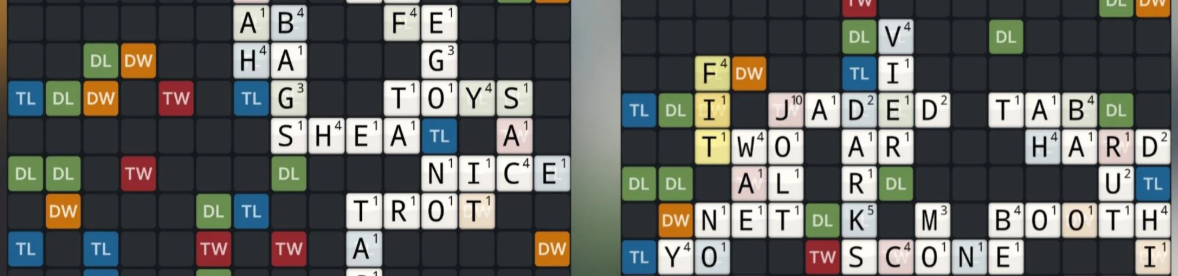
A random Wordfeud board is not Scrabble with noise.
It is a new topology every match.
Memorized openings become liabilities.
Cluster geometry replaces corner scripture.
Read the map. Then place the first tile.
Wordfeud lets you choose a standard board or a random board. On standard, premium squares (DL, TL, DW, TW) sit in fixed, repeatable positions. On random, those same premium families are re-placed each game. The 15×15 grid remains. The scoring engine remains. The spatial contract does not.
That is the Chaos Matrix: identical rules, unstable geography.
The Symmetry Break Paradox
Competitive Scrabble and standard-board Wordfeud reward pattern memory. Players internalize opening lengths, safe center exits, and classic TW approach roads. Random boards break that symmetry on purpose.
The paradox:
- The more automatic your opening script, the higher your donation rate on random grids.
- The board that looks “familiar” for one move can hide a TW one cell off your muscle-memory lane.
- Advantage shifts from repertoire depth to pre-game topological literacy.
Standard-board skill ≈ f(memory, rack equity, known lanes)
Random-board skill  ≈ f(fresh map scan, cluster control, risk mitigation)
Opening scripts fail because they optimize for a map that no longer exists. A five-letter center push that is “book” on Scrabble can seat a vowel beside an unmapped TW corridor on random Wordfeud. Your opponent does not need better tiles. They need your outdated symmetry.
Operating doctrine: Treat every random board as a unique spatial problem. Scan first. Script never.
2. Mathematical Topology: Identifying Clusters and Choke Points
Randomization does not sprinkle premiums evenly in strategic terms. It creates local density anomalies — zones where high-value squares sit close enough that one realistic rack can chain them.
Multiplier Clustering Zones (MCZs)
A Multiplier Clustering Zone (MCZ) exists when Triple Word (TW) and Triple Letter (TL) squares land adjacent or within 2 spaces of each other along a shared row, column, or short bridging path.
Why TL+TW proximity matters:
- Letter multipliers apply before word multipliers.
- A power tile on TL is tripled, then the whole word can be tripled by TW.
- That single letter’s contribution becomes 9× face value inside the word score.
- If the same word also covers a second TW, word multipliers stack (3 × 3 = 9 on the word), and a TL-boosted letter can contribute at 27× effective scale within that stacked word math.
Critical clarification: One tile occupies one square. It cannot sit on TL and TW simultaneously. The combo is multi-square: TL under a high tile + TW (or stacked TWs) covered by the same word.
MCZ subtypes:
| MCZ shape | Geometry | Threat profile |
|---|---|---|
| Adjacent TL–TW | Next-cell contact on a line | Immediate detonation risk |
| Gap-1 TL…TW | One empty cell between | One-tile bridge danger |
| Gap-2 TL..x..TW | Two cells between | Mid-length word fuse |
| Dual-TL → TW | Two TLs feeding one TW lane | Extreme outer-quadrant hazard |
Explosive Point Index (EPI)
Estimate the maximum realistic single-turn yield of an exposed cluster before you open toward it:
EPI ≈ (Σ (tile_value × letter_mult)) × word_mult_product + crosswords + bingo_bonusWhere:
letter_mult= 1, 2 (DL), or 3 (TL) for newly covered letter premiums.word_mult_product= product of DW/TW factors covered by the main word (TW×TW = 9,DW×TW = 6, etc.).- Wordfeud bingo bonus = +40 when seven tiles are played (not Scrabble’s +50).
Worked cluster sketch:
- TL under J (10) → letter contribution 30 before word mult.
- Same word covers one TW → that boosted path rides ×3.
- Add ordinary other letters + possible crosses.
A “quiet-looking” outer cluster routinely clears 80–120+ when looted with average-good tiles. That is why MCZ defense outranks center vanity scoring.
Randomized Grid Anomalies
| Grid pattern type | Cluster proximity | Maximum point yield | Defensive priority rating |
|---|---|---|---|
| TL adjacent to TW | 0 cells (touching) | 90–150+ with power tile | Emergency |
| TL within 1 of TW | 1 cell | 70–130+ | Critical |
| TL within 2 of TW | 2 cells | 55–110+ | High |
| Dual TL feeding one TW | ≤2 on approach | 100–180+ | Emergency |
| DW stacked near TL | ≤2 | 45–90 | High |
| Isolated TW, no TL ≤2 | >2 to nearest TL | 35–70 | Medium |
| Premium-sparse dry zone | No TW/TL nearby | 8–25 | Low (dump zone) |
Topology rule: Rank every open approach by Defensive Priority before optimizing your own score. Random boards punish players who chase points inside someone else’s MCZ.
3. The 3-Phase Scanning Protocol (Pre-Game Analysis)
Do this before the first tile. The center star can wait thirty seconds. The map cannot.
Phase 1 — The Premium Square Audit
Count and locate every premium family:
- Mark all TW positions.
- Mark all DW positions.
- Mark all TL positions.
- Mark all DL positions.
- Score side weighting: are premiums concentrated left/right/top/bottom?
Audit outputs you must write mentally:
- Total TW count and quadrant ownership.
- Whether one half-board owns a majority of TW+TL mass.
- Whether the center neighborhood is hot (premiums within 2–3 of star) or cold.
Bias implication:
| Audit finding | Opening bias |
|---|---|
| Hot outer quadrant MCZ | Delay expansion toward that quadrant |
| Hot center ring | Shorter, tighter first word |
| One-sided premium mass | Play toward the dry side first |
| Balanced scatter | Standard equity play with local MCZ vetoes |
A board heavily weighted to one side is an asymmetrical war from move one. Do not “play the middle” out of habit if the middle feeds the heavy side.
Phase 2 — The Combo Hunter Map
Hunt overlapping intersections where one word can cover a letter premium and a word premium together.
What you are looking for:
- TL (or DL) and TW (or DW) on the same row or column within a realistic 2–7 tile span.
- Dual word premiums on one line (
DW+DW,DW+TW,TW+TW) creating stacked word multipliers. - Power-tile seats: TL squares that can host J/Q/X/Z/C/H (remember Wordfeud’s letter economy — C and J are expensive relative to Scrabble instincts).
Effective combo multipliers (main-word math):
| Coverage pattern | Word mult product | Letter-premium effect | Practical label |
|---|---|---|---|
| TL + one TW | ×3 | TL tile contributes ×9 inside word | 9× letter path |
| TL + two TW | ×9 | TL tile contributes ×27 inside word | 27× letter path |
| DL + one TW | ×3 | DL tile contributes ×6 inside word | Strong mid combo |
| Two DW | ×4 | Depends on letter premiums covered | Double-Double family |
Circle every 9×/27× path on the empty board. Those circles are your Combo Hunter Map. They are also your opponent’s win conditions if left open.
Phase 3 — The Defensive Moat Blueprint
Find dry zones: regions with no TW/TL within a practical dump radius, and limited DW access.
Moat criteria:
- No TW within 4 cells of the planned dump mass.
- No TL within 2 cells of soft vowel terminals you might leave.
- Parallel expansion cannot quickly bridge into an MCZ.
- Enough empty cells to accept garbage consonants / excess vowels safely.
Moat uses:
- Early vowel dumps.
- Heavy consonant relief.
- Tempo plays when you refuse to open a Critical/Emergency cluster.
Blueprint summary: Audit premiums → map combos → draw moats. Only then choose the opening word length.
4. Spatial Positioning: Asymmetrical Warfare
Random boards reward asymmetrical plans. Mirror habits die here.
1. The Center-Star Vault
Wordfeud’s first move must cover the center tile. That rule is fixed. Everything else about opening length is map-dependent.
Decision tree:
Measure distance from center to nearest TW/TL/MCZ.
│
├─ Premium within 1–2 of center → OPEN SHORT (2–4 letters)
│     Goal: score modestly; refuse to hand a one-move bridge.
│
├─ Nearest hot premium 3–4 away → OPEN MEDIUM (4–5)
│     Goal: take equity without fully arming the approach.
│
└─ Center neighborhood cold; MCZs live on outer rim → OPEN FLEXIBLE (4–7)
      Goal: normal rack equity, then pivot to cluster guarding.
Vault principle:
The center is mandatory geography, not mandatory aggression. A long opening into a near-center TW is not “development.” It is a donated fuse.
2. Cluster Guarding
Strict mathematical rule:
Never play toward an un-looted MCZ unless your play completely blocks primary access to it.
Partial approaches are worse than distance. A four-letter step that ends one cell from a TL→TW chain converts a dormant anomaly into an active weapon for the opponent.
Legal reasons to enter an MCZ:
- You loot it now (EPI realized for you).
- You occupy the keystone cell(s) so opponent cannot complete the combo path.
- You create a sealed wall that collapses Reach Length to zero.
Illegal (losing) reasons:
- “It scores 8 more points than the safe play.”
- “I might get it next turn.”
- “The cluster is probably too hard to hit.”
If EPI ≥ your lead + opponent’s average reply, treat the cluster as a match weapon. Guard it like a closed file in chess.
3. Asymmetrical Parallel Blocking
Use tight parallel blocks to cut lucrative randomized lanes while leaving dry zones playable.
Implementation steps:
- Identify the highest-EPI open lane from the Combo Hunter Map.
- Build a parallel word wall that occupies the on-ramp cells of that lane.
- Keep your garbage dumps oriented into the Defensive Moat.
- Accept lower immediate scores when the block permanently reduces opponent ceiling.
Schematic:
Hot lane (row toward TW):  . . TL . . TW
Your block (parallel):     W A L L
Effect: on-ramp cells clogged; dry zone elsewhere stays open for dumps
Asymmetrical warfare means you do not open both wings equally. You freeze the expensive wing. You recycle tiles through the cheap wing. Random boards make that split obvious if you scanned correctly.
5. Case Studies: Symmetrical Folly vs. The Random Appreciation
Case Study A — The Symmetrical Folly
Setup: Random Wordfeud board. Player imports a standard Scrabble/center-script opening.
Play: Mindlessly drops a 5-letter opening through the center, optimizing for familiar shape rather than local premiums.
Hidden topology: An unmapped TW sits immediately beside the opening’s soft vowel terminal — a classic Symmetry Break miss. The Premium Square Audit was skipped. The Combo Hunter Map was never drawn.
Opponent reply: Capitalizes on the gifted approach for a 112-point counter-play (TL/power-tile path into the exposed TW corridor, plus crosses).
Net exchange:
Your opening value:        ~20–28 (typical)
Opponent counter:          112
Symmetry-tax on the exchange: ≈ −85 to −95
Post-mortem failures:
- Used a memorized length instead of center-to-premium distance.
- Seated a vowel on the hot edge of a random TW.
- Treated random board as standard board with cosmetic noise.
- No Cluster Guarding mindset on move one.
Correction: Short vault opening away from the TW contact cell, or an orientation that ends on a low-hook consonant facing the dry side.
Case Study B — The Matrix Masterstroke
Setup: Outer quadrant shows a dangerous MCZ — two TL squares aligned toward a TW within a short bridging span. Center offers an open ~30-point vanity play that expands toward the cluster.
Master evaluation:
| Candidate | Score now | Effect on MCZ | EPI conceded |
|---|---|---|---|
| Center 30-point line | 30 | Opens approach | High (80–120+) |
| Quiet 12-point keystone block | 12 | Chokes cluster access | ~0 |
Play: Ignore the 30. Lay a quiet 12-point block occupying the cluster’s keystone on-ramp. Permanently collapses Reach Length into the dual-TL→TW fuse.
Result:
- Immediate score sacrifice: 18 points (30 − 12).
- Opponent’s explosive ceiling in that quadrant: strangled.
- Midgame swings shift to slower, controllable channels.
- Random Appreciation realized: topology > optics.
Why this is elite random-board play:
- EPI math beat raw score math.
- Cluster Guarding rule applied without exception.
- Dry-zone recycling remained available afterward.
- Opponent cannot “earn” the 112-style detonation you refused to assemble for them.
Appreciation doctrine: On random grids, the best move is often the one that deletes the opponent’s best future board.
6. Randomized Grid Cheat Sheet
Execute these adjustments the moment you toggle from standard to random:
Immediate operational switches
- Delete opening scripts. No default 5- or 7-letter center pushes.
- Run the 3-Phase Scan before any placement: Audit → Combo Map → Moat Blueprint.
- Measure center-to-premium distance. Shorten openings when hot premiums sit within 1–2.
- Circle every MCZ with TL/TW proximity ≤2. Rank Emergency/Critical first.
- Compute rough EPI before stepping toward any cluster.
- Apply Cluster Guarding: approach only to loot or fully block — never to “develop.”
- Fight asymmetrically. Freeze the lucrative wing; dump into dry moats.
- Respect Wordfeud scoring specifics: letter mults before word mults; bingo = +40; letter values differ from Scrabble (notably stronger C/J instincts).
- Hunt 9× and 27× paths (TL + TW / TL + TW×TW) as both offense targets and defense crises.
- Prefer parallel walls that cut randomized lanes over symmetrical mirror development.
- Re-scan after every opponent play. Random boards create new bridges from ordinary dumps.
- If leading, bias to ceiling denial. If trailing, loot an open MCZ only when you can actually cash EPI now.
One-line operating system
Standard boards reward memory. Random boards reward cartography.
Master the Chaos Matrix and scrambled multipliers stop feeling like luck. They become a readable topology — clusters, choke points, moats, and calculated silence — where the first player to respect the map owns the match.
Leave a Reply