1. Executive Summary — The Anomalous Overhead
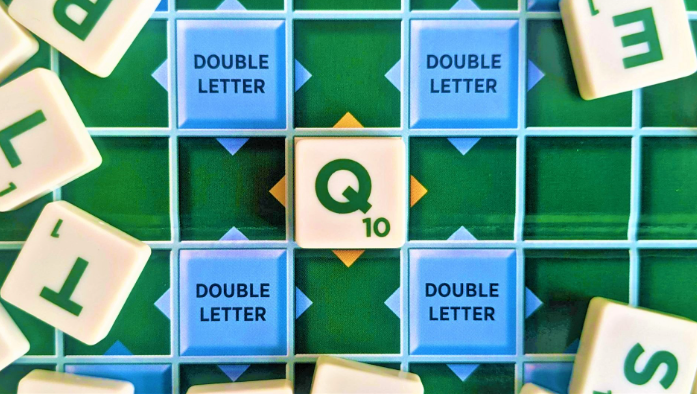
A lone Q without a U is not a scoring asset.
It is a structural rack emergency.
Every unplayed turn compounds the damage.
Elite players do not pray for a U.
They deploy Q-without-U relief valves.
The Q tile is worth 10 points. That face value creates a dangerous illusion. Amateurs treat the tile as latent firepower. Masters treat an unpaired Q as anomalous overhead — a high-mass liability that freezes bingo shape, wrecks leave equity, and taxes every subsequent turn until extracted.
Without a U on the rack, and without a U already open on the board, the Q becomes nearly unplayable through ordinary English stems. The rack collapses into a six-tile problem wearing a ten-point ball and chain.
The Turn Loss Penalty
Passing or one-tile trading to escape a stranded Q looks cheap. It is not.
Model the average competitive midgame turn as worth roughly 30 points of turn equity (a blend of score this turn + leave quality + board access). When you spend a full turn swapping the Q — or pass because you cannot place it — you bank 0 while your opponent still fires a normal reply.
Turn Loss Penalty ≈ −30 (your forfeited turn equity)
                  + Opponent's Expected Reply
Worked proof:
| Action | Your score | Opponent expected reply | Net exchange |
|---|---|---|---|
| Panic pass / Q-trade | 0 | ~30–45 | −30 to −45 |
| Elite Q-without-U clear | 18–28 | ~20–30 | Near-parity or better |
A single panic trade therefore carries an average −30 point Turn Loss Penalty before you even count the opponent’s free tempo. If they land a 45-point reply on the gifted turn, the true swing approaches −45 to −75 across one exchange cycle.
Conclusion: Memorizing ten U-less Q exits is cheaper than any trade.
These words are not trivia. They are structural defensive relief valves — emergency exits that restore rack balance, preserve tempo, and deny the opponent a free scoring turn.
2. The Mathematical Underpinnings of Rack Emergency Exits
Rack Volatility Mitigation — definition
Rack Volatility Mitigation is the practice of converting an unplayable high-value tile into a legal placement before it degrades multi-turn scoring expectancy.
Holding an unplayable Q does not merely cost the 10 points you failed to score. It degrades the other six tiles:
- Bingo probability collapses (seven-tile anagrams rarely tolerate a stranded Q).
- Parallel density falls (you avoid openings that would require spending the Q later).
- Leave quality tanks (you keep awkward companions hoping a U appears).
- Exchange temptation rises (feeding the Turn Loss Penalty).
Across two to three stuck turns, cumulative damage routinely exceeds 40–60 points of expectancy even if the Q eventually finds a U.
Why U-less anchors change the equation
A known Q-without-U word converts the Q from a volatility bomb into a controlled dump. You choose length, hooks, and lane safety. You keep tempo. You restore vowel/consonant balance on the remaining leave.
Anomalous Tile Equity Shift
| Word length | Playable hooks | Average point yield | Defensive value rating |
|---|---|---|---|
| 2 letters (QI) | Front/back limited; QIS primary | 11–22+ (parallels / DL under Q) | Elite — universal emergency exit |
| 3–4 letters | Moderate S-plurals; some fronts | 14–28 | High — fits choked boards |
| 5 letters | S-backhooks common; lane risk rises | 18–32 | High — best full-clear tools |
| 6+ letters | Fewer casual hooks; bigger footprint | 20–40+ | Specialist — bag/ rack dependent |
Equity shift rule:
Playing a U-less Q word for 20 points while restoring a balanced six-tile leave often beats keeping the Q for a theoretical 40-point future that never arrives.
3. The Master Directory: 10 Elite Q-Without-U Anchors
Dictionary notes below reflect common tournament families: CSW (Collins / international), TWL (NASPA / North America), and major Words With Friends enablements. Always confirm against the exact lexicon of your club, app, or event.
Short Hooks (2–4 Letters) — plus the FAQIR bridge
1. QI
Definition: Variant romanization of chi — vital life force in Chinese philosophy and medicine.
Legality: CSW: yes. TWL: yes. WWF: yes (where modern lists are enabled). The single most important U-less Q word in competitive English word games.
Tactical Hook Vulnerability:
- Backhook: S → QIS (high frequency; treat as semi-open).
- Front hooks: rare in standard lists; do not assume casual fronts.
- Parallel danger: high if adjacent letters form illegal crosses — validate every crossword.
Spatial Footprint: Maximum. Two cells. Fits the tightest clogged boards. Ideal when only a single vowel pocket exists. Primary tool for the QI Overlap Shield (Section 4).
2. QAID
Definition: A Muslim provincial governor or local commander (also related to caid).
Legality: CSW: yes. TWL: yes. Widely accepted in serious playlists; confirm WWF variant lists.
Tactical Hook Vulnerability:
- Backhook: S → QAIDS.
- Front hooks: limited; still scan for opportunistic vowels.
- Ending D is moderately hookable — safer than E/R/S terminals, not inert.
Spatial Footprint: Strong. Four letters with A + I vowels already inside. Excellent when the board offers a lone A or I contact and your rack is vowel-poor elsewhere. Occupies little corridor space relative to its Q-clear power.
3. QOPH
Definition: The nineteenth letter of the Hebrew alphabet (also transliterated koph).
Legality: CSW: yes. TWL: yes. Core study list word for tournament players.
Tactical Hook Vulnerability:
- Backhooks: S → QOPHS; advanced plural QOPHIM (see #9).
- Front hooks: low in casual play.
- Internal O can invite vertical vowel overlaps — check parallels.
Spatial Footprint: High. Four letters, one vowel. Superb on consonant-heavy, low-vowel boards. The PH cluster is awkward for opponents to extend cleanly without specific tiles.
4. FAQIR
Definition: A Muslim or Hindu religious ascetic; variant of fakir.
Legality: CSW: yes. TWL: yes. FAQIR / FAKIR both appear in major families — know which form your lexicon prefers.
Tactical Hook Vulnerability:
- Backhook: S → FAQIRS.
- Front hooks: limited.
- Leading F and trailing R are not inert — R especially invites suffixes if the lane stays open.
Spatial Footprint: Medium-high. Five letters (listed here as the short-rack bridge clear). Needs A + I. Best when an open F, A, or R already sits on the board and you can complete the stem with minimal new corridor length.
Mid-Range Clears (5 Letters)
5. QANAT
Definition: An underground aqueduct or gently sloping tunnel system for conveying water (from Persian/Arabic engineering tradition).
Legality: CSW: yes. TWL: yes. Elite mid-length U-less clear.
Tactical Hook Vulnerability:
- Backhook: S → QANATS — critical pluralization risk (Section 4).
- Front hooks: uncommon; still verify.
- Dual A structure creates vowel magnets for parallel plays.
Spatial Footprint: Medium. Five cells. Outstanding when a lone board A lets you hang Q-N-A-T or complete the full stem. Primary Case Study B extraction tool.
6. TRANQ
Definition: Informal shortening of tranquilizer.
Legality: CSW: yes. TWL: yes in modern lists. Confirm older club dictionaries.
Tactical Hook Vulnerability:
- Backhook: S → TRANQS.
- Front hooks: possible with common consonants in some lists — scan carefully.
- Terminal Q facing an open premium is a dual-use weapon: great for you, dangerous if hookable later.
Spatial Footprint: Specialist-high. Ends with Q — unique geometry. Ideal for burying the Q on a dead-end cell while the TRAN body overlaps existing letters. Excellent Defensive Grid Burial candidate.
7. CINQ
Definition: The number five on a die or in cards (from French).
Legality: CSW: yes. TWL: yes. Short enough to behave like a 4-letter hook tool despite sitting in the mid-clear study group.
Tactical Hook Vulnerability:
- Backhook: S → CINQS.
- Front hooks: limited.
- Compact shape reduces extension surface area.
Spatial Footprint: Elite for tight boards. Four letters, one vowel (I). When racks are vowel-starved, CINQ outperforms longer U-less options that demand multiple vowels.
8. QIBLA
Definition: The direction faced during Muslim prayer — toward the Kaaba in Mecca.
Legality: CSW: yes. TWL: yes. Elite mid-range U-less clear; also appears as QIBLAH in some lists — know your exact lexicon form.
Tactical Hook Vulnerability:
- Backhook: S → QIBLAS where listed.
- Front hooks: limited in standard play.
- Internal I and terminal A create vowel contact points for parallel replies — validate crosses before committing.
Spatial Footprint: High. Five letters with I + A already inside. Excellent when a board A or I acts as a hinge. Strong alternative to QANAT when you hold B/L instead of N/T. Compact enough for midboard pockets without demanding a full bingo runway.
Advanced Extensions (6+ Letters)
9. QOPHIM
Definition: Plural form of qoph (Hebrew letter), analogous to other Hebraic plurals in the lexicon family.
Legality: CSW: typically yes as an advanced plural pathway from QOPH. TWL: verify your current edition — North American lists are stricter on some transliteration plurals. Confirm before tournament use.
Tactical Hook Vulnerability:
- Already a pluralized/extended form — further hooks are rarer.
- Long body creates more crossword junctions; illegal parallels are the real risk.
- Safer as a committed clear than as a lane-opening fish.
Spatial Footprint: Low-medium. Six letters demand open runway or strong overlaps. Best in mid/endgame when the board still has a medium corridor but you must empty the Q without waiting for U.
10. MBAQANGA
Definition: A style of South African popular music with Zulu roots (township jazz/pop lineage).
Legality: CSW: yes. TWL: yes. The glamorous eight-letter U-less Q bingo-capable stem (with floating letters) and late-game nuke.
Tactical Hook Vulnerability:
- Backhook: S → MBAQANGAS where listed.
- Huge surface area — many potential parallel seams.
- Do not play into an open TWS approach unless NTV still favors the clear.
Spatial Footprint: Specialist. Needs substantial space or heavy overlap. Highest ceiling, lowest frequency. Memorize for bag tracking moments when M/B/A/G/N tiles align and the Q must die now.
Directory snapshot
| Word | Len | Core legality | Primary mission |
|---|---|---|---|
| QI | 2 | CSW / TWL / WWF | Universal emergency exit |
| QAID | 4 | CSW / TWL | Short clear with A/I |
| QOPH | 4 | CSW / TWL | Low-vowel consonant board dump |
| FAQIR | 5 | CSW / TWL | Bridge clear / F-contact plays |
| QANAT | 5 | CSW / TWL | Open-A extraction classic |
| TRANQ | 5 | CSW / TWL | Terminal-Q burial |
| CINQ | 4 | CSW / TWL | Vowel-starved short clear |
| QIBLA | 5 | CSW / TWL | Mid-range A/I hinge clear |
| QOPHIM | 6 | CSW (verify TWL) | Extended QOPH clear |
| MBAQANGA | 8 | CSW / TWL | Late-game specialist nuke |
4. Spatial Placement: Consonant Parallels
U-less Q words fail when placed as lonely islands. They succeed when woven into consonant-parallel geometry.
1. The QI Overlap Shield
Mission: Score 20+ with only two tiles on a clogged board while extracting the Q.
Setup conditions:
- An existing word has at least one edge letter that forms a legal two-letter cross with Q or I.
- A double-letter square under the Q is ideal, not mandatory.
- Board is too choked for QANAT/FAQIR length.
Step-by-step:
- Scan for legal QI seats beside vowels/consonants that create valid crosses in your lexicon.
- Prefer Q on a letter premium.
- Confirm both main word and every crossword.
- Evaluate the S backhook: if QIS would open a TWS lane, bury QI against a dead edge instead.
Schematic:
Existing row:  A T E
Parallel QI:   Q I .
Cross checks:  QA / TI / E.  → only keep legal pairs
A clean QI parallel routinely prints 11 face + crosses + premium = 20–30 without needing a U anywhere on rack or board.
Shield principle: Two tiles. Full crisis resolution. Minimal lane gift.
2. Defensive Grid Burial
Mission: Deposit a 5-letter U-less Q word into a Dead Zone so the opponent cannot open a fresh parallel lane.
Preferred burial tools: QANAT, TRANQ, FAQIR, QIBLA.
Step-by-step:
- Identify a region with Reach Length to premiums already broken (Dead Zone criteria).
- Place the five-letter clear so terminals face sealed edges, not open files into TWS/DWS.
- Prefer TRANQ when you can park the Q on the most inert terminal cell.
- Refuse placements that create a new 4–7 cell parallel track beside the word.
Schematic:
Dead zone pocket (no TWS within 7):
Row 11:  . . Q A N A T .
Row 12:  (clogged / sealed)
Row 10:  (clogged / sealed)
You score the clear. You restore rack balance. You do not manufacture a new bingo runway.
3. Pluralization Management
Front and back hooks rewrite safety after you leave the table.
Critical watch list:
| Base play | Common hook | Safety change |
|---|---|---|
| QI | +S → QIS | Often acceptable; dangerous near premiums |
| QANAT | +S → QANATS | Extends one cell toward hot corridors — high alert |
| QIBLA | +S → QIBLAS | Same one-cell extension risk as other 5s |
| QAID / QOPH / CINQ | +S plurals | Moderate; score the hook risk before committing |
| TRANQ | +S → TRANQS | Extends past terminal Q; can reopen edge files |
| MBAQANGA | +S where listed | Large body already risky; S adds more surface |
Pluralization protocol:
- Before playing the base word, mark the empty cell an S would occupy.
- If that cell touches a Dangerous Open Corridor, bias to a different U-less exit.
- If you must accept the S-hook, pair the play with a plan to block that cell next turn.
- Never celebrate a Q-clear that gifts an S-shaped runway into Triple Word Score.
5. Case Studies: Passing Panic vs. The Structural Extraction
Case Study A — The Panic Trade
Rack: Q B C F N T W (no vowels; no U)
Player response: Panic. Spend the entire turn exchanging the Q (or exchanging toward a U). Score: 0.
Board consequence: Opponent, with a healthy rack and open midboard premiums, lands a 45-point play.
Net exchange:
Your turn equity:     0
Opponent reply:      45
Turn Loss Penalty:  ≈ −30 (forfeited average turn value)
Observed swing:     ≈ −45 to −75 across the cycle
Why it failed:
- Treated the Q as unsolvable instead of searchable against U-less anchors.
- Paid the full Turn Loss Penalty voluntarily.
- Gifted tempo on a live board.
- Retained a still-awkward consonant pile even after the trade.
Structural diagnosis: This is not “bad luck.” It is a memorization failure. CINQ, QOPH, or a board-contact QI could have kept tempo alive.
Case Study B — The Tactical Clear
Rack: Q N T R W + needs vowels (conceptually a zero-fresh-vowel crisis with Q overhead).
Board: An open A sits safely inside a non-premium stretch on row 8.
Master response: Play QANAT using the open A, completing the five-letter U-less clear.
Example geometry:
Row 8:  . . Q A N A T . . . . . . . .
             ^board A used as hinge
Results:
- Score: ~26 (face value with ordinary overlaps; more with premiums).
- Q extracted. Anomalous overhead gone.
- Leave returns toward balance (consonants reduced; future draws usable).
- Opponent does not receive a free tempo turn.
Comparative NTV framing:
| Line | Your score | Opponent expected reply | Practical outcome |
|---|---|---|---|
| Panic trade | 0 | 45 | Deficit snowball |
| QANAT clear | 26 | ~20–30 | Crisis neutralized |
Why it worked:
- Recognized the open A as a hinge tile, not scenery.
- Selected a mid-range U-less anchor with exact letter fit.
- Converted a collapse rack into a scored, balanced leave.
- Avoided pluralization into a hot lane (A-terminals checked before commit).
Extraction doctrine: The board often holds the vowel you lack. Your job is to know which Q-word unlocks it.
6. Memorization Matrix Checklist
Drill this list until recall is instant under clock pressure.
Instant recall — by length
2 letters
- QI — first reach, every game, every lexicon family that allows it.
4 letters
- QAID — A/I short clear.
- QOPH — low-vowel dump.
- CINQ — vowel-starved escape.
5 letters
- FAQIR — F-contact bridge clear.
- QANAT — open-A extraction classic.
- TRANQ — terminal-Q burial tool.
- QIBLA — mid-range A/I hinge clear.
6+ letters
- QOPHIM — extended QOPH path (confirm TWL edition).
- MBAQANGA — specialist late-game nuke.
Pre-play Q emergency scan
- Do I hold Q without U?
- Is a U already on the board within reach?
- If no → search QI seats first.
- If no QI → search CINQ / QOPH / QAID.
- If board offers A/F hinges → search QANAT / FAQIR / QIBLA.
- If Q can terminate safely → search TRANQ.
- If long runway exists and tiles fit → QOPHIM / MBAQANGA.
- Check S-hook cell against premium corridors.
- Prefer Dead Zone burial over hot parallel lanes.
- Trade the Q only after all ten anchors fail — and price the −30 Turn Loss Penalty honestly.
One-line operating system
The U is optional. The exit word is not.
Master these ten anchors, and the stranded Q stops being a collapse event. It becomes a solved tactical subroutine.
Leave a Reply